How Loud Is a Quiet Air Compressor? Decibels Explained
A quiet air compressor typically lists a noise rating of about 60 to 70 dB. In our comparison data, listed ratings run from 59 dB to 95 dB, and the models we rank highest sit between 60 dB and 71.5 dB. Treat the number as a starting point, because the tank size, airflow and the tools you connect also affect how loud your work feels.
 Stealth SAQ-1234Best overall
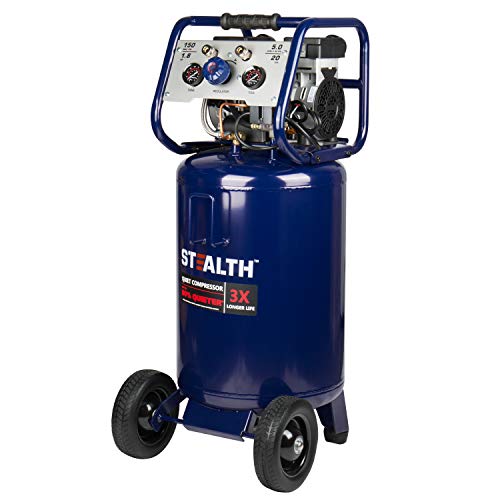 Stealth SAQ-12018Quiet with a 20 gal tank
 Klutch 203001005001Largest tank in top five
What the decibel number tells you
Decibels (dB) measure sound level on a logarithmic scale. That means small changes in the number hide big changes in sound. Every 10 dB increase is generally heard as roughly twice as loud, so a 70 dB unit sounds noticeably louder than a 60 dB one, not just a little louder.
A rating of 60 dB is about the level of normal conversation. A rating in the 90s is closer to what many people expect from a traditional shop compressor, and it calls for hearing protection. Our own comparison data reflects this spread, with listed figures from 59 dB to 95 dB.
One caution: the dB figure on a listing is the maker's claim. Makers often do not say how far away the sound was measured, so two numbers may not be directly comparable. We compare published specifications, so we pass along the number as listed.
What counts as a quiet air compressor
There is no official cutoff, but a practical rule works well. Models rated around 60 dB are the quietest group we see. Models in the mid to high 60s are still considered quiet for a compressor, and low 70s is where the label starts to stretch.
In the top ten on our best quiet air compressor page, listed ratings run from 60 dB to 71.5 dB. Many products across the page list no noise rating at all. If quiet is your main goal, skip the ones that leave it out.
| Model | Listed noise | Tank | Weight |
|---|---|---|---|
| Stealth 2 Gallon Trim Finish (SAQ-1234) | 60 dB | 2 gal | 41.89 lb |
| California Air Tools 8010A | 60 dB | 8 gal | 37.25 lb |
| VEVOR 13-Gal Oil-Free | 66 dB | 13 gal | 70.99 lb |
| Stealth 20 Gallon Quiet (SAQ-12018) | 68 dB | 20 gal | 121.4 lb |
| Klutch 29-Gallon Vertical | Not listed | 29 gal | 127 lb |
Why some compressors run quieter
Compressors get loud mostly from the motor and the pump. Makers that aim for low noise tend to change both. The California Air Tools 8010A, for example, lists a 1.0 HP motor that runs at only 1680 RPM, and the maker says this reduces noise and wear. A slower motor usually means less racket.
Housing and vibration control matter too. The Stealth 2 gallon lists soundproofing materials and a low-vibration design for its 60 dB rating.
An oil-free pump is common among quiet models. Every product in our top ten has one. It means no oil changes and less mess, but it does not guarantee a low dB rating by itself. Always read the number.
Quiet does not mean silent
Even a 60 dB compressor is audible, and it still cycles on and off as the tank refills. In a small room you will notice it. In a garage with the door closed, it is easier to talk over than a conventional unit, but it is not whisper quiet.
The tool at the end of the hose adds its own noise. A nailer, impact wrench or spray gun can be louder than the compressor. A low rating helps with the background hum, not the tool itself.
- Compressor noise: the motor and pump, heard while the tank refills.
- Tool noise: the nailer, wrench or blow gun, heard only while you use it.
- Room effects: hard walls and a small space make any sound seem louder.
Balancing noise, tank size and airflow
The quietest model is not always the right one. A small tank at low noise suits nailers, staplers and tire inflation. Heavier jobs need more air. The Stealth 20 gallon lists 68 dB and 5 SCFM at 90 PSI, while the 2 gallon Stealth lists 60 dB and 1.8 SCFM at 90 PSI. You give up 8 dB for much more airflow and tank volume.
Check your tools' air needs against the SCFM at 90 PSI before you choose. A compressor that cannot keep up will run constantly, which means more noise over time. For help matching a unit to your space, see our guides to the best air compressor for home garage and the best air compressor for home shop.
Weight is the other trade-off. The 20 gallon Stealth weighs 121.4 lb, while the 8 gallon California Air Tools unit weighs 37.25 lb and lists 60 dB. If you move your compressor often, a lighter model may fit better. If you want to compare more options side by side, our best quiet air compressor page puts noise, tank, airflow, weight and warranty in one table.
Practical tips and safety
Read the spec sheet in this order: noise rating, tank size, SCFM at 90 PSI, then weight. If the noise line is blank, the maker has not published one.
Placement can also cut the noise you hear. A few simple habits help:
Safety matters here. Wear hearing protection whenever you run loud tools or work near a compressor for a long time, even a quiet one. Wear eye protection when using air tools or blow guns. Plug into a properly rated outlet, and never exceed the maximum pressure on the tank or the tool.
- Place the unit on a rubber pad or mat to reduce vibration.
- Use a longer hose so the compressor can sit farther from where you work.
- Keep it out of the middle of a room and away from hard, bare walls.
- Drain the tank after use, as the maker's manual describes.
Frequently asked questions
Is 60 dB quiet enough to use indoors?
It is about the level of normal conversation, so it is a reasonable choice for a garage or workshop. You will still hear it cycle on, especially in small rooms.
Does an oil-free pump make a compressor quieter?
Not on its own. Oil-free pumps cut maintenance and mess. Noise depends on motor speed, housing and design, so check the dB rating.
Why do some listings show no noise rating?
Many makers simply do not publish one. In that case you cannot compare the model on noise, so we mark it as not listed.
Can I run an automotive shop on a quiet compressor?
It depends on the tools. Shop work often needs more airflow, so compare SCFM first. Our page on the best air compressor for automotive shop covers that use.