How Long Will a 2000 Watt Inverter Run on a 12 Volt Battery?
At a full 2000W load, a single 100Ah 12V battery runs a 2000 watt inverter for roughly 15 to 25 minutes, depending on whether it is lead-acid or lithium. A 200Ah battery roughly doubles that. Most real loads are far below 2000W, so run time is usually much longer, and you can estimate it with one formula.
 BESTEK MRI3011BU-4.8ABest overall
 BESTEK MRZ3011HU-PD-BKRDMost efficient
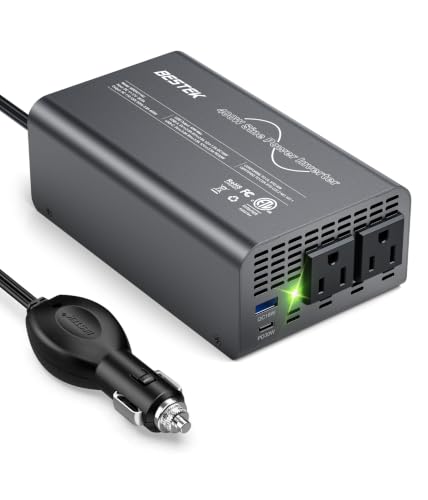 BESTEK MRZ4011AUMost power with USB-C PD
The quick formula
Run time in hours equals battery amp-hours times 12 volts, times the usable fraction of the battery, times inverter efficiency, divided by your load in watts.
Two numbers need a sensible guess. Lead-acid and AGM batteries should usually be drained only about halfway to protect their lifespan, so use 0.5. Lithium iron phosphate (LiFePO4) batteries can usually use about 80 percent or more, so use 0.8. Inverter efficiency is typically somewhere around 85 to 90 percent, so 0.85 is a cautious choice. Check your inverter's spec sheet for the real figure.
Here is an example. A 100Ah lead-acid battery holds 1,200 watt-hours (100 x 12). Half of that is 600. At 85 percent efficiency you get about 510 watt-hours to use. Divide by 2000W and you get about 0.26 hours, or roughly 15 minutes.
Why a 2000W inverter drains a battery so fast
Power equals volts times amps. At 12 volts, a 2000W load pulls about 167 amps from the battery, and closer to 196 amps once you add inverter losses. That is a very heavy current.
Lead-acid batteries also lose usable capacity when they are discharged quickly, so the real result is often shorter than the formula says. Lithium batteries hold up better under heavy draw, but their built-in battery management system may shut down if it cannot supply that current. Check the maximum continuous discharge rating before you buy.
Estimated run times at full 2000W load
The table below uses the formula above with 85 percent inverter efficiency and a constant 2000W load. These are estimates, not guarantees. Age, temperature and battery quality all shift the results.
| Battery (12V) | Lead-acid / AGM (50% usable) | Lithium (80% usable) |
|---|---|---|
| 100Ah | About 15 minutes | About 24 minutes |
| 200Ah | About 31 minutes | About 49 minutes |
| 400Ah | About 61 minutes | About 98 minutes |
What happens with a smaller load
Few people run an inverter at its full rating for long. Run time scales with the load, so halving the load roughly doubles the time. A 500W load is one quarter of 2000W, so it lasts about four times as long as the table shows.
For example, a 200Ah lead-acid battery gives about 1,020 usable watt-hours by our formula. Divide by 500W and you get about 2 hours. The same battery running a 100W device could last around 10 hours.
To find your own load, add up the watt ratings printed on the labels of the devices you plan to run. Devices with motors or compressors, such as fridges, pumps and power tools, draw a short burst of extra power when they start. Your inverter must handle that surge, and the battery must supply it.
How to make the battery last longer
You can stretch run time without buying a bigger inverter. These steps help most:
- Right-size the inverter. An oversized inverter wastes more power just staying switched on, even with little attached.
- Use DC where possible. Charging a phone or laptop through a USB-C port skips the conversion to AC and back.
- Add batteries in parallel. Two matching 12V batteries wired in parallel double the amp-hours at the same voltage.
- Choose lithium if you can. It offers more usable capacity per battery and handles heavy draw better.
- Keep batteries warm. Cold weather reduces the capacity of most battery types.
- Turn the inverter off when you are not using it.
Do you really need 2000W?
Many people buy a 2000W unit for loads that a much smaller inverter could handle. A laptop, camera batteries, a small fan or a CPAP machine draws only a small fraction of 2000W. If that describes your use, a compact plug-in model is simpler and puts far less strain on a battery. Our best power inverter for car cigarette lighter page lists 150W to 500W options with their specifications side by side.
Keep one limit in mind. Most car lighter sockets are fused for roughly 150W, so a larger inverter needs battery clamps to deliver its full rating. For example, the BESTEK 400W pure sine wave model on that page is rated for 400W continuous and 800W surge, with two AC outlets and a USB-C PD port. To run the appliances that a 2000W inverter is built for, such as a microwave or power tool, you need a heavy-duty inverter wired straight to the battery bank, not a lighter-socket unit.
Safety notes for high-current setups
A 2000W inverter on 12 volts carries around 200 amps, which can melt thin cables and start a fire.
Use cables rated for the current and keep them as short as practical. Install a properly rated fuse or breaker close to the battery's positive terminal. Make firm, clean connections, since loose ones heat up. Follow the inverter manual's cable size chart.
Lead-acid batteries can release hydrogen gas when charging, so keep them ventilated and away from sparks. Never run an engine to recharge in a closed garage, because exhaust contains carbon monoxide. Keep the inverter dry, give it airflow, and do not cover it while it runs.
Frequently asked questions
Can I run a 2000W inverter from my car battery?
Only briefly and with care. A starter battery is not designed for deep discharge, and you may not be able to restart the engine afterward. A deep-cycle or lithium battery is a better fit, and the inverter must be wired directly to the battery, not to the lighter socket.
How many batteries do I need for a 2000W inverter?
It depends on how long you want to run it at full load. Using the formula in this guide, divide the watt-hours you need by the usable watt-hours per battery. For long runs at high loads, a bank of 200Ah or larger is common.
Does an inverter use power when nothing is plugged in?
Yes. Every inverter draws a small idle current just to stay on, and larger models generally draw more. Check the no-load draw on the spec sheet and switch the inverter off when you are not using it.
Does pure sine wave change the run time?
Not directly. Run time depends on your load and the inverter's efficiency, which varies by model. Pure sine wave output matters more for sensitive devices such as CPAP machines.