How Long to Leave Wood in Clamps After Gluing
For standard PVA wood glue, leave the joint in clamps for 30 minutes to 1 hour if it will not be stressed, and about 24 hours if it will carry load right away. The glue reaches full strength after roughly a day, so keep the piece undisturbed that long even after the clamps come off. Always check your glue bottle, because the label for your product overrides any general rule.
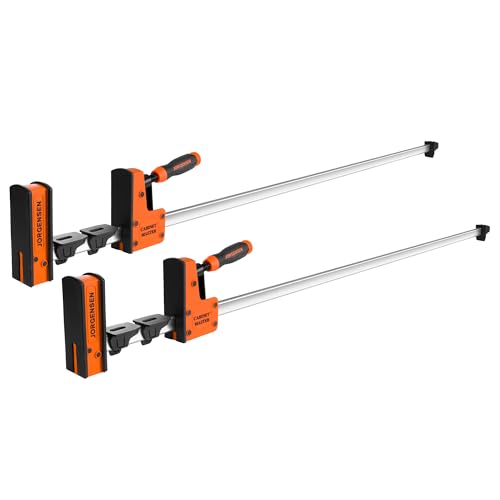 Jorgensen 99050Best overall
 VEVOR 50 inch 2packLong reach, simple spec
 WEN CLP502Deepest throat, soft pads
The short version: clamp time versus cure time
Two timers run after a glue-up, and people often mix them up. Clamp time is how long the joint needs outside pressure to stay tight while the glue grabs. Cure time is how long the glue needs to reach full strength.
With common yellow and white PVA wood glues, clamp time is short, often 30 minutes to an hour for a joint that is not under strain. Cure time is longer, usually about 24 hours. Pulling clamps early is usually fine for a simple edge joint. Putting that joint to hard use the same hour is not.
Typical clamp times by glue type
Use these numbers as a starting point only. Product formulas vary, and a fast-setting version of a glue will differ from a slow-setting one.
| Glue type | Typical clamp time | Typical full cure |
|---|---|---|
| PVA (yellow or white wood glue) | 30 to 60 minutes for light joints | About 24 hours |
| Water-resistant PVA | About 30 to 60 minutes, see label | About 24 hours |
| Polyurethane glue | 1 to 2 hours, see label | About 24 hours |
| Slow-set epoxy | Several hours, see label | 24 hours or more |
| Liquid hide glue | Several hours, see label | About 24 hours |
| Cyanoacrylate (super glue) | Seconds to a few minutes | Often within hours |
What changes the timing
Clamp time is not fixed. A few conditions push it longer or shorter, and it helps to know which way each one moves.
- Cold shop: Glue sets more slowly in cool air, so add time. Many PVA glues also list a minimum working temperature on the label.
- Humidity: Very damp air slows drying of water-based glues.
- Thick glue lines or gaps: More glue means more water to leave the joint. Tight-fitting joints set faster than loose ones.
- Dense or oily woods: Some species take longer to bond well. Wipe oily woods with solvent first if the glue maker recommends it.
- Joint stress: Bent laminations, long glued-up tabletops and joints that spring back need much longer in clamps than flat edge joints.
When to leave clamps on longer
Some glue-ups are under constant tension from the moment you tighten them. A curved lamination wants to straighten. A warped board pulled flat wants to bow again. If you release these after an hour, the joint can creep or spring open before the glue has real strength.
For stressed joints, plan on leaving the clamps on for the full 24 hours. The same goes for cabinet frames you will move around and for anything you need to be square. That is also a good reason to use clamps that hold parallel pressure steadily, as covered in our guide to the best wood clamps.
For a simple edge-glued panel with tight joints, many woodworkers remove the clamps after the minimum time and then scrape squeeze-out. Even then, leave the panel flat and lightly handled until the next day before planing, sanding hard or cutting it to size.
Step by step: removing clamps safely
Safety note: Wear eye protection when scraping, chiseling or sanding glue lines, and keep your hands behind the blade of any chisel. Heavy bar clamps can fall when released, so support the work and the clamp before you open the jaws. Wear hearing protection and a dust mask if you move on to power sanding.
- Check the time against your glue label, and add extra time if the shop is cold or the joint is stressed.
- Look for squeeze-out beads. If they are rubbery rather than wet, the glue has started to set and is easy to remove with a chisel or scraper.
- Loosen the clamp slowly, one at a time, and watch for any gap opening along the glue line.
- Set the piece on a flat surface and keep it undisturbed until the full cure time has passed.
- Wait for the full cure before machining, heavy sanding or putting the piece to use.
Using the right clamps helps timing work
Short clamp times only work when the joint is held tight and square the whole time. Clamps that tilt or slip can leave gaps that no amount of waiting fixes. Parallel jaws keep pressure even across the glue line, while a plain F-clamp suits lighter jobs. Our best F-clamps page compares the lighter options in more detail.
Size and force matter too. In our listings, the Jorgensen 50 in parallel bar clamp opens to 50 in and lists 2200 lb of clamping force. The WEN 50 in set lists 2000 lb with a 4.125 in throat and removable soft jaw pads. For smaller panels, the VEVOR 24 in four-pack lists 1500 lb with soft pads and quick release. More force is not always better, because overtightening can squeeze out too much glue and starve the joint.
Soft pads or scrap wood between the jaws prevent dents, and glue squeeze-out can bond the clamp to your work. Wax paper or packing tape on the contact points keeps clamps from sticking.
Quick checklist before you walk away
Before you leave a glue-up, confirm that the joint is tight, the work is square, and the clamps are snug but not crushing the wood. Write the time on a piece of tape on the work so you remember when it went in.
If you are unsure, wait longer. An extra hour in clamps costs nothing, while a joint that fails later means starting over.
Frequently asked questions
Can I take clamps off after 30 minutes?
Often yes, for a PVA edge joint that fits tightly and is not under strain. Handle the piece gently and do not stress it until about a day has passed.
Does leaving clamps on overnight hurt the wood?
No. Extra time in clamps does not harm a glue joint. Just use pads or scrap wood so the jaws do not dent the surface.
Should I clamp tighter to speed things up?
No. Tightening more does not make glue set faster. Snug pressure that closes the joint and shows small beads of squeeze-out is enough.
How do I know the glue is dry enough to sand?
Wait for the full cure time on the label, usually about 24 hours for PVA. Sanding too early can pull soft glue into the grain and leave marks.