How Long Should You Leave a Battery Charger On a Battery?
With a smart charger, leave it on until it reports the battery is full, then let it stay in float or maintenance mode if you like. With an older manual charger that has no automatic shutoff, plan on roughly the battery's missing amp-hours divided by the charger's amps, and unplug it once the battery is full. Charging time depends mostly on how drained the battery is and how many amps your charger delivers.
 birvsw DM1264Strongest truck jump power
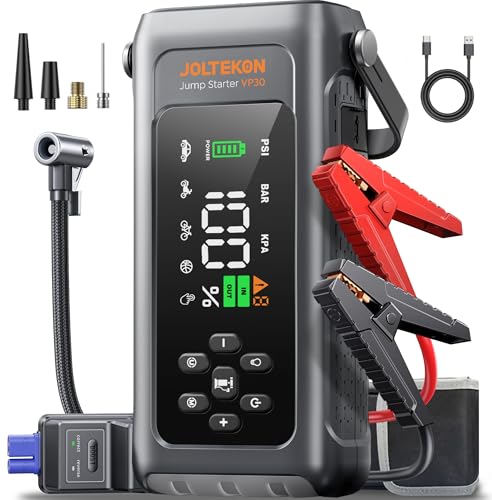 Joltekon VP30Balanced combo for cars
 NACKEO N30High pressure, light body
The short rule: it depends on the charger type
The real question is whether your charger can stop on its own. A modern smart charger or maintainer watches the battery voltage, moves through charging stages, and then drops to a low-current float or maintenance mode. That kind of unit is designed to stay connected for days or weeks without harming a healthy battery.
A basic manual charger keeps pushing current until you unplug it. Left on too long, it can overcharge the battery, heat it up, boil off electrolyte in a flooded battery, and shorten its life. If your charger has no automatic shutoff, treat it like a timer job and check on it.
Charger types and how long each can stay connected
Check the label or manual before you assume. The table below covers the common cases.
| Charger type | Stays on after full? | What to do |
|---|---|---|
| Smart charger with float mode | Yes, for long periods | Connect it and let it finish. It maintains the battery after full charge. |
| Battery maintainer or trickle-style smart unit | Yes, designed for storage | Good for vehicles that sit for weeks. |
| Older manual charger, no auto shutoff | No | Set a timer, check the battery often, and unplug when full. |
| Jump starter or power bank | No, not for ongoing charging | Use it to start the engine, then disconnect. It is not a battery charger. |
Estimating charging time from amps
You can do a rough estimate with simple math. Take the amp-hours (Ah) the battery needs, then divide by the charger's amps. Add extra time, because charging is never perfectly efficient and the last stretch of charge slows down.
Here is an illustration using a 50 Ah battery as an example. Your battery's rating will differ, so check its label. The times below are the best case, and real charging usually takes longer.
- Half drained (about 25 Ah needed): about 12 hours at 2 amps, 5 hours at 5 amps, 2.5 hours at 10 amps.
- Fully drained (about 50 Ah needed): about 25 hours at 2 amps, 10 hours at 5 amps, 5 hours at 10 amps.
- A deeply discharged or older battery often takes longer than the math suggests, because it accepts charge more slowly.
Signs the battery is done
A smart charger will tell you. Most show a full or ready indicator, switch to a maintenance light, or display a completed charge on a screen. Follow that signal rather than guessing from the clock.
If your charger has no indicator, a multimeter helps. A rested 12V lead-acid battery that reads around 12.6 volts or higher is generally close to full. Rest means the charger has been disconnected for a few hours. A reading right after charging looks higher than the real value, so wait before you measure.
Warning signs of a problem include a hot battery case, a swollen case, a rotten-egg smell, or hissing and bubbling. If you see any of these, disconnect the charger safely and let the battery cool before you handle it.
Choosing a charger that is safe to leave on
If you often leave a charger connected overnight or through the winter, buy for that use. Look for automatic shutoff, a float or maintenance mode, and protection against reverse polarity and short circuits. Our best battery charger page compares units on these features side by side.
Battery type matters too. Absorbed glass mat batteries are sensitive to charge voltage, and a mode made for them protects their lifespan. If you own one, see our best battery charger for AGM batteries page. For large diesel batteries, which hold more charge and take longer to fill, our best battery charger for diesel truck page is a better starting point.
Do not confuse a charger with a jump starter. Some combo products can both start an engine and charge devices. For example, the birvsw DM1264 lists a recharge in about 4 hours with its included 57W charger, but that charges the jump starter itself, not your vehicle's battery. If you want both functions in one box, our best battery charger and jump starter combo page shows which models fit your needs.
Safety steps before and during charging
Batteries store a lot of energy, and charging can produce flammable gas. A few habits reduce the risk.
- Charge in a ventilated area, away from sparks, flames, and anything that could ignite hydrogen gas.
- Wear safety glasses and gloves. Battery acid can burn skin and damage eyes.
- Make sure the charger is unplugged from the wall before you connect or remove the clamps.
- Connect the positive clamp first, then the negative clamp to a clean metal ground point on the vehicle, away from the battery. Remove them in reverse order.
- Never charge a frozen, cracked, or leaking battery.
- Do not leave an old manual charger unattended overnight.
- Keep the charger on a flat, stable surface and away from water.
If you only need a quick boost
Sometimes you only need enough charge to start the car. A charger set to a higher amp rate can bring a weak battery back to starting strength faster than a low-amp unit, but it will not fully charge it in that time. Plan a longer, full charge afterward, because a battery kept partly charged wears out sooner.
Driving also recharges a battery, but short trips often replace less than the engine used to start. If your battery keeps going flat, the cause may be the battery's age, a parasitic drain, or a charging system fault, and a charger will only be a temporary fix. Have the battery and alternator tested if it keeps happening.
Frequently asked questions
Can I leave a smart charger on all winter?
Yes, if it has a float or maintenance mode and the manual says it is meant for long-term connection. Check the connections occasionally and keep the unit dry and ventilated.
Will a charger keep charging after the battery is full?
A smart charger switches to a low maintenance current. A basic manual charger keeps pushing current, which can overcharge the battery, so unplug it when the battery is full.
Is it better to charge at a low or high amp setting?
A lower setting is gentler on the battery and fine when you have time. A higher setting is faster, but it can run warmer, so follow the charger and battery manuals.
Why is my battery not holding a charge?
An old or damaged battery may not hold charge, and a drain on the vehicle can also run it down. If a full charge fades within days, have the battery tested.