How Long Should Concrete Be Vibrated and Can It Be Overdone?
Most insertion points need roughly 5 to 15 seconds of vibration, but the right time is when large air bubbles stop rising and the surface turns glossy and level, not a fixed number on a clock. Yes, you can overdo it. Vibrating too long can make the mix separate, with water and fine paste rising to the top and heavy stone sinking, which weakens the finished concrete.
 XtremepowerUS 61064Best overall
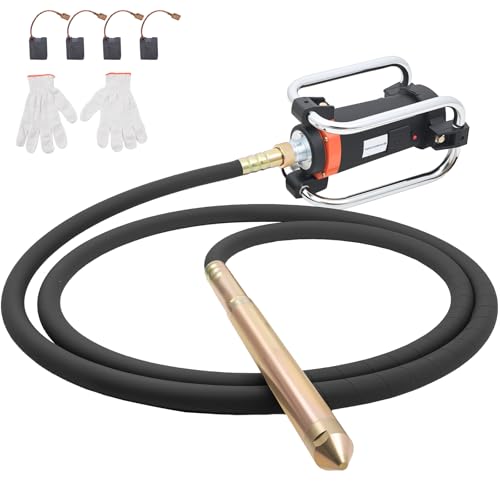 MECHINHUB MGCCFastest vibration, longest reach
 Seeutek SY-BZ-496Wide head, 6.6 ft shaft
The short rule: watch the concrete, not the clock
A common rule of thumb is 5 to 15 seconds at each insertion point. Stiffer mixes and bigger lifts sit at the long end. Wetter mixes and thin layers sit at the short end. Treat the range as a starting guess and let the concrete tell you when to stop.
The goal of vibrating is to remove trapped air and help the mix settle tightly around rebar, corners and form faces. Once that has happened, more vibration adds nothing useful and starts to do harm.
Signs the concrete has had enough
Look at the surface around the vibrator head as you work. A well-consolidated spot gives clear signals, and you should pull the head out when you see them.
- Large air bubbles stop breaking at the surface.
- The surface turns shiny and slightly wet looking, with a thin film of cement paste.
- The coarse stone settles and the surface levels out.
- The pitch of the vibrator changes from a strained sound to a steady hum as the concrete flows around the head.
Can you vibrate concrete too much?
Yes. Over-vibration is a real problem, especially in wet or high-slump mixes. The heavy aggregate sinks, while water and fine cement paste rise. This is called segregation. The result is a weak, dusty or flaky top layer and a stony, harsh bottom.
Extra water at the surface also raises the water-to-cement ratio in that zone. That can mean a surface that scales, dusts or wears faster than the concrete below it. Over-vibration near forms can also leave streaks or sand lines on the face of a wall.
Under-vibrating is just as risky. Too little time leaves honeycombing (rough, stony pockets with voids) and trapped air against the form. So the aim is a middle path: enough time to settle the mix, then stop.
Technique matters as much as time
How you move the vibrator affects how long you need to hold it. Good technique often means shorter holds and better results.
Work in a steady pattern instead of dragging the head sideways through the pour. Dragging can leave gaps and push the mix around. Instead, insert the head straight down and let it fall under its own weight.
- Place the head vertically, at evenly spaced points, so each treated zone slightly overlaps the next.
- Push it through the fresh layer and a few inches into the layer below, so the two knit together.
- Hold until you see the signs above, then pull it out slowly. A fast withdrawal can leave a hole that does not close.
- Pour in layers of manageable depth instead of one deep lift, so air has a short path out.
- Keep the head away from form faces and rebar contact where you can. Resting on steel can transmit vibration down the bar and disturb concrete that has already started to set.
How your vibrator changes the timing
Head size and vibration frequency both affect how fast a spot consolidates. A larger head treats more concrete per insertion, while a smaller head treats a smaller area and may need more insertions. Frequency is listed in vibrations per minute, or VPM, and it is worth reading next to head size and motor power, as we do on our best concrete vibrator comparison.
Here is how a few listed models differ on those numbers. Use it to understand tendencies, not to set a stopwatch.
These numbers come from published specifications. They do not replace the signs on the surface.
| Model | Head diameter | Vibration frequency | What it suggests |
|---|---|---|---|
| XtremepowerUS 2200W | 1.375 in | 5000 VPM | Wide head, lower frequency. Watch the surface closely, since the head covers a larger area per insertion. |
| Seeutek SY-BZ-496 | 1.375 in | 13000 VPM | Wide head with a higher frequency. Suits thick sections. |
| DEWALT DCE531M1 | 1.125 in | 14000 VPM | Mid-size cordless head. Suits tighter rebar. |
| Makita XRV02T | 1 in | 12500 VPM | Small head. Expect more insertion points and a smaller treated zone each time. |
Choosing a vibrator that suits the job
If you are shopping, match the tool to the pour. Thick slabs and footings suit larger heads, such as the 1.375 in size on two corded models. Narrow forms and dense rebar suit 1 in or 1.125 in heads. Our concrete vibrator comparison lays out head size, frequency and shaft length side by side so you can see which fits your work.
Shaft length matters for reach. A longer shaft means fewer moves and less time spent repositioning. The MECHINHUB lists a 14.7 ft shaft, while the DEWALT lists 4 ft.
Safety notes
Concrete work mixes electricity, water and heavy tools, so take a few precautions.
Never run the vibrator head in open air. The MECHINHUB listing warns that the needle can overheat when it runs outside the concrete and is only cooled effectively when immersed. Many corded models list overheat or overload protection, but do not rely on it as a substitute for good habits.
Use a corded vibrator only on a properly protected circuit, keep plugs and connections out of standing water, and inspect the cord before each pour. Wear waterproof gloves and boots, since wet concrete is caustic to skin. Wear eye protection against splashes and hearing protection, since vibrators and generators can be loud over a long day. Keep your footing steady on forms and planks, especially when working above ground level.
Frequently asked questions
Should I vibrate the surface of a slab?
Insertion vibrators work best inside the mass of the concrete. For slabs, insert the head at an angle or vertically through the depth, then use screeding and finishing tools for the surface. Dragging the head along the top can bring too much paste up.
Does very wet concrete need vibrating?
Wet mixes consolidate more easily, so they need less vibration, and they are the most likely to segregate. Use short holds and watch for water pooling at the surface.
What does under-vibrated concrete look like?
Look for honeycombing, which shows as rough, stony pockets and visible voids, and for air pockets along form faces after stripping. These can reduce strength and let moisture reach the rebar.
Can I use the vibrator to move concrete sideways?
No. It is meant to consolidate concrete that is already placed. Using it to push concrete across the form can cause segregation, so place the concrete close to where it needs to end up.