How Long Should a Miter Saw Stand Be?
For most home shops, plan on a miter saw stand or station that gives you about 8 to 10 feet of total support, with the blade near the middle. A simple rule is that the support on each side of the blade should reach at least half the length of the longest board you cut. If you cut 12-foot trim or long lumber, go longer or add roller stands.
 EVOLUTION 005-0002Best overall
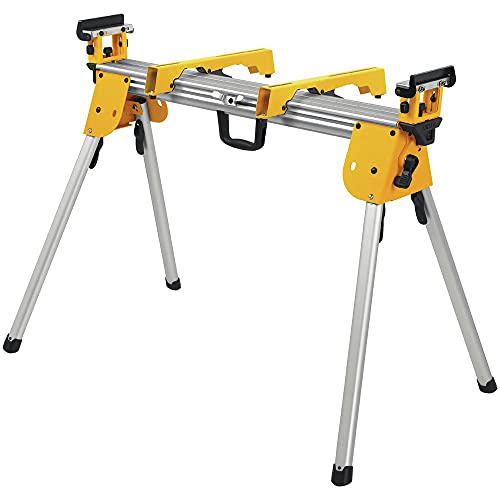 DEWALT DWX724500 lb aluminum stand
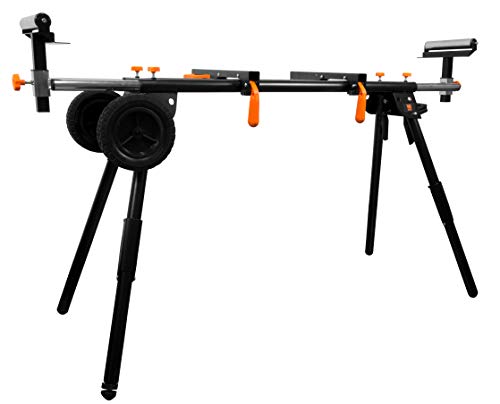 WEN MSA330Longest board support
The Short Rule for Stand and Station Length
Think of your longest regular workpiece. A miter saw cuts well only when the board lies flat and steady on both sides of the blade. If one end hangs in the air, the board tips, the cut drifts and the offcut can pinch the blade.
So the rule is simple. Measure from the blade to each end of the stand or table. Each side should be at least half the length of the longest board you cut. For a 10-foot board, that means about 5 feet on each side of the blade, or about 10 feet in total.
That total length is a starting point, not a hard limit. A shorter stand works if you add outfeed supports, and a built-in station can be much longer if you have the wall space.
Length by Board Size
The table below turns the half-length rule into planning numbers. It assumes the blade sits at the center of the stand. If you cut mostly from one side, give that side the extra length instead.
Treat the numbers as the supported surface at the same height as the saw table. Space that is lower or higher than the saw bed does not count as support.
| Longest board you cut | Support from blade to each end | Approximate total length |
|---|---|---|
| 4 feet (shelving, small trim) | 2 feet | 4 feet |
| 8 feet (studs, most trim) | 4 feet | 8 feet |
| 10 feet (long trim, baseboard) | 5 feet | 10 feet |
| 12 feet (long lumber, crown) | 6 feet | 12 feet |
Stand, Station or Table: Does the Name Change the Length?
Not in the math. A folding stand, a workshop station and a table all need to support the same boards. What changes is how easily you can reach the length you want.
Portable folding stands usually come with extendable wings or rails. They store flat, but their reach is limited, so long boards often need extra roller supports. Permanent stations, built along a wall, can run the whole length of a garage and let you add shelves, stop blocks and dust collection.
If you are still choosing a stand, our best miter saw stand page compares the options side by side, including how far each one extends.
Do Not Forget the Saw Itself
The saw body takes up room in the middle of your stand. A larger saw, especially a sliding model, has a wide footprint and rails that extend behind it. That reduces the length left over for board support on each side.
Check the width of your saw in its published specifications, then add it to your support lengths. If your saw is 2 feet wide and you want 4 feet of board support per side from the blade, the stand needs to be longer than the board-only math suggests.
Sliding saws also need depth. The rails travel backward on a pull cut, so the stand or station needs clearance behind the saw. Our page on the best 12 sliding compound miter saw lists the published dimensions, which helps when you plan the space.
Get the Height Right Too
Length gets the attention, but height decides whether your cuts are accurate. The saw table should line up with the support surfaces on both sides. Even a small step can tilt a board and ruin an angle.
A few practical points:
- Set the saw bed and the side supports at the same height, and check with a straightedge.
- Pick a working height that keeps your forearms relaxed when you hold the handle, usually near hip or waist level.
- Saw bases are not all the same height, so measure your own saw before building a station or adjusting a stand.
- Use shims or adjustable feet to level the saw to the surface, not the other way around.
- Mount the saw so you can reach the switch and lock without leaning over the blade.
Choosing a Length for Your Kind of Work
Match the stand to the projects you do most, not the rare long cut. A stand that is 12 feet long but crowds your shop will not get used.
For small projects and occasional trim, a stand around 8 feet total, with a stop block on one side, handles most boards. If you cut framing or baseboard regularly, aim for 10 feet or more. Woodworkers who cut furniture parts often need less length but more accuracy, so a stable surface and a good fence matter more. See our best miter saw for woodworking page for saws that suit that kind of work.
If you are new to miter saws, start with a modest stand and add roller supports as your projects grow. Our best miter saw for beginners guide can help you pick a saw first, since its size sets the minimum for the stand.
Safety Notes When Setting Up
A longer stand means longer boards, and longer boards are harder to control. Clamp or hold the workpiece firmly against the fence, and keep your hands well clear of the blade path.
Wear eye protection and hearing protection every time you cut. Miter saws are loud and throw chips and dust. Unplug the saw before you change the blade or adjust anything near it.
Make sure the stand is stable before you load it. Lock all legs and wings, and do not let a heavy board overhang one side without support, since it can tip the whole stand. Saws are heavy, so get help when lifting one onto a stand. If you are cutting a lot, a dust-focused saw can reduce the mess, as shown on our best miter saw for dust collection page.
Frequently asked questions
Can I use a short stand for long boards?
Yes, if you add outfeed supports such as roller stands or a sawhorse set to the same height as the saw bed. Never let a long board hang unsupported.
Should the saw sit in the middle of the stand?
Only if you cut boards from both sides equally. If you work mostly from one direction, put the saw closer to the other end so the working side has more length.
How deep should a miter saw station be?
Deep enough for the saw's base plus any rail travel behind it, with a little room for the fence. Check your saw's manual for how far it extends when you pull the head forward and back.
Is a stop block worth adding?
Yes. A stop block clamped to the support surface lets you repeat the same cut length without measuring each time, which helps when you cut many matching pieces.