How Long Should a Home Tool Kit Last?
A home tool kit used for occasional repairs should last many years, and often decades if you store it dry and use each tool for its intended job. Lifespan depends far more on materials, finish, case quality and care than on piece count. Check the steel type, the corrosion-resistant finish and the warranty before you buy.
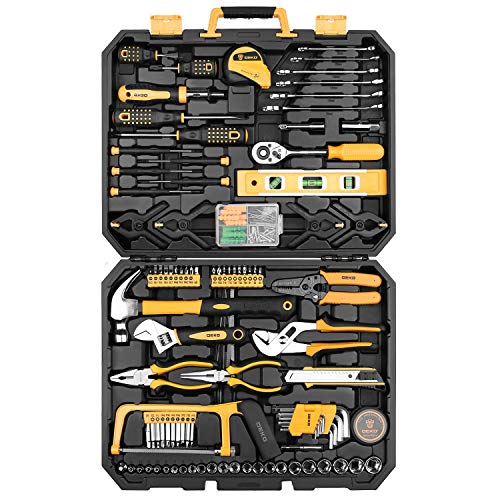 DEKOPRO ET00654Best overall
 DEWALT DWMT75049Three drive sizes
 DEKOPRO DKMHTK094BMC-OrangeClosest to a basic kit
What a realistic lifespan looks like
There is no fixed expiration date on hand tools. A screwdriver, pair of pliers or hammer that is used for hanging shelves and tightening furniture screws can stay in service for a very long time. What usually ends a tool's life is rust, abuse or loss, not normal wear.
Different parts of a kit age at different speeds. The tools themselves tend to outlast the case, and small items such as bits and fasteners tend to wear out or go missing first. Think of the kit as a set of parts with different lifespans, not one product with one lifespan.
What makes a kit last longer
Four things matter most when you compare kits on paper. Our best home tool kit page lists these specs side by side so you can check them quickly.
- Material: chrome vanadium steel is a common choice for durable hand tools. Not every maker publishes the steel type, so a missing spec means unknown, not bad.
- Finish: a corrosion-resistant finish, such as polished chrome, helps in damp garages and basements.
- Case: a hard case with sturdy latches protects the tools and keeps pieces from getting lost.
- Warranty: a long warranty suggests the maker expects the tools to last, though you should read what it covers.
What the product data shows
Among the kits we compare, the published details vary quite a bit. Some list steel type, finish and warranty, and others list only a piece count. Here are a few examples from the specs.
Keep in mind that most large kits in this category are mechanics sets built around sockets. They are durable for car work, but they may not include a hammer or tape measure for household jobs.
| Kit | Material or finish listed | Warranty listed | Case |
|---|---|---|---|
| DEWALT 192-piece mechanics set | Chrome vanadium steel, corrosion-resistant finish | 99 | Hard case |
| DEWALT 168-piece mechanics set | Chrome vanadium steel, full-polish chrome finish | Not listed | Hard case with metal latches |
| CRAFTSMAN 57-piece mechanics set | Not listed | 99 (full lifetime on mechanics tools, limited lifetime on hand tools) | Blow-molded hard case |
| DEKOPRO 228-piece socket kit | Forged high-quality steel, high-polish chrome | Not listed | Blow-molded hard case |
| DEKOPRO 94-piece basic kit | Not listed | Not listed | Plastic hard case |
How use changes the answer
Occasional use is easy on tools. Hanging pictures, assembling furniture and tightening loose hinges put little stress on a kit, so a well-made set can serve a household for many years.
Frequent or heavy use is different. Regular car work, stubborn bolts and long sessions wear down ratchets, sockets and screwdriver tips faster. If that sounds like you, look for a set with a 72-tooth ratchet, several drive sizes and tougher materials, and match it to the work. Our best power tool combo kit for the money page may help if you find yourself reaching for drills and drivers more than hand tools.
A kit that suits your jobs will also last longer in practice, because you will not force the wrong tool to do the work.
How to make your kit last
Most tool failures come from moisture and misuse. A few habits go a long way.
- Wipe tools dry after use, especially if they were outside or in a damp space.
- Return every piece to its slot so nothing gets lost or damaged in the case.
- Use screwdrivers for screws, not for prying or chiseling.
- Use the right size socket or bit so fasteners do not round off and tips do not chew up.
- Store the case off the floor in a dry spot, away from sinks and leaky pipes.
- Do not use a hammer as a pry bar, and do not hit hardened tools against each other.
Signs it is time to replace a tool
You do not need to replace the whole kit when one piece fails. Replace single tools when you see the problem.
Watch for rounded or chipped screwdriver tips, bits that slip out of screw heads, ratchets that skip or slip under load, cracked sockets, loose hammer heads and pliers that no longer grip squarely. Heavy rust that flakes off is another warning sign.
Safety note: a cracked socket, a slipping ratchet or a loose hammer head can fail suddenly and hurt you. Retire damaged tools instead of pushing through the job. Wear safety glasses when hammering, prying or working under tension, and wear gloves if edges are sharp.
Choosing a kit built to last
Start with the jobs you do, then check materials and finish. A compact kit with a hammer, pliers, screwdrivers and a tape measure will serve most household repairs, and a smaller set you actually use will outlast a huge set you rarely open.
Do not buy on piece count alone. A high count often means many small sockets and bits. Read the contents, check the case, and treat a long warranty as one useful signal among several.
Frequently asked questions
Do hand tools wear out from normal home use?
Rarely. Light household use is gentle on hand tools, and rust, loss or misuse usually shortens their life before wear does.
Does a lifetime warranty mean the tool will last forever?
No. A warranty is a promise from the maker with its own terms. Check what it covers, such as which tools are included and what counts as normal use.
Should I replace the whole kit when one tool breaks?
Usually not. Replace the single tool or bit, and keep the rest of the kit in service as long as it works well.
Is a bigger kit more durable?
Not necessarily. A larger piece count mostly adds sockets and bits, so durability still depends on materials, finish and build quality.