How Long Should a Cooling System Pressure Test Take?
Plan on about 15 to 30 minutes for a full cooling system pressure test, including setup and inspection. The system should hold steady pressure for roughly 10 to 15 minutes with no needle drop. If the gauge falls or coolant shows up somewhere it should not, you have found a leak.
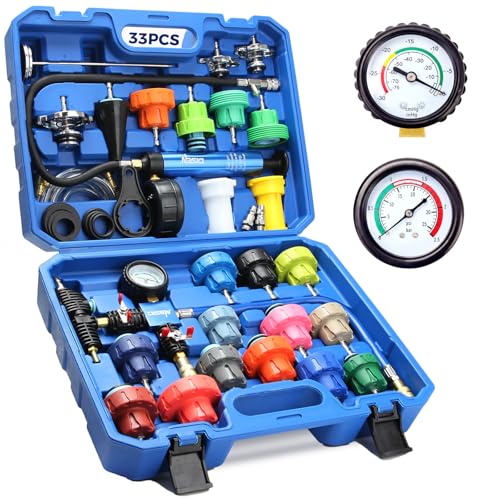 DISEN DS-33LQYZKJZTJBest overall
 Orion Motor Tech RCPDual-scale 35 psi gauge
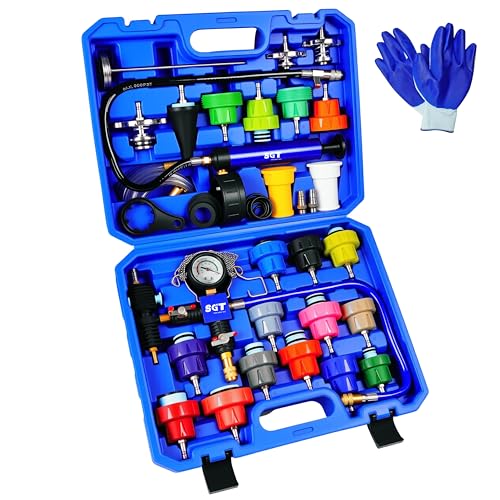 SGT SUPER GARAGE TOOLS SGT-Q295-BLUEListed pressure and vacuum ranges
The short answer: how long to hold pressure
Most of the test is waiting. Hooking up the tester takes a few minutes, pumping to pressure takes under a minute, and then you hold and watch. A common rule of thumb is to hold pressure for 10 to 15 minutes. Some technicians stretch that to 20 minutes for a full system, and a radiator cap on its own is often watched for a shorter spell.
A healthy system should show a steady needle for the whole hold. A slow, small drop can still point to a seep, so give it a little extra time before you call it good.
These times are guidelines, not a fixed standard. Your vehicle's service manual has the final word on test pressure and hold time.
What happens during the test
Knowing the steps helps you see where the minutes go. Here is the usual order:
- Let the engine cool fully. Never start a test on a hot system.
- Check the coolant level and top it up if needed.
- Choose the adapter that matches your filler neck or expansion tank, then seat it snugly.
- Pump slowly until the gauge reaches the pressure printed on the radiator cap or listed in your manual.
- Stop pumping and watch the gauge for 10 to 15 minutes.
- While the gauge holds, look and listen around hoses, clamps, the radiator, the water pump, and the heater hose connections.
- Release pressure with the valve before you remove the tester.
Pick the right test pressure first
Time and pressure go together. Test at the pressure your cap or manual specifies, not higher. Going over can create a leak that was not there, or damage a hose, radiator tank, or heater core.
Many testers top out at 35 psi, which covers common passenger car caps. For example, the Orion Motor Tech 19pc kit lists a 2.5 in. gauge that tests up to 35 psi (2.5 bar), and the SGT 33-piece kit lists a 0 to 35 psi gauge. Some kits on our list do not publish a max pressure, so check the listing if that figure matters to you. Our cooling system pressure tester comparison shows which kits list a pressure limit and which leave it out.
Reading the gauge while you wait
What the needle does tells you more than the clock does. Use this quick guide:
| What you see | What it usually means | Next step |
|---|---|---|
| Needle stays steady for 10 to 15 minutes | No significant external leak at that pressure | Inspect visually, then finish the test |
| Needle drops slowly | Small external seep or a weak cap or hose joint | Look for wet spots, crusty residue, or drips |
| Needle drops fast | Larger leak | Release pressure and trace the source right away |
| Needle drops but nothing is visible outside | Possible internal leak, such as a head gasket | Do further checks before you condemn the engine |
| Needle climbs without more pumping | Heat or combustion gases entering the coolant | Release pressure and investigate further |
When a test can take longer
Some leaks do not show up fast. A pinhole in a heater core or a seeping gasket may only appear after a longer hold. If the needle holds but you still suspect a leak, you can keep the system pressurized a bit longer while you inspect. Some technicians leave a system under pressure for much longer, but only when the vehicle is parked safely and the pressure stays at or below the cap rating.
Do not leave a tester attached and unattended for long stretches. Heat from the engine bay and small temperature changes can raise pressure. A tester left on for a long time can also stress old plastic filler necks.
Cold leaks and hot leaks can differ too. If the system holds at rest but you see coolant loss after a drive, the problem may only open up under heat and load. In that case, pressure testing is one clue among several.
Safety notes before you start
A cooling system under pressure holds hot liquid that can cause serious burns. Treat every step with care.
Wear safety glasses and gloves, since coolant can spray when a connection lets go. Keep your hands and face clear when you release pressure. Never open a radiator cap or filler neck on a warm engine. Keep the fan area clear, and make sure the engine cannot be started while you work.
Coolant is toxic to pets and people if swallowed. Wipe up spills right away and dispose of used coolant properly.
Also watch your adapter fit. A loose adapter can pop off under pressure. Kits with color-coded adapters and size markings, such as the DISEN 33-piece kit with 23 adapters, make it easier to pick the right one, but always confirm the fit by eye.
Choosing a tester that makes the job easier
You can do a good test with a basic tester, but a few features save time. A dual-scale gauge helps if your manual lists bar. A vacuum refill tool helps you purge air after a repair, which matters because trapped air can cause overheating. Adapter coverage decides whether you can test the vehicles you work on without hunting for parts.
If you are comparing kits, our best cooling system pressure tester page lines up adapter counts, listed pressures, vacuum ranges, and weights in one place. A few kits there list 23 adapters, while others list only 3, so match the set to your cars.
Frequently asked questions
Can I pressure test a cooling system while the engine is running?
Generally no. A standard leak-down test is done with the engine off and cool. Running the engine adds heat and moving parts, which raises risk and can push pressure above the cap rating.
Why does the gauge need to stay steady?
A sealed system should not lose pressure at a steady temperature. A falling needle means liquid or gas is escaping somewhere, even if you cannot see it yet.
How long should I test just the radiator cap?
A cap is usually watched for a shorter time than a full system, often a few minutes. It should hold at its rated pressure and release near that rating. Follow the cap adapter instructions that come with your tester.
What if the pressure holds but I still lose coolant?
The leak may only open when the engine is hot or under load. Check the oil for a milky look, watch for white exhaust, and consider more tests, such as a combustion gas check.