How Long Does MIG Wire Last and How Much Do You Need?
Solid MIG wire has no set expiration date. Kept dry and covered, it stays usable for years, and the main threat is rust and moisture, not age. How much you need depends on weld size: a 1/4 in fillet uses roughly a tenth of a pound per foot, and a 10 lb spool of 0.030 in wire holds about 4,000 feet.
 HYW Products ER70S603504544Best overall
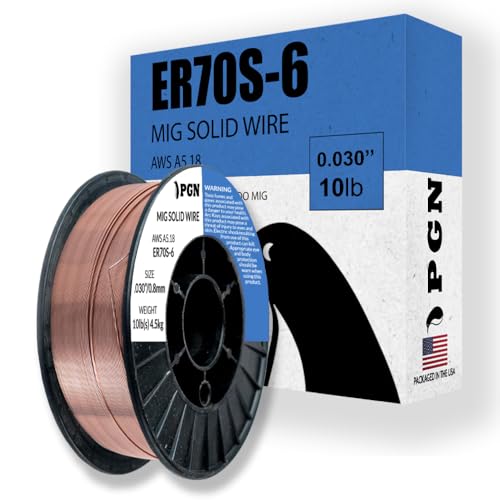 PGN Bearings WW-ER70S6-030-10LBBest for hobby welders
 PGN Bearings WW-ER70S6-035-33LBBest mid-size spool
How long MIG wire lasts on the shelf
Solid steel wire such as ER70S-6 does not spoil the way food or adhesive does. It is bare steel with a thin protective coating, so the real question is not how old it is but how it has been stored. A spool kept in a dry, covered spot can sit for a long time and still weld well.
Trouble starts when moisture reaches it. Damp air in a garage or shed lets surface rust form on the wire, and rust brings porosity, an erratic arc and a dirty feed path. That is why our best MIG wire for mild steel page advises keeping spools dry and covered. Some spools, like the ATLASWELDER 0.030 in wire, are sold vacuum-sealed to keep moisture out until you open the package.
Once a spool is open, the clock runs faster. Wire that stays on the machine in a humid shop picks up moisture sooner than wire sealed in a bag or box.
Signs your wire has gone bad
Check the wire before you blame your technique. If you see any of these, the wire may be the problem:
- Orange or brown rust on the surface, especially on the outer layers of the spool
- Rough, flaky wire that leaves dark dust in the liner and contact tip
- Welds full of tiny pinholes even with good gas flow and clean metal
- A sputtering, unstable arc that was smooth when the spool was new
- Wire that tangles or sticks because the outer wraps have corroded together
How long a spool lasts while welding
Spool life depends on wire diameter, spool weight and how fast your machine feeds wire. Steel wire has a known weight per foot, so we can estimate length. By our calculation from steel density, one pound of 0.035 in wire is roughly 300 feet, and one pound of 0.030 in wire is roughly 415 feet. Treat these as approximations.
The table applies that math to spool sizes from the products on our comparison page.
Real welding time is shorter than it looks. Wire only feeds while you hold the trigger, and you spend time positioning, grinding and fitting parts. For example, at a feed speed of 300 inches per minute (25 feet per minute), a 10 lb spool of 0.030 in wire would give around 165 minutes of pure arc time. Your machine's setting will differ.
| Spool | Diameter | Approx. wire length | Example product |
|---|---|---|---|
| 10 lb | 0.030 in | About 4,100 ft | PGN, ARCCAPTAIN, ATLASWELDER |
| 11 lb | 0.035 in | About 3,400 ft | BIG RED |
| 33 lb | 0.035 in | About 10,000 ft | PGN, HYW |
| 44 lb | 0.035 in | About 13,400 ft | HYW |
How much wire a project needs
The simplest way to estimate is by weld size. A fillet weld is roughly a triangle, so its volume grows with the square of the leg size. Doubling the leg size means about four times the wire. The numbers below come from that geometry plus a small allowance for the weld bead's convex shape and spatter loss, so they are estimates, not measured figures.
To use the table, measure the total length of weld in your project, then divide by the feet per pound. Add some extra for test welds, restarts and mistakes.
| Fillet leg size | Approx. wire per foot of weld | Approx. feet of weld per lb |
|---|---|---|
| 1/8 in | About 0.03 lb | About 35 to 40 ft |
| 3/16 in | About 0.06 lb | About 16 to 18 ft |
| 1/4 in | About 0.10 to 0.11 lb | About 9 to 10 ft |
Choosing the right spool size
Match the spool to both your machine and your workload. Spools on our comparison page run from 2 to 44 lb, and diameters run from 0.023 to 0.035 in. Thinner wire suits thin sheet and smaller welders, while 0.035 in suits heavier steel. Check what spool size and diameter your welder accepts before buying, since many small machines only take 10 or 11 lb spools.
Light, occasional work usually suits a 10 lb spool of 0.030 in wire, like the options in our mild steel wire comparison. Steady shop work benefits from a 33 or 44 lb roll, which means fewer spool changes and less downtime, as long as your machine can hold it.
A bigger spool also sits longer once opened. If you weld only now and then, a smaller spool you will finish in reasonable time may be safer than a large one that sits and rusts.
Storing wire and staying safe
Good storage is what makes wire last. Store it somewhere dry, away from outside walls and floors where condensation forms. Cover the spool on the machine when you finish for the day, or take it off and bag it if the shop is damp.
Handle wire and equipment with care:
- Wear a welding helmet with the right shade, plus gloves and eye protection when feeding or cutting wire
- Unplug the machine before changing spools, liners or contact tips
- Cut wire ends carefully, since a loose coil can spring open and the cut end is sharp
- Secure shielding gas cylinders upright and keep the valve closed when not in use
- Weld with good ventilation, because fumes from steel and any coatings are harmful to breathe
Frequently asked questions
Can I use rusty MIG wire if I clean it?
Light surface rust on the outer wraps can sometimes be stripped off by unwinding a layer or two. If rust runs deep into the spool or welds show porosity, replace the wire. A poor weld is not worth the savings.
Does thicker wire last longer on the spool?
No. A pound of thicker wire is shorter than a pound of thinner wire, so a 0.035 in spool holds fewer feet per pound than a 0.030 in spool. Thicker wire does deposit more metal per foot, so it usually lays down weld faster.
Should I buy extra wire for a project?
Yes, add a margin beyond your estimate. Test welds, restarts, spatter and mistakes all use wire, and running out mid-project is more annoying than having a little left over.
Does the type of wire change how much I need?
Not much. The amount depends mostly on weld size and length. Diameter affects how long a spool lasts, and your feed speed decides how quickly you use it.