How Long Does a Water Heater Usually Last?
A traditional tank water heater usually lasts about 8 to 12 years. A tankless water heater often lasts 15 to 20 years or more. Your water quality, the upkeep you do and how hard the unit works can move those numbers in either direction.
 Rheem RTEX-06TBest overall
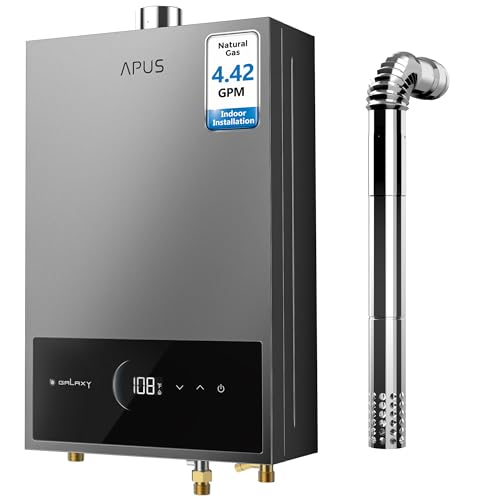 APUS AP-AWH-Q13NGNatural gas pick
 GE GE20P08BARLargest plug-in tank
Typical lifespan by water heater type
Most guidance on water heater life falls into two groups. Storage tanks sit on the shorter end because a steel tank holds water all day and slowly corrodes from the inside. Tankless units have no big tank to rust, and their parts can often be cleaned or replaced, so they tend to last longer.
These are typical ranges, not promises. A well maintained tank in soft water can outlast its range, and a neglected tankless unit in hard water can fall short of its own.
Here is a quick comparison of the common types.
| Type | Typical lifespan | Main reason it ages |
|---|---|---|
| Storage tank (electric or gas) | About 8 to 12 years | Tank corrosion and sediment buildup |
| Small plug-in point-of-use tank | Often in the same range as other tanks | Same tank wear, with less water volume to heat |
| Tankless electric | Often 15 to 20 years or more | Scale on heating parts and water quality |
| Tankless gas | Often 15 to 20 years or more | Scale in the heat exchanger and venting issues |
Why tank heaters wear out sooner
Inside a tank, minerals settle into a layer of sediment on the bottom. On a gas unit the burner heats the tank from below, so that layer makes the metal work harder. On an electric unit it can coat the lower element. Either way, the heater loses efficiency and the steel suffers.
Most tanks also have a sacrificial anode rod. It is a metal rod that corrodes in place of the tank walls. Once it is used up, the tank itself starts to corrode, and that is usually the point of no return. A leaking tank cannot be repaired, only replaced.
Size and use matter too. A tank that is too small for the household cycles on and off constantly and works harder than a right-sized one.
Why tankless units often last longer
A tankless heater warms water only when you open a tap. There is no standing water to corrode a tank, and the parts that do the heating can be flushed and serviced. That is a big reason the 15 to 20 year range is commonly cited.
Design details can help as well. The Westinghouse listing in our lineup says its separated water and electricity pathway reduces internal corrosion and scale buildup, which it says extends service life. The GE 18 gal plug-in storage model lists a stainless steel heating element that resists rust and corrosion. These are manufacturer claims from the listings, not lifespan guarantees.
Tankless units are not maintenance free. Scale is their main enemy, especially in hard water areas. If you are weighing the options, our best tankless water heater page lays out flow rate, power needs and certification side by side.
What shortens or extends the life
Several factors decide where your own heater lands in the range.
- Water hardness: Hard water leaves scale on elements, tanks and heat exchangers.
- Maintenance: Flushing and inspections catch problems early.
- Temperature setting: Higher settings speed up scale and put more stress on parts.
- Installation quality: Wrong wire size, breaker, venting or gas supply can cause early failure.
- Freezing: Cold weather can crack internal parts. The APUS gas unit lists freeze protection, and its listing says the unit must be drained if it will sit unused for a long time in cold conditions.
- Usage: A heater that is too small for your demand runs harder and wears faster.
Signs your water heater is near the end
Age is a useful clue, but symptoms tell you more. Check for these warning signs.
- Water pooling around the base of a tank, or any visible leak.
- Rusty or discolored hot water.
- Rumbling, popping or banging sounds from sediment.
- Less hot water than before, or water that runs lukewarm quickly.
- Frequent repairs or error codes on a tankless unit.
- A tank that is past the 10 to 12 year mark, even if it still works.
Maintenance that helps it last
A little regular care goes a long way. Check your manual for the exact steps and schedule for your model.
- Set the thermostat no higher than you need.
- Flush a tank periodically to clear sediment.
- Have the anode rod inspected on a tank model, and replaced when worn.
- Descale a tankless unit if you have hard water. The listing for the Westinghouse model mentions a removable inlet filter you can take out by hand, so check filters too.
- Test the temperature and pressure relief valve as the manual directs.
- Drain or winterize units in spaces that can freeze.
Repair or replace, and what to buy next
If a tank is under about 8 years old and the problem is a thermostat, element or valve, repair is often reasonable. If the tank is leaking, replacement is the only option. If the unit is near the end of its range and repairs keep piling up, replacing it usually makes more sense than repairing it again.
When you shop, match the new heater to your home first. Our best water heater page compares the specs that decide whether a unit will fit. For example, tankless flow in our lineup runs from 0.66 GPM to 4.8 GPM, and the 14000 W electric units need a 240 V supply with a 60 amp breaker and 6 AWG wire, according to their listings. Plug-in storage models such as the 10 gal and 18 gal options run on 120 V.
Also look for ETL or UL certification. Orbek 14kW, Westinghouse and Thermomate list safety certification. If a listing says nothing, ask for proof before you buy.
Safety notes
Water heaters involve electricity, gas and very hot water, so take care with any work on them.
- Shut off power at the breaker, or the gas at the valve, before touching a unit.
- Do not work on high-power electric units yourself unless you are qualified. Hire a licensed electrician for 240 V circuits.
- Have a licensed professional handle gas lines, venting and combustion air. Leaks and poor venting can cause fire or carbon monoxide poisoning.
- Hot water can scald. Be careful when draining a tank and keep the thermostat at a sensible level.
- Wear safety glasses and gloves when flushing or descaling, and use a stable ladder for high installations.
Frequently asked questions
Can a water heater last longer than 12 years?
Yes. Some tanks run past 12 years, especially with soft water and regular anode rod checks. Plan ahead once yours is that old, because a leak can start without much warning.
Does a smaller point-of-use heater wear out faster?
Not necessarily. It still has a tank that can corrode, so the same factors apply. Water quality and upkeep matter more than the size alone.
Is it worth replacing a heater before it fails?
Often yes, if it is at the end of its range. Replacing on your schedule lets you compare options and avoid water damage from a sudden leak.
Does a longer warranty mean the heater will last longer?
Not always. A warranty shows what the maker covers, not how long the unit will actually run. For example, the APUS listing mentions 2-year coverage, which says little about its full service life.