How Long Does a Measuring Wheel Last? Care Tips
No maker publishes a fixed lifespan for a measuring wheel, but a well-kept wheel can stay useful for many years of regular work. What decides it is how you treat the tire, the gears and, on digital models, the battery and buttons. Clean it, fold it gently, store it dry, and check it against a known distance now and then.
 zozen 002Best overall
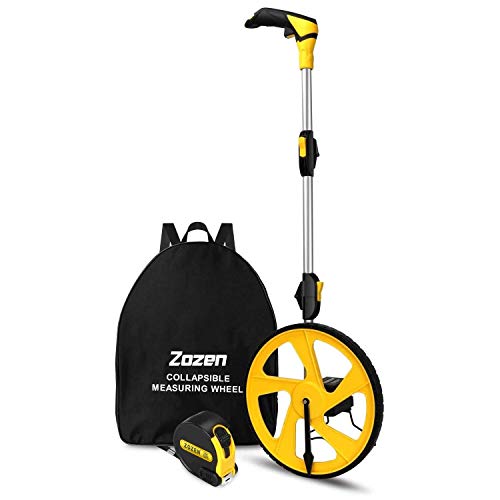 zozen Best mechanical wheel
 zozen hong-2Easiest to spot on site
What actually decides how long a wheel lasts
A measuring wheel is a simple machine. A tire rolls along the ground, a gear train counts the turns, and a counter shows the distance. Fewer moving parts means fewer things to fail, but the parts that do the work take a beating from dirt, grit and rough handling.
Wear usually comes from four things: the surface you roll over, how often you use it, how you fold and carry it, and how you store it. A wheel used a few times a year on a driveway is under far less strain than one rolled across gravel lots every day. Because we compare published specifications, we can't give you a tested lifespan. What we can do is show you which parts matter and how to protect them.
Mechanical vs digital: what wears out first
Both types share the same frame, handle, folding joints and tire. The difference is what sits behind the wheel. Mechanical counters have no battery, so there is nothing to run flat. Digital models add a screen, buttons and a power source, which gives you extras like metric units and memory but also more to look after.
Our best measuring wheel page lists both types side by side. Here is how the wear points compare in general.
| Part | Mechanical wheel | Digital wheel |
|---|---|---|
| Tire | Wears with distance and rough ground | Same |
| Gear counter | Can collect grit or lose accuracy if dropped | Same gear idea, plus a sensor and screen |
| Folding joints | Can loosen or crack if forced | Same |
| Power | None needed | Battery needs replacing and removing for storage |
| Buttons and screen | Single reset button | More buttons; keep them clean and dry |
A simple care routine
Most of the damage to a measuring wheel is slow and avoidable. A few habits after each job make a real difference.
- Wipe off mud, grass and dust from the tire and fork before you fold the wheel.
- Brush grit away from the hub and counter area with a dry cloth or soft brush. Avoid spraying water into the counter.
- Check that the tire turns freely and that nothing is wrapped around the axle.
- Reset the counter and leave the wheel folded with the handle locked.
- Wipe the display and buttons on digital models with a slightly damp cloth, then dry them.
Handling, folding and carrying
Folding joints and the handle collar take the most mechanical stress. Open and close them gently and don't force a joint that sticks. Clear out dirt first, since grit is often the reason a joint won't lock.
Several wheels on our page fold to 16 inches, and the Zozen models extend to 40 inches. The DEKOPRO digital model folds to 15.5 inches and also reaches 40 inches. A compact folded size fits into the included bag, and using that bag keeps the tire and display from getting knocked around in a truck bed.
Never throw a wheel into a toolbox or let heavy gear sit on it. A bent fork or a cracked joint can change how the tire tracks, and that affects your readings.
Battery and button care for digital wheels
If your wheel has a screen, the battery is the first thing most owners replace. Switch the unit off after each use, and if you won't touch it for a few months, take the battery out so it can't leak inside the case. Replace the battery with the type the manual calls for.
The Zozen 002 listing says its buttons are rated IP54 against dust and splashes and are built for up to 1 million keystrokes. That rating means splash resistance, not that the wheel can be soaked or hosed down. Keep digital models out of heavy rain when you can, and dry them before storing.
Dispose of used batteries at a proper recycling point instead of the household trash.
Storing it and checking accuracy
Store the wheel folded, in its bag, in a dry place away from direct sun and extreme heat. Moisture can rust metal parts and corrode battery contacts, and heat can harden or warp a rubber tire over time.
Most wheels on our page list 0.5% accuracy, so a 100 ft run could be off by about half a foot. If your readings start to drift well beyond that, something is wrong. A quick check takes a minute:
- Lay out a known distance with a long tape, such as 50 ft on flat pavement.
- Roll the wheel along it at a steady walking pace with the wheel upright.
- Compare the reading to the tape.
- If it is clearly off, clean the tire and hub and try again before blaming the counter.
Signs it is time to repair or replace
A wheel that is worn out usually tells you. Watch for these signs:
- A tire with flat spots, deep cracks or a smooth tread that slips on pavement.
- A counter that skips, sticks or won't reset to zero.
- Readings that stay off after you clean the wheel and recheck it against a tape.
- A handle or fork that wobbles, so the wheel no longer rolls straight.
- A digital display that stays dim or blank even with a fresh battery.
Safety and choosing one that will hold up
If you measure along a road, face traffic when you can, wear a high-visibility vest and keep your eyes up instead of on the counter. Watch your footing on uneven ground and keep the wheel in front of you so you don't trip on the handle.
When you shop, match the wheel to your work. Larger 12.5 in wheels roll over grass, gravel and cracks with less bouncing, while the smaller 6 in and 4 in models suit floors and sidewalks better. Using a wheel in the conditions it was built for is the easiest way to extend its life. For a side-by-side look at sizes, display types and kickstands, see our measuring wheel comparison.
Frequently asked questions
Should I use a measuring wheel on gravel?
You can with a larger wheel, but gravel wears the tire faster and can jam grit into the hub. Clean it afterward and expect to replace the tire sooner than if you only roll it on smooth ground.
Do mechanical wheels last longer than digital ones?
Not necessarily. Mechanical wheels skip batteries and screens, so there is less to fail, but the tire, joints and gears wear the same way on both. Care matters more than the display type.
Can I clean a measuring wheel with water?
Wipe it with a damp cloth and dry it. Avoid soaking it or spraying into the counter or buttons, since water can reach the gears and electronics.
Why does my wheel give different readings each time?
Rolling at an angle, skipping over bumps, a dirty tire or a loose handle can all change the count. Keep the wheel upright, walk at a steady pace and compare it to a tape measure.