How Long Does a Crowfoot Wrench Set Last?
With normal care, a crowfoot wrench set can last for many years of home and shop use. No published spec gives a fixed lifespan, because how long a set lasts depends mostly on the steel, how much torque you apply, and how you store it. Light use with a hand ratchet will outlast heavy use with extensions and impact tools.
 NEIKO 03324ABest overall
 VEVOR XMNJBS0030ATMost pieces included
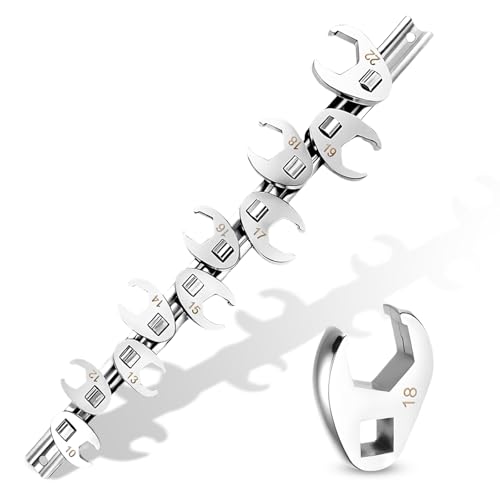 DikTalk RP-CT04301Simple clip-on organizer
The short version: it depends on use, not a calendar
Crowfoot wrenches are simple, solid pieces of forged steel with no moving parts. That is why they tend to last. They rarely fail from age. They wear out from rounding, cracking, rust, or getting lost.
So instead of asking for a number of years, ask what will wear your set. A set used a few times a year on brake lines or plumbing fittings faces very different stress than a set used daily on stubborn fasteners. The rest of this guide covers what to look for and how to stretch the life of a set you own or plan to buy.
What actually wears a crowfoot wrench out
A crowfoot wrench grips a nut on a few small contact points, so the jaw edges take most of the load. Over time the edges can round off, and a rounded jaw slips instead of gripping.
Several habits speed this up:
- Using the wrong size, even one that is close, which rounds the nut and the jaw together.
- Pulling hard on a frozen fastener without first loosening it with penetrating oil.
- Adding a pipe or cheater bar to the ratchet handle.
- Using the tool with an impact wrench when it is not made for that.
- Leaving it wet or dirty in a toolbox, which invites rust and pitting.
Steel, hardness and finish: what to read on the spec sheet
The steel type and finish are the best clues to durability before you buy. Chrome molybdenum and chrome vanadium are both common alloy steels for hand tools. Hardness, when a maker lists it, is given in HRC, and a higher number means harder steel. Harder steel resists wear, though very hard steel can be more brittle, so a higher number is not automatically better.
Only two sets on our comparison page publish a hardness range. The table below shows what each set lists for steel, hardness and finish.
| Set | Steel | Listed hardness | Finish |
|---|---|---|---|
| Neiko 15-piece metric | Chrome molybdenum | Not listed | Not listed |
| VEVOR 30-piece metric and SAE | Chrome molybdenum | 38 to 45 HRC | Electroplated |
| DikTalk 10-piece metric | Chrome vanadium | Not listed | Mirror-polished |
| BILITOOLS 14-piece jumbo SAE | Chrome vanadium | Not listed | Mirror chrome |
| YIYEIE 24-piece metric and SAE | Chrome vanadium | Not listed | Chrome, mirror polished |
| SHALL 11-piece metric | Carbon steel | 40 to 50 HRC | Chrome-plated, mirror polished |
| LainKeen 16-piece jumbo metric | Chrome vanadium | Not listed | Black phosphate, chrome-plated handle |
How you use the set matters as much as the steel
Most crowfoot wrenches attach to a ratchet, a torque wrench or an extension. The Neiko, VEVOR, YIYEIE and others list compatibility with these. Some listings also mention impact torque wrenches. Chrome-plated hand tools are usually meant for hand drive, so check that the maker rates a set for impact use before you put it on an impact wrench.
A crowfoot also changes the effective length of a torque wrench. If you are tightening to a specification, such as on a brake line, account for that offset or you will over- or under-tighten the fitting. Over-tightening stresses both the fitting and the wrench.
Drive size plays a part too. A 3/8 in drive suits small and mid fasteners, while the 1/2 in sets cover larger sizes. Using a small set on a big job is a common way to damage it.
Signs it is time to replace a piece
You do not need to replace a whole set when one piece wears out. Inspect the pieces you use most often, because those age first. Replace or retire a piece if you see any of these:
- Rounded or chewed jaw edges that slip on a clean, correctly sized nut.
- Visible cracks, especially near the drive square or where the jaw meets the body.
- A drive square that is worn or deformed, so it no longer sits snugly on the ratchet.
- Deep rust pitting that flakes or cannot be wiped away.
- Faded size markings that make it easy to grab the wrong piece.
Care steps that add years
Good habits cost almost nothing and make a real difference. Follow these steps after each job:
- Wipe off oil, brake fluid and grime with a clean rag.
- Let the pieces dry fully before closing the case.
- Put each piece back in its own slot so sizes stay in order and nothing goes missing.
- Store the set somewhere dry, away from a damp garage floor.
- Use the exact size every time, and pull steadily rather than jerking.
Safety notes
Wear safety glasses when loosening stuck fasteners, because a slipping wrench can send you into the work and small chips can fly. Never use a damaged crowfoot under heavy load. A cracked piece can break suddenly and hurt your hand.
When working on brake lines, fuel lines or anything under pressure, relieve the pressure first and work in a ventilated space. If you use power tools or an impact wrench nearby, wear hearing protection too.
Picking a set built to last
If longevity is your priority, start with steel and published hardness, then check storage. A hard case or a rail that holds each piece keeps a set intact for years. Our best crowfoot wrench set page lays these details side by side, including drive size, size range, and weight.
It also helps to match the set to your fasteners so you never force the wrong size. Mixed metric and SAE work suits a set such as the VEVOR or YIYEIE. Metric-only work suits the Neiko, DikTalk or SHALL. If you also need regular open and box ends for the same jobs, see our best combination wrench set page, since a crowfoot is best for tight spots and not for everything.
Frequently asked questions
Do crowfoot wrenches wear out faster than sockets?
They can, because the open head grips on fewer contact points. Using the right size and pulling steadily keeps wear similar to other hand tools.
Does a higher HRC number always mean a longer life?
No. Harder steel resists wear better, but very hard steel can be more brittle. The steel type, finish and how you use the tool all matter too.
Can I repair a rounded crowfoot wrench?
Not reliably. Once the jaw edges are rounded, the piece will slip and can damage fasteners, so replace that size.
Is a missing piece a sign the set is finished?
Not at all. A set with a case or tray that shows each size makes a gap easy to spot, and you can often replace just that size.