How Long Does a Corded Jigsaw Last? Saw and Blade Lifespan
A corded jigsaw body can last many years, often well past a decade for occasional home use, because it has no battery to wear out. The parts that fail first are the blade, which wears out in hours of cutting or less, and the motor's carbon brushes. How long yours lasts depends mostly on how hard you push it and how well you look after it.
 Bosch JS470EBest top-handle Bosch
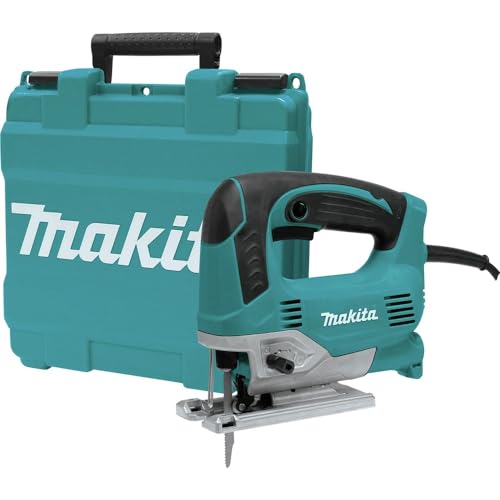 Makita JV0600K-RBest overall
 Bosch JS470EBBest barrel-grip control
The short version: saw body versus blade
There are really two lifespans to think about. The saw itself is a motor, a gearbox and a housing, and these can keep working for years. The blade is a consumable part, like a sanding sheet, and you should expect to replace it often.
No maker publishes one number for how long a jigsaw lasts, because it depends on use. A saw that cuts a few shelves a year is under very little strain. A saw used daily on a job site wears much faster. That is why this guide focuses on what you can control instead of promising a figure.
How long a corded jigsaw body lasts
A corded jigsaw skips the battery, which is usually the first part to fade on a cordless tool. Our best corded jigsaw comparison points out that corded saws keep full speed through long cuts, and the same design means there is less to age out.
What does wear is mechanical. Carbon brushes inside the motor slowly shorten with use and eventually need replacing. The blade clamp, the guide roller that supports the back of the blade and the foot plate also see wear. Bearings and gears take the strain of rapid reciprocating motion.
Some kits make upkeep easier. The DEKOPRO DKPJGSD075C1-K1UL-GYAZ kit lists 2 spare carbon brushes in the box. The Bosch JS365 is listed with a one-year limited warranty, which covers defects but not normal wear.
How long a jigsaw blade lasts
Blade life varies far more than saw life. It depends on the blade type, the material, the speed and how much you force the cut. A fine-tooth blade in thin plastic can stay useful for a long time. The same blade in hardwood or metal dulls much sooner.
Because a blade is cheap compared with the saw, treat it as something to swap early. A dull blade makes the saw work harder, and that extra strain is what shortens the life of the motor.
| Material | Blade wear | What helps |
|---|---|---|
| Softwood and plywood | Moderate | Use a wood blade and a higher orbital setting for rough cuts |
| Hardwood and laminate | Faster | Lower orbit, slower feed and a sharp blade |
| Metal | Fastest | Use a metal blade, slow the speed and use cutting oil if the blade maker recommends it |
| Plastic | Varies | Slow speed so the blade does not melt the edge |
Signs it is time to replace the blade
Most people keep a blade too long. Look for these clues:
- You have to push harder to keep the saw moving.
- The cut drifts or wanders away from your line.
- The edge looks rough, burned or chipped.
- You see smoke or smell burning wood.
- Teeth look rounded, bent or missing.
What shortens a jigsaw's life
Most early failures come from habits, not defects. Forcing the saw through a cut makes the motor draw more power and heat up. Letting the blade bind in a tight curve can bend it and strain the clamp. Running a dull blade does the same kind of damage over time.
Dust is another factor. Sawdust packs into vents and the blade guide, so a dust blower or vacuum port helps beyond keeping your line visible. The Makita JV0600K-R lists a through-the-body dust port for use with a vacuum, and the Skil JS314901 lists an on/off dust blowing switch.
Heat matters too. Long cuts at full speed in dense material warm the motor. Use the variable speed dial to match speed to the job. Our guide to the best corded jigsaw models notes that a variable speed dial lets you slow down for metal and plastic.
How to make your jigsaw last longer
A few simple habits go a long way. Follow these steps after each job:
- Unplug the saw, then remove the blade and let it cool first if it is hot.
- Blow or brush dust out of the vents, the blade clamp and the foot plate.
- Check the power cord for cuts or crushed spots and replace a damaged cord before use.
- Store the saw in its case or a dry spot. The Makita JV0600K-R is listed with a tool case.
- Replace worn carbon brushes if the saw sparks heavily, loses power or cuts in and out.
- Pick the right orbital setting. Use high orbit for rough cuts in wood and zero orbit for clean curves and metal.
Safety notes
Always unplug the saw before changing a blade, adjusting the bevel or cleaning, even if your model has a tool-free blade change. Fresh blades and used blades can both be sharp, and a used blade can be hot. A blade ejection lever, listed on the Bosch JS470E and Bosch JS365, keeps your fingers away from a hot blade.
Wear safety glasses, since chips and dust fly up during cutting, and use hearing protection for longer jobs. Clamp the workpiece so it cannot move, and keep the cord behind you and clear of the blade. Do not use a saw with a damaged cord or cracked housing.
Frequently asked questions
Is a corded jigsaw more durable than a cordless one?
Corded saws avoid battery wear, so they often stay useful longer with the same care. Motor, gearbox and clamp wear still apply to both types.
Can I sharpen a jigsaw blade?
Not in a practical way. Jigsaw blades are thin and cheap enough that replacing them is the normal choice.
Why does my jigsaw smell hot or spark?
A little sparking can be normal from the brushes. Heavy sparking, a burning smell or lost power can mean worn brushes or a clogged motor. Unplug the saw and check it before using it again.
Do all jigsaws accept the same blades?
No. The Bosch JS260, for example, uses a clamp for T-shank blades and does not accept U-shank blades, so check the clamp type before buying blades.