How Long Does a Chainsaw Chain Last?
There is no fixed lifespan. A chain used a few times a year can stay in service for years, while a chain used daily for heavy cutting may be worn out in weeks. What matters is how often you sharpen it, what you cut and how well you look after it, so replace the chain when it is worn, damaged or can no longer be sharpened to a proper edge.
 KAKEI 18" 3/8"LP .050" 62DL- German Steel *3Best overall
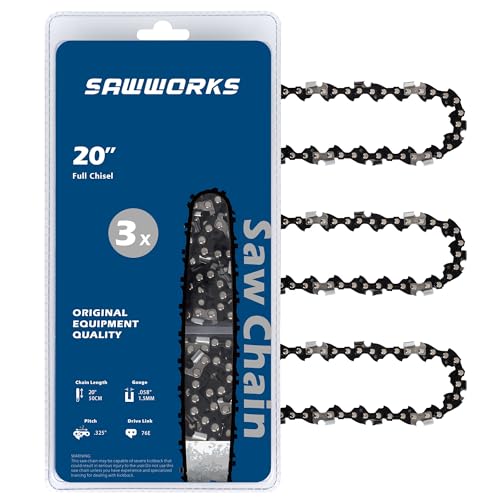 SawWorks 20" 76DL .325" .058"-GermanSteel *3PcsBest for big saws
 GSSHBR 18Inch 3/8 050 62 5PackBest 18 in value pack
Why chain life is measured in wear, not years
Chains do not expire on a calendar. A chain is a set of small steel cutters, and each cutter loses a little metal every time you sharpen it. Hitting dirt, rocks or metal dulls it much faster than clean wood does. So the honest answer to "how long does a chain last" is "until the cutters are used up or the chain is damaged."
That is why two people with the same chain can get very different results. Someone who trims a few branches each spring may go years on one chain. Someone cutting firewood every weekend, or a crew cutting every day, will go through chains far more quickly. Hours of cutting and the condition of the wood matter more than the age of the chain.
What shortens or extends chain life
Most of the difference comes down to a handful of habits and conditions. The first is dirt. Cutting wood that is on the ground, or bark packed with soil and grit, dulls cutters quickly. The second is how you cut. Forcing a dull chain through a log heats the steel and wears the cutters and the bar.
Lubrication is the third factor. A chain that runs dry gets hot, stretches and wears faster. The last is the cutter design itself. Our best chainsaw chain page explains that semi-chisel cutters stay sharp longer in dirty or frozen wood and are easier to file, while full chisel cutters cut fastest in clean wood but dull sooner.
- Cutting dirty, sandy or frozen wood wears cutters faster.
- Touching the ground with the tip or the chain dulls it at once.
- Low bar oil makes the chain run hot and stretch.
- Letting the chain go dull means more filing later to restore the edge.
- Storing a chain wet or dirty invites rust.
Semi-chisel and full chisel: what to expect
Cutter type affects how often you will sharpen, which in turn affects how long the chain lasts. The table uses details from chains on our comparison page, such as the KAKEI 18 in semi-chisel 3-pack and the SawWorks 20 in full chisel 3-pack. Treat it as a rule of thumb, not a promise of hours of life.
| Feature | Semi-chisel | Full chisel |
|---|---|---|
| Cutting speed | Steady, good all-round | Fastest in clean wood |
| Dulls in dirty wood | Slower | Sooner |
| Ease of filing | Easier | Needs more care |
| Good fit for | Homeowners, mixed or dirty wood | Experienced users, clean wood |
| Example from our page | KAKEI 18 in, 62 drive links, 3/8 LP | SawWorks 20 in, 76 drive links, .325 pitch |
Signs it is time to sharpen, and signs it is time to replace
Sharpening and replacing are different jobs. A dull chain usually just needs a few strokes with a round file or a trip to a sharpening shop. A worn-out chain cannot be brought back, no matter how carefully you file it.
Sharpen when the saw makes fine sawdust instead of chips, when you have to push the saw into the cut, or when the saw pulls to one side. Replace the chain when you see any of the signs below.
- Cutters are filed down to the wear marks or are too short to sharpen.
- Cutters, tie straps or drive links are cracked, bent or chipped.
- The chain keeps stretching so you must tighten it again and again.
- Rivets are loose or the chain has rust that will not clean off.
- The saw still cuts crooked after you sharpen all cutters evenly.
- Drive links are worn thin or rounded so the chain rides poorly in the bar groove.
How to get more life from a chain
A few simple habits make a real difference. Keep the bar oil reservoir topped up and check that oil is reaching the chain. Set the tension correctly: the chain should sit snug against the bar but still pull around by hand. Cut clean wood when you can, and keep the tip away from the ground.
Sharpen early and often. A light touch-up costs the cutter much less metal than a heavy regrind after the chain has gone dull. Keep all the cutters the same length and angle so the chain cuts straight.
Rotating chains also helps. Packs of several chains, like the 3-pack and 5-pack options we list on our best chainsaw chain comparison, let you swap a dull chain in minutes and sharpen the spare later. Rotating means each chain wears more evenly, and you can keep cutting while a chain is waiting for attention.
Safety when checking or changing a chain
Chains are sharp even when they are worn, and a saw can start unexpectedly. Treat every inspection as work around a running tool.
Before you touch the chain, switch the saw off and engage the chain brake. For a gas saw, pull the spark plug boot. For a battery saw, remove the battery. For a corded saw, unplug it. Wear cut-resistant gloves when handling the chain, and wear eye protection when filing or cleaning. When you cut, add hearing protection, since gas saws are loud.
Never run a chain you suspect is cracked or badly stretched. A chain can break under load and whip back toward the operator.
Buying a replacement chain that fits
When it is time to replace, fit comes first. Bar length, pitch, gauge and drive link count must all match your guide bar, and they are usually stamped on the bar. For example, the KAKEI 18 in chain on our page is 3/8 LP pitch, .050 in gauge and 62 drive links, while the SawWorks 20 in chain is .325 pitch, .058 in gauge and 76 drive links. These are not interchangeable, even if both are for roughly similar saws.
Most homeowners are well served by a low-kickback chain. Compare current options on our best chainsaw chain page, and match the four numbers to your bar before you order.
Frequently asked questions
Can I sharpen a chain until it is gone?
Not safely. Each sharpening removes metal, and once the cutters reach the wear marks or become too short, the chain should be retired.
Does a chain wear out if I rarely use it?
The cutters will not wear from sitting, but rust can damage them. Store the chain clean and lightly oiled so it is ready when you need it.
Should I replace the bar when I replace the chain?
Not every time, but inspect it. A bar with a worn or pinched groove, or one that is bent or burred, can wear a new chain quickly, so check it before you fit a new chain.
Why does my new chain loosen so quickly?
New chains stretch a little as they settle in. Check the tension after the first few minutes of use and again after a short break once the chain has cooled.