How Long Do Kitchen Faucets Last?
A well-made kitchen faucet commonly lasts around 10 to 15 years, and some run longer with good care. Parts like the cartridge, aerator and hoses usually wear out sooner than the body, so many faucets can be repaired instead of replaced. Touchless models add electronics and batteries, which are extra parts that can fail.
 Moen 7594SRSBest overall
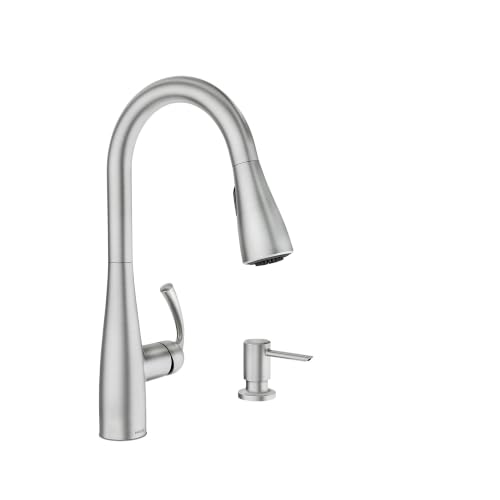 Moen 87014SRSBest for big sinks
 GIMILI GM1019NBest for RVs and small sinks
The short version
There is no fixed expiration date for a kitchen faucet. Most guidance puts the typical range at roughly 10 to 15 years, and well-built faucets in homes with gentle water can go beyond that. Treat that as a rule of thumb, not a promise.
What really matters is which part fails. The faucet body, whether stainless steel or plated brass, often outlives the internal parts. A drip or a stiff handle usually points to a worn cartridge, not a dead faucet.
What decides how long a faucet lasts
Two identical faucets can age very differently depending on the home they live in. These are the biggest factors:
- Water quality: hard water leaves mineral scale that clogs aerators, stiffens handles and wears seals.
- Daily use: a busy family kitchen puts more cycles on the handle and sprayer than a single-person apartment.
- Build quality: solid metal bodies, quality cartridges and a good finish hold up better over time.
- Maintenance: wiping the finish, cleaning the aerator and replacing worn seals early all extend life.
- Installation: loose mounting, kinked supply lines or overtightened fittings shorten the life of a faucet.
How long do kitchen faucet cartridges last?
The cartridge is the part inside a single-handle faucet that controls flow and temperature. It is the most common thing to fail. Cartridge life varies with water quality and use, so there is no single number that fits every kitchen.
Some makers publish cycle ratings, which count how many times the handle is run through a test. In the data we compare, the OWOFAN 9009SN-A lists a ceramic cartridge rated for 500,000 cycles. Our best kitchen faucets page also highlights a model rated for 5,000,000 cycles as the most durable cartridge. A cycle rating is a lab figure, so it shows relative build quality but not exactly how many years you will get at home.
Signs of a tired cartridge include a drip from the spout when the handle is off, a handle that feels gritty or loose, and water that will not mix to the right temperature. Replacement cartridges are often sold for a specific model, so check the brand and model number first.
How long do touchless kitchen faucets last?
A touchless faucet has the same plumbing as a regular one, plus a sensor, a small valve that opens and closes the water, and a power source, usually batteries or a plug-in adapter. Those extra parts give you more things that can wear out, so the whole system may not last as long as a simple manual faucet.
The good news is that the weak points are usually easy to spot. Weak or slow response often means the batteries are low. A sensor that fires on its own can be caused by a dirty or wet sensor window, or by reflections from a shiny sink.
Keep batteries fresh, wipe the sensor area, and check the maker's warranty terms before you buy. Replacement sensor and valve parts are not available for every model.
Parts that wear out first
Knowing which part is failing helps you decide whether to fix or replace. This table lists the usual suspects and what to do about them.
| Part | Common sign of wear | Usual response |
|---|---|---|
| Aerator | Weak or uneven stream | Unscrew and soak in vinegar, or replace |
| Cartridge | Drip, stiff or loose handle | Replace the cartridge |
| Spray hose and docking | Head does not stay docked, hose sticks | Check for kinks or a stuck weight, replace hose if frayed |
| Supply lines | Dampness under the sink | Replace the lines promptly |
| Finish | Flaking, pitting or heavy spotting | Clean first; replace if the coating is breaking down |
| Touchless sensor or battery | Slow, random or no response | Change batteries, clean sensor, then check warranty |
Repair or replace?
Repair is usually the better first step when the faucet body and finish are in good shape and only one internal part has failed. Replacement makes more sense when you see corrosion on the body, repeated leaks, or a finish that is flaking.
Safety matters here. Shut off the water at the supply valves before you take anything apart, and open the faucet to release pressure. Wear eye protection when working in the dark space under the sink, where debris and old fittings can fall. If your faucet has any electrical parts, unplug the power adapter or remove the batteries first, and keep electrical connections away from water.
If you use vinegar or a descaler on scale, follow the label directions and keep the area ventilated. Never mix cleaning products.
Choosing a faucet that will last
When you shop for durability, look at the details that signal careful construction. A stainless steel or solid metal body resists corrosion. A ceramic cartridge with a published cycle rating gives you something to compare. A fingerprint and spot-resistant finish tends to look better for longer with less scrubbing.
Warranty terms help too. In the data we use, the Moen Arbor 7594SRS and Moen Essie 87014SRS list lifetime-style warranty coverage, as do several others on our best kitchen faucets page. Read the actual warranty to see what it covers, because many exclude finish wear or require proof of purchase.
Finally, look for NSF certification and lead-free construction, since this faucet delivers your drinking water. You can see these specs side by side on our comparison page.
Frequently asked questions
Does hard water shorten a faucet's life?
Yes, it can. Mineral scale builds up in the aerator, cartridge and seals, which causes weak flow and stiff handles. Regular cleaning helps.
Can I replace just the cartridge?
In most cases, yes. Cartridges are made for specific faucets, so match the brand and model number. Shut off the water first.
Is a faucet drip a sign I need a new faucet?
Not necessarily. A drip often comes from a worn cartridge or seal that costs less to fix than replacing the whole faucet.
Do pull-down sprayers wear out faster than fixed spouts?
The hose, docking weight and spray head have moving parts, so they can show wear sooner. Keeping the hose free of kinks and the head docked cleanly helps.