How Long Do Fire Extinguishers Last and When Should They Be Serviced?
Most home fire extinguishers last about 10 to 12 years, but the exact number depends on the manufacturer and the type. Disposable units are replaced at the end of that life, while rechargeable units are serviced by a certified technician and refilled after any use. Either way, check the pressure gauge monthly and follow the dates on the label.
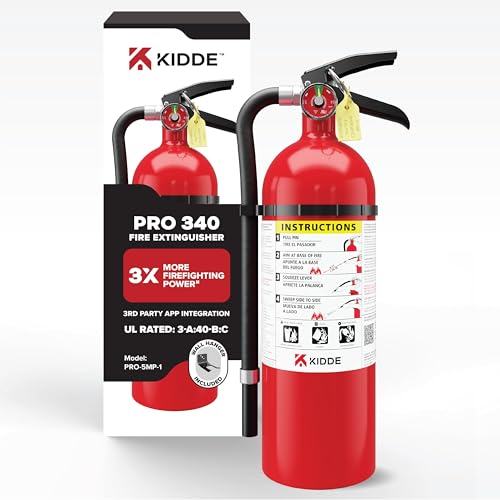 Kidde PRO-5MP-1Best overall
 Kidde FA110GLightest in the lineup
 Kidde KD143-210ABC12-year life with mount
The short version: a fire extinguisher does expire
A fire extinguisher is a pressurized container, and the seals, valve and powder can all wear down over time. That is why every unit has a limit on how long you should rely on it, even if it has never been used.
For typical home units, the limit is usually 10 to 12 years from the date of manufacture. Some makers state a shorter period. The label, the manual or the manufacturer's site gives the number that applies to your unit, and that number wins over any general rule.
Our product data shows how this looks in practice. The Kidde Basic 110 and the Kidde Living Area 4 lb both list a 12 year service life, and neither is rechargeable. The Kidde Basic 110 also comes with a 6 year limited warranty, which is a separate thing from how long the unit is meant to stay in service.
Disposable vs rechargeable: two different timelines
The biggest factor is whether your extinguisher can be recharged. A disposable unit has no service path. When it is used, even briefly, or when it reaches the end of its stated life, you replace it.
A rechargeable unit is built so a certified technician can inspect it, replace worn parts and refill it. The Kidde Pro 340, for example, is described as rechargeable after professional servicing, and the Amerex B500 is described as rechargeable by a certified technician. Rechargeable does not mean you refill it yourself. Pressurized refills are work for a trained shop.
| Type | What it means for you | What to do |
|---|---|---|
| Disposable (non-rechargeable) | Fixed service life, often 10 to 12 years from manufacture | Check monthly, replace at the end of the stated life or after any use |
| Rechargeable | Can be serviced and refilled by a certified technician | Check monthly, schedule professional service, recharge after any use |
| Unit with no date or life listed | No way to confirm how old it is | Look for a manufacture date stamp, and replace it if you cannot find one |
What to check yourself every month
A quick monthly look takes under a minute and catches most problems early. Pick a day you will remember, such as the first of the month, and do it for every extinguisher in the house.
Many models use a color-coded gauge or a pressure indicator. On the Kidde units in our data, an arrow in the green means the unit is charged. The OYEEICE listing describes the same idea.
- Check that the gauge needle or arrow sits in the green zone.
- Make sure the safety pin is in place and the tamper seal is not broken.
- Look for dents, rust, cracks, a clogged nozzle or a damaged hose.
- Confirm the unit is where it belongs, easy to reach and not blocked.
- Read the label to make sure it is still legible, and check the manufacture date.
- Note the date of your check on the inspection card, if your unit came with one.
When a rechargeable unit needs professional service
Rechargeable extinguishers need more than a monthly glance. A common schedule for stored-pressure dry chemical units is an annual check by a qualified technician, plus a deeper internal inspection about every 6 years and a pressure test about every 12 years. Local fire codes, workplace rules and the manufacturer's manual can set different requirements, so use them as your guide.
Home use is usually less formal than a business setting, but the same logic applies. A technician can spot internal corrosion, a failing valve or powder that has caked, none of which you can see from outside.
Recharge a rechargeable unit after any use, even a short burst. A partly used extinguisher can lose pressure quickly, and you will not know how much powder is left.
Signs you should replace it now
Do not wait for the calendar if you see damage or a warning sign. Replace or have the unit professionally evaluated if any of these apply:
The gauge is out of the green zone and stays there. The body is dented, corroded or leaking powder. The hose or nozzle is cracked or blocked. The unit has been used, even once, and it is not rechargeable. The label is missing or unreadable. The unit has passed the life stated by its manufacturer.
An old or empty extinguisher gives a false sense of security, which can be worse than having none. If you are unsure, treat the unit as unreliable and plan a replacement. Ask your local fire department or waste authority how to dispose of an old extinguisher, since pressurized containers should not go in regular trash.
Garage conditions and choosing a long-lasting unit
Garages are hard on equipment. Temperatures swing between freezing and hot, and humidity can attack the metal. Look at the listed operating temperature before you buy. Among the models in our data that list one, the OYEEICE 5 lb unit operates from -22°F to 140°F, and the Ougist 5 lb lists storage temperatures from -40°F to 120°F.
If you are shopping, our best fire extinguisher for garage page lines up ratings, agent weight, temperature range and mounting options on one spec sheet. It is also a good place to see which units list a service life or are rechargeable.
Mount the extinguisher near the door at a height you can reach, and away from the car engine and heat sources. A wall mount keeps it off the floor, where it can get knocked, rusted or buried under stored items. When you compare options, you can also use our garage extinguisher comparison to check which models include a mount.
Safety notes
Never try to refill or repair a pressurized extinguisher yourself. A damaged cylinder can fail under pressure. Keep your back to an exit when fighting a small fire, and stay several feet away. If a fire grows, spreads or fills the space with smoke, leave and call 911.
Dry chemical powder can irritate eyes and lungs, so ventilate the area after any discharge. Wear eye protection if you are doing hands-on inspection of a damaged unit, and keep powder away from skin and pets.
Frequently asked questions
Where is the manufacture date on a fire extinguisher?
Look at the label, the bottom of the cylinder or a stamped band near the neck. Some units show only a code. If you cannot find or decode the date, check the manufacturer's site or replace the unit.
Can I use an extinguisher that is past its date but looks fine?
It is safer not to count on it. Internal parts and pressure can fail without any outside sign. Replace it, or have a technician evaluate it if it is rechargeable.
How long does professional servicing take?
A basic inspection is often quick, but recharging or testing can take longer if the shop must send the unit out. Call ahead and ask for a loaner or a timeline, especially for a business.
Do I need to service a disposable extinguisher?
No. Disposable units have no service path, so your job is the monthly check. Replace the unit when it reaches the end of its stated life or has been used.