How Long Do Air Compressor Fittings Last?
There is no fixed lifespan for air compressor fittings. A well-made brass fitting that is kept clean and used within its pressure rating can serve for years, while a worn one may start leaking much sooner. Replace a fitting when it leaks, sticks or no longer locks the plug, not when a calendar says so.
 Ailbiuko aircoupler_plug-iron-45pcsBest overall
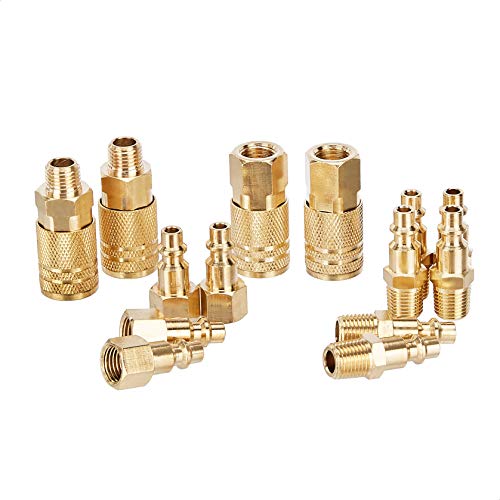 Amazon Basics A140001Brass starter set
 SOKOSEY 20SMmutou2packsReplacement M/D couplers
What decides how long a fitting lasts
Fittings are small parts that take a lot of repeated stress. Every time you connect and disconnect a plug, the locking balls, the sleeve and the internal seal wear a little. Over time that wear shows up as slow leaks or plugs that do not seat firmly.
Because use varies so much, no honest number fits everyone. A fitting on a weekend garage hose sees far fewer cycles than one on a shop hose that is swapped many times a day. Think in terms of condition and use, not age.
- Material: brass resists corrosion and wear, while plated steel and aluminum can wear or corrode sooner.
- Connection cycles: the more often you connect and disconnect, the sooner the seal and locking balls wear.
- Moisture: water in the air line promotes rust and pitting, especially on plated steel.
- Dirt and grit: debris scratches the seal surfaces and the plug.
- Pressure and heat: running at or near the rated limit, or in a hot space, speeds up wear.
- Mixing brands or profiles: a poor match between plug and coupler wears both parts faster.
Material and rating: what to look for
Material is the biggest factor you can control when you buy. On our best air compressor fittings page, most kits are solid brass, which resists corrosion and wear. The top-ranked 45-piece kit uses brass and plated steel, with a copper-style plating meant to improve corrosion resistance. Another kit is listed as aluminum.
Pressure rating matters too. Several kits list 300 psi, but some makers do not publish a rating. A missing rating does not prove a fitting is weak, but it leaves you guessing. Stay well under any stated limit, and check your compressor's regulator setting before you connect.
| Material | Typical wear behavior | What to watch for |
|---|---|---|
| Solid brass | Resists corrosion and wear well | Worn seals and sleeves from frequent use |
| Plated steel | Fine while the plating holds | Rust once plating wears through or if moisture is present |
| Aluminum | Light, but softer | Wear and thread damage with heavy use |
Signs a fitting is wearing out
Most fittings give warning before they fail. Catching the signs early saves wasted air and keeps your compressor from running more than it needs to.
A common field habit is to replace both halves of a leaking connection together, since a worn plug can quickly damage a new coupler. That is a practical approach rather than a rule, but it often avoids repeat leaks.
- A hissing sound when the line is pressurized, or a tank that loses pressure overnight.
- Soapy water that bubbles at the joint or thread.
- A plug that wobbles, pops out or needs extra force to seat.
- A sleeve that sticks or does not spring back.
- Visible rust, pitting, cracks or flattened threads.
- The compressor cycling on more often than it used to.
How to make fittings last longer
A few habits make a real difference. None of them are complicated, and most take seconds.
Drain the tank regularly so moisture does not travel down the line. Keep couplers capped or wiped clean when they are lying on a dirty floor. Do not drop them onto concrete, and avoid pulling on the hose to disconnect a plug.
- Match thread size first. The kits we compare use 1/4 in NPT, and mismatched threads will not seal.
- Wrap NPT threads with thread tape and snug them by hand first, then tighten a little with a wrench. Overtightening can crack a fitting.
- Use plugs and couplers of the same profile, such as Industrial (M/D).
- Release pressure before disconnecting anything.
- Keep a spare set on hand so a leaking pair can be swapped right away.
Replacing fittings safely
Always shut off and unplug the compressor, then bleed the tank and hose to zero pressure before removing any fitting. A fitting that comes loose under pressure can whip the hose and cause injury. Wear safety glasses, since debris and sudden bursts of air can reach your eyes. Compressors are loud, so use hearing protection when you work near one running.
Remove the old fitting, clean the threads and wrap fresh tape in the direction of the threads. Install the new part, restore pressure slowly and test with soapy water. If it still leaks, check the thread size and the plug profile before assuming the part is faulty.
Choosing replacements and kit size
Count what you need before you buy. Couplers go on one side of a connection and plugs on the other, so you need both. Our comparison lists large sets with 8 couplers and 28 plugs, and small packs with just 2 couplers. If you only need to replace worn couplers, a pair on its own may be enough. If plugs are the problem, a plug-only refill pack covers it.
If you are matching fittings to a new setup, the compressor you own also matters. See our guides to the best air compressor for home garage and the best air compressor for automotive shop to see how heavier use changes what you should expect from your hardware.
Frequently asked questions
Should I replace the male and female parts together?
Often yes. A worn plug can damage a new coupler, and the reverse is also true. Replacing both halves of a leaking connection helps avoid repeat leaks.
Can I fix a leaking fitting with more thread tape?
Sometimes, if the leak is at a threaded joint. Remove the fitting, clean the threads and re-wrap it. If the leak is at the plug and coupler seal, tape will not help and the part needs replacing.
Do all plugs fit all couplers?
No. Plugs only work with couplers of the same profile. Industrial (M/D) is meant to interchange across makers, but check the listing, since some do not state a profile.
Is a fitting without a listed pressure rating unsafe?
Not necessarily. It simply means the maker did not publish a rating. If you want certainty, choose a fitting that states one.
How do I find a leak at a fitting?
Pressurize the system, then brush soapy water on each joint. Bubbles show where air is escaping.