How Does an Engine Hoist Work?
An engine hoist is a wheeled steel crane with a hydraulic jack that raises a boom, and a chain or sling on the boom end carries the engine. You pump a handle to lift, turn a release valve to lower, and roll the hoist away with the load hanging from it. People use it to pull or install engines and transmissions, and the boom position you pick sets how much weight it can safely carry.
 Garvee bGc-OaKS-Gnv75Tn3-XOiBest overall
 Maxsa Innovations bxt-zZ9Zfp9tz6J8R1c-P-sVYbkDuLightest hoist
 Maxsa Innovations YellowHeaviest-built frame option
The short version of how it works
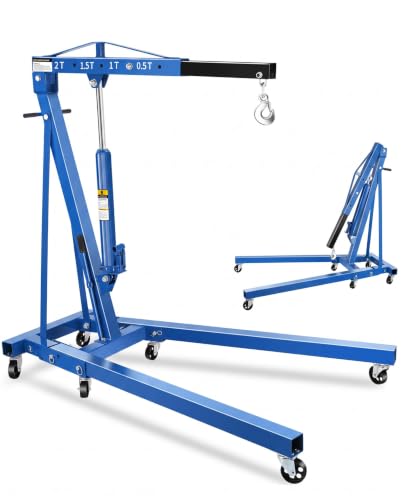
Think of an engine hoist as a lever powered by a small hydraulic jack. A tall mast and a long boom arm sit on a wheeled base. The jack pushes the boom upward, and the chain at the boom tip lifts whatever you have hooked to it.
Hydraulics do the heavy work. Pumping the handle pushes fluid into a cylinder, and the fluid forces a piston out. That motion tilts the boom up. Because fluid is hard to compress, the load holds steady between pump strokes. Some hoist listings mention an 8 ton hydraulic pump or cylinder. That figure describes the jack itself, not the rating of the whole hoist, so always use the hoist's own capacity rating.
To lower the engine, you slowly open a release valve. Opening it a little lets fluid return and the boom drops gradually. Opening it too fast drops the load, so go slowly.
The main parts and what each one does
Most folding shop cranes share the same basic layout. Knowing each part makes it easier to read a spec sheet or spot a problem before a lift.
- Base and legs: The wheeled frame that carries the weight. Wider legs add stability, and some designs have retractable outriggers so the legs can fit around a vehicle.
- Mast: The upright post that the boom pivots on.
- Boom: The arm that reaches over the engine. Many hoists have a telescopic boom with marked positions.
- Hydraulic jack: The pump and cylinder that raise the boom. A release valve lowers it.
- Chain and hook: The load-carrying link between the boom tip and the engine's lift points.
- Casters: The wheels. The hoists on our comparison page list six casters each, and some are described as 360° swivel types with locks.
- Engine leveler: An optional adjustable bar or chain setup that tilts the engine so it fits through the opening at the right angle.
Why boom position changes capacity
A longer reach means more leverage working against the hoist, so the rating drops as you extend the boom. The hoists in our data have four boom positions marked 0.5 ton, 1 ton, 1.5 ton and 2 ton. The highest rating applies at the retracted position, and the lower ratings apply as you extend the boom outward.
This is the rule that trips people up. A hoist sold as a 2 ton unit only lifts that much at its shortest setting. If your engine sits far from the hoist base, you may need a longer reach, and the capacity at that reach is what counts. Our best engine hoist page lists capacity and boom positions so you can check this before you buy.
One model on that page lists a telescopic reach of 38 to 57 in. Another lists a maximum lift height of 82.68 in, which is about 6.89 ft. Both numbers matter. Reach decides whether you can get over the engine, and height decides whether it clears the front of the vehicle.
What an engine hoist is used for
The main job is pulling an engine out of a car or light truck for a rebuild, a swap or access to parts that are hard to reach. It also lifts transmissions, axles and other heavy parts. Some listings mention boat motors, tractor parts and motorcycles as well.
A hoist is also useful once the engine is out. You can move it on its casters to a stand or workbench, then bring it back for reinstallation. Rolling a loaded hoist works best on a smooth, level floor, and the load should be kept low while moving.
A basic step-by-step lift
Every vehicle has its own procedure, so follow the service manual for disconnecting parts. The hoist steps below are the general pattern.
- Drain fluids and disconnect everything that holds the engine in place, including wiring, hoses, mounts and exhaust parts.
- Pick the boom position that reaches the engine's lift points, and confirm its rating covers the engine's weight with some margin.
- Attach the chain to approved lift points on the engine. Do not use hoses, wiring or random brackets.
- Pump the handle until the chain is snug, then check that the engine hangs level and secure.
- Raise the engine slowly until it clears the mounts and the front of the vehicle. If you have a leveler, adjust it so the engine tilts the way it needs to.
- Roll the hoist back slowly with the load as low as practical, then lower it onto a stand or support using the release valve.
Comparing hoist features
The spec differences between models are small but useful. The table below uses the published numbers from our comparison page.
The table does not show every spec, so check the full page before you decide.
| Hoist | Capacity (lb) | Weight (lb) | Folded length (in) | Leveler |
|---|---|---|---|---|
| Garvee 2 Ton with Lever | 4400 | 101.41 | 51.18 | Included |
| Maxsa 2 Ton Hydraulic (telescopic, 38 to 57 in reach) | 4400 | 147.71 | 53.54 | Not listed |
| Maxsa Cherry Picker Shop Crane | 4000 | 127.87 | 51.97 | Included, 1500 lb |
| Oekaafvi 2 Ton Folding | 4000 | 141.92 | Not listed | Not listed |
Safety notes you should not skip
A hanging engine is a serious crush hazard. Treat every lift with care, and never put any part of your body under a suspended load.
Wear safety glasses and gloves, and closed-toe boots. Fluids can drip, and chains can swing. Keep the floor clear of tools and hoses, and keep bystanders away.
Do not exceed the rating for the boom position you are using. Check the chain, hook and welds before each lift, and stop if you see leaks, bends or cracks. Lock the casters whenever the hoist is not being rolled. Once the engine is clear, set it on a rated engine stand or solid supports instead of leaving it hanging for a long time.
If you use a leveler, check its own rating too. The Maxsa cherry picker model above lists a 1500 lb leveler. A leveler adds a second rated component to the lift, so both ratings matter.
Frequently asked questions
Can I lift an engine with a hoist by myself?
It is possible, but a second person makes the job safer. Someone can guide the engine past the firewall and mounts while you control the jack. Never rush the lowering step.
Do I need an engine leveler?
Not always, but it helps. A leveler lets you tilt the engine to clear the vehicle or line up with the transmission. Some hoists on our page include one, so compare that when you shop.
Can a folding hoist be stored upright?
Many folding hoists collapse so they can sit against a wall. The folded lengths on our comparison page range from 51.18 to 64.17 in, so measure your storage space first.
How do I lower the load safely?
Open the release valve a small amount and let the boom drop slowly. Close it again if the load moves too fast or shifts.