How Does a Measuring Wheel Work?
A measuring wheel counts how many times its wheel turns as you walk and multiplies that count by the wheel's circumference. The result shows as a distance on a mechanical counter or a digital screen. Because the math is simple, accuracy depends mostly on the surface you roll over and how steadily you walk.
 zozen 002Best overall
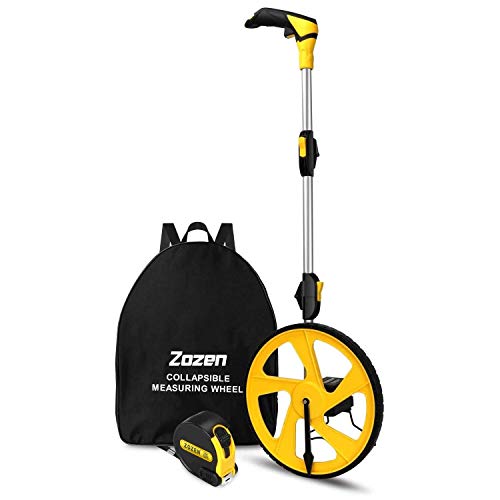 zozen Best mechanical wheel
 zozen hong-2Easiest to spot on site
The basic idea: turns times circumference
Every measuring wheel is built around one fact. When a wheel rolls one full turn without slipping, it travels a distance equal to its circumference. Circumference is the diameter multiplied by pi (about 3.14).
A 12.5 in wheel, the size used by most models on our comparison page, has a circumference of roughly 39 inches. That works out to a little over 3 feet per turn. A counting mechanism tallies each turn, and the tool converts turns into feet, inches or meters for you.
This is why the tool is often called a surveyor's wheel or a trundle wheel. They are all the same idea: a wheel on a handle that you push along the ground.
What happens inside: mechanical counters
A mechanical wheel uses a set of gears connected to the wheel axle. Each turn advances the gears by a fixed amount, and numbered dials or drums show the total. No battery is involved, so the tool is ready whenever you are.
Our mechanical Zozen picks use a precise gear structure and list feet and inches only, so the readout matches what you would see on a tape measure. The counter goes forward when you roll forward and back when you roll backward, which cancels out small retraces. A reset button returns the display to zero before the next run.
What happens inside: digital wheels
A digital measuring wheel does the same job with a sensor instead of a gear train. The sensor detects each turn, a small processor multiplies the count by the wheel's circumference, and an LCD shows the answer. Because the processor does the math, the same tool can switch units on demand.
On our best measuring wheel page, the top-ranked Zozen 12.5in Digital model switches between imperial and metric, has a backlight, and saves 5 readings. The Calculated Industries DigiRoller Plus III goes further and finds areas, volumes and perimeters from the distances you roll.
Digital tools need power, so check the battery before a long job. Buttons on some models are rated IP54 for dust and splashes, but that is not the same as being safe to submerge.
What a measuring wheel is used for
People use measuring wheels any time a tape measure is too short or too slow. Walking a distance is faster than pulling a tape across a yard, a parking lot or a job site.
In surveying, a measuring wheel gives a quick field distance for tasks like checking property lines, laying out a rough boundary or estimating road and path lengths. It is not a replacement for precision survey instruments, but it is useful for fast checks and layout work. Common uses include:
- Construction layout, such as footings, slabs and fence lines
- Landscaping, including lawns, beds, paths and edging
- Real estate and property walks to estimate lot dimensions
- Roads, runways and sidewalks, where long runs are the norm
- Crime scene and accident documentation by law enforcement
- Estimating the size of a room, garage or warehouse
Comparing the main types
Range, accuracy and folded size all vary by model. The table below uses published specs from our comparison page.
| Model | Display | Units | Max distance | Accuracy | Folded length |
|---|---|---|---|---|---|
| Zozen Double Collapsible | Mechanical | Feet/inches only | 9999 ft | 0.5% | 16 in |
| Zozen 12.5in Digital | Digital | Imperial and metric | 9999.99 | 0.5% | 16 in |
| Calculated Industries DigiRoller Plus III | Digital | Imperial and metric | 9,999,999 ft | 99.5% | 21.5 in |
How to get an accurate reading
A listed accuracy of 0.5% means a run could be off by about 5 feet over 1,000 feet. You can keep errors near that level, or lower, with good habits. Follow these steps:
- Zero the counter before you start.
- Hold the handle upright and push in a straight line, keeping the wheel on the ground.
- Walk at an even pace. Skipping or jerking can make the wheel bounce.
- Choose a bigger wheel for grass, gravel and cracked pavement, since small wheels bounce more.
- Stop and use the hold or kickstand feature, if your model has one, before you write down a number.
- Roll the same line a second time and compare the readings. If they differ by more than expected, check the surface and your pace.
Safety notes
Watch your footing. You will be looking at the wheel and the line rather than where you are stepping, so scan for holes, curbs and tools first.
If you measure along a road or driveway, face traffic or have a spotter, and wear a high-visibility vest. Before placing marking flags or stakes in the ground, make sure you know where buried utility lines run, and call your local utility locating service if you are unsure.
Frequently asked questions
Can a measuring wheel measure curves?
Yes. The wheel counts distance along the path it rolls, so it follows a curve as easily as a straight line. Roll slowly and keep the wheel in contact with the ground, then read the total at the end.
What happens if I roll the wheel backward?
On the Zozen models, the count goes down when you roll backward, which helps cancel small retraces. Check the instructions for your model to confirm how it behaves.
Can a measuring wheel find square footage?
Any wheel can give you the length and width of a space, and you multiply the two to get the area. Some digital models, such as the DigiRoller Plus III, calculate areas and volumes for you.
Does wheel size change how it works?
The principle is the same, but a larger wheel covers more ground per turn and rides over bumps more smoothly. Smaller wheels suit indoor rooms and smooth floors better than rough fields.