How Does a Light Bulb Work? A Step-by-Step Explanation
A light bulb works by sending electricity through a part that reacts by giving off light. In an old incandescent bulb, a thin wire called a filament gets so hot that it glows. In an LED bulb, electricity passes through a small semiconductor chip that gives off light directly, which is why LEDs need far less power for the same brightness.
 TJOY QASN83+85Best overall
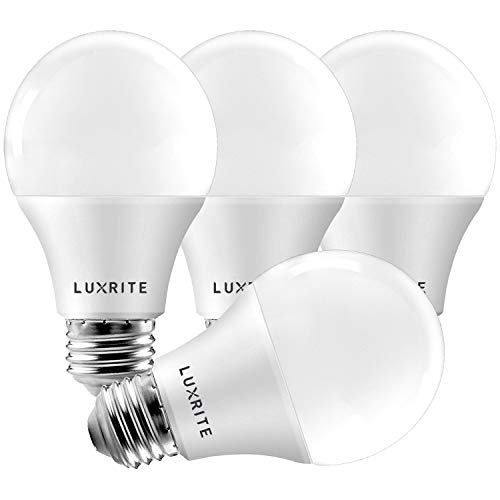 LUXRITE B07BHVRVPSLongest lasting
 GE 42977Best known brand
The short version, in plain words
Every light bulb needs a complete loop for electricity to travel around. Power comes from your home wiring, flows into the bulb through one contact, passes through the light-making part, and flows back out through a second contact. This loop is called a circuit.
What happens in the middle depends on the bulb type. Incandescent bulbs make light from heat. LED bulbs make light from the way electrons behave inside a special material. Both turn electrical energy into light, but they do it in very different ways.
Step by step: how an incandescent bulb works
The classic bulb is easy to picture, so it is the best place to start. Here is what happens from the moment you flip the switch.
Tungsten is the usual filament metal because it can get extremely hot without melting. The glass bulb keeps air away from the filament. Oxygen would make a white-hot wire burn up almost at once, so the bulb is either emptied of air or filled with an inert gas.
- You flip the switch. This closes a gap in the circuit, so electricity can flow.
- Current enters through the metal tip at the bottom of the base.
- It travels up a support wire to the filament, a very thin coil of metal.
- The filament resists the flow of electricity. That resistance turns electrical energy into heat, a process called Joule heating.
- The filament heats up until it glows white-hot, and that glow is the light you see.
- Current leaves through a second wire to the metal screw shell of the base, then returns to the wiring in the wall.
What the circuit looks like
Think of a bulb as one stop on a loop. The switch is a gate on that loop. When the gate is open, nothing moves. When it is closed, current flows around the loop and the bulb lights.
In your home the supply is alternating current, which reverses direction many times a second. A filament does not care which way the current runs, because heat is made either way. The base has two separate contacts, the screw shell and the tip at the bottom, and a small insulator keeps them apart so the current has to travel through the filament.
This is also why a burned-out incandescent bulb stays dark. When the filament breaks, the loop is no longer complete, so no current can flow.
Step by step: how an LED bulb works
An LED, short for light-emitting diode, has no filament and nothing that burns. Its light comes from a tiny chip made of semiconductor material. The chip has two layers, and electrons move across the boundary between them. As they cross, they give off energy as light. Physicists call this electroluminescence.
Most LEDs in household bulbs produce bluish light at first. A yellowish coating called a phosphor sits over the chip and converts part of that light, so the mix looks white. A different coating mix gives a warmer or cooler look, which is how makers get a color temperature such as 2700K or 3000K.
LEDs run on low-voltage direct current, while your wall supplies alternating current. So an LED bulb has a small circuit board in the base, called a driver, that converts the power. The chips also give off some heat, and a metal or plastic body helps carry that heat away. That is why an LED bulb has a thicker base than its thin glass shape suggests.
How bulb types compare
The table below summarizes the main differences in how the common types work. For the numbers on current LED bulbs, see the figures after the table.
On our best light bulbs page, a typical A19 LED uses about 9 watts and gives about 800 lumens, which is the light you would expect from a 60W incandescent. The bulbs on that page list rated lifespans from 10,000 to 25,000 hours. Lumens measure how much light a bulb puts out, while watts measure how much power it draws.
| Type | How it makes light | What to know |
|---|---|---|
| Incandescent | Electricity heats a tungsten filament until it glows | Simple and warm, but most of the energy becomes heat |
| Halogen | Same idea, with a special gas around the filament | A hotter, brighter version of the incandescent design |
| CFL | Electricity excites gas in a tube, and a coating turns the glow into visible light | Needs a short warm-up and contains a small amount of mercury |
| LED | Electrons cross a semiconductor chip and release light | Runs cooler and uses a driver circuit in the base |
Safety notes before you handle bulbs
Bulbs are simple, but sockets carry household electricity. A few habits keep changing a bulb safe.
If you are changing a bulb in a ceiling fixture, use a stable stepladder and keep your weight centered. Do not stretch from the top step. If a bulb breaks in the socket, switch off the circuit at the breaker before reaching in, and wear eye protection when picking up glass.
- Turn the light off at the switch and let the bulb cool first. Incandescent and halogen bulbs can burn skin.
- Never touch the inside of a socket while the power is on.
- Stay within the maximum wattage printed on the fixture, and check that the base type matches. Many A19 bulbs use an E26 base.
- Use bulbs with a UL listing or similar safety certification when you can.
- Only use a dimmable bulb on a dimmer, and check that the two are compatible.
Choosing a bulb once you understand how it works
Knowing how bulbs make light helps you read a package. Watts tell you how much power the bulb uses, lumens tell you how bright it is, and color temperature tells you how warm or cool the light looks. Color accuracy, shown as CRI, tells you how natural colors appear.
For example, the TJOY 8-pack in our data is an A19 LED rated at 9 watts, 800 lumens, 3000K and CRI 85. The LUXRITE option is rated at 800 lumens and 2700K, and lists 25,000 hours of life. If you want a side-by-side view of these and others, our best light bulbs comparison lays out the specs in one place.
If you are looking for a bulb for a specific job, such as a workshop, our best work light page covers lights built for that purpose. For a garage opener, our best light bulb for garage door opener page covers bulbs suited to that fixture.
Frequently asked questions
Why do incandescent bulbs burn out?
The filament slowly wears thinner as it gets hot, and eventually a weak spot breaks. That opens the circuit and the bulb goes dark.
Why does an LED bulb still get warm?
The chip and the driver circuit both give off some heat. The bulb's body is designed to carry that heat away, so the bulb feels warm but is usually much cooler than an incandescent.
How would I explain a light bulb to a child?
Say that electricity runs in a circle, like a race track. On its way around, it passes through the bulb. In an old bulb it makes a thin wire so hot that it glows. In an LED it makes a tiny chip shine.
What does the base of a bulb do?
The base holds the bulb in the socket and has two metal contacts that link it to the circuit. A small insulator keeps those contacts apart so the current has to go through the light-making part.