How Does a Fluid Extractor Work?
A fluid extractor creates a vacuum, either by hand, with compressed air or with a 12V motor, and outside air pressure then pushes fluid up a thin tube and into a sealed tank or container. You feed the tube down the dipstick tube, run the pump, and the old oil comes out the top instead of the drain plug. That means no lifting the car and no crawling underneath.
 VEVOR YS-087BBest overall
 Lustriix QDSDCYBBest compact dual-mode
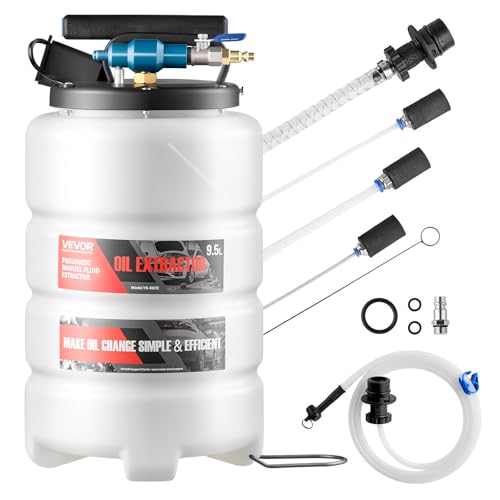 VEVOR YS-087CLongest tube
The basic idea: vacuum does the lifting
Think of drinking through a straw. When you suck air out of the straw, the air pressure around the drink pushes the liquid up into your mouth. A fluid extractor does the same thing, only with a pump instead of your lungs.
The tank is sealed. When the pump removes air from inside it, the pressure in the tank drops below the pressure outside. A tube runs from the tank into the engine's oil pan or another reservoir. The higher outside pressure pushes fluid up the tube and into the tank, and it keeps flowing until the pump stops or the tube sucks air.
This is why a tight seal matters so much. A loose lid or a worn O-ring lets air leak in, the vacuum weakens and the flow slows or stops. It is also why the tube needs to reach the bottom of the pan, where the fluid collects.
The main parts
Most tank-style extractors share the same handful of components, so once you know them you can read any spec sheet with confidence.
- Tank: a sealed container that holds the extracted fluid. Some are semi-transparent so you can watch the level rise.
- Pump: the part that makes the vacuum. It can be a hand pump, an air-compressor connection or a 12V motor.
- Main tube: the thicker tube that connects to the tank. The VEVOR 9.5L model, for example, lists a 59 in main tube, while the VEVOR 15L lists 39.37 in.
- Extension tubes: thinner tubes in different diameters that slip into the dipstick tube. The VEVOR 15L comes with two, and the Lustriix 6.5L comes with three.
- Seals and O-rings: these keep the tank airtight so the vacuum holds.
- Drain valve or pour spout: this lets you empty the tank into a waste container.
Manual, pneumatic and electric types
The way the pump makes its vacuum is the biggest difference between models. All of them still rely on the same pressure principle described above.
A manual extractor has a hand pump on the tank. You work the pump a number of times to build vacuum, then the fluid flows on its own. It needs no power, so it works in a driveway, on a boat or beside a lawn mower.
A pneumatic extractor connects to an air compressor. Compressed air rushing through a fitting inside the pump pulls air out of the tank, which makes the vacuum for you. Many tank models are dual-mode, meaning they offer both a manual pump and an air connection. The VEVOR 15L and 9.5L, the Lustriix 6.5L and the EWK 6.5L all list both modes. The EWK lists a rate of up to 1.8 L/min.
An electric extractor uses a 12V motor, often wired to the car battery. The Harpy Eagle in our data is a 100W 12V pump with a listed rate of 0.95 L/min. It moves oil through hoses into a container you provide and runs hands-free once it is set up.
How the pump types compare
Here is how the three power sources line up, using the models in our data as examples.
If you want to see more models laid out on one spec sheet, our best fluid extractor page lists tank sizes, tube lengths and power sources together.
| Type | What powers it | Example from our data | Good for |
|---|---|---|---|
| Manual | Hand pump | Dual-mode models include a manual mode | Outdoor jobs, boats, lawn equipment, no power nearby |
| Pneumatic | Air compressor | VEVOR 15L, Lustriix 6.5L, EWK 6.5L (all dual-mode) | Faster work in a garage or shop |
| Electric | 12V motor | Harpy Eagle, 100W, 0.95 L/min | Hands-free extraction from a battery |
Step by step: a typical oil extraction
Always check your owner's manual first, since a few engines and vehicles are not compatible with dipstick extraction. For example, the EWK listing notes it does not work with certain Mercedes models.
The usual process looks like this:
- Run the engine for a few minutes so the oil is warm and flows more easily, then switch it off and let it cool a little so it is not dangerously hot.
- Pull the dipstick and choose the tube that fits the dipstick tube snugly.
- Feed the tube down until it reaches the bottom of the pan. You can often feel it stop.
- Connect the tube to the tank and close the vent.
- Pump by hand, connect the compressor or switch on the 12V motor.
- Watch the tank until the flow stops, then disconnect and replace the dipstick.
- Pour the used oil into a sealed container for recycling. Many auto parts stores and local recycling sites accept it.
- Add fresh oil, then check the level on the dipstick.
What size and features to look for
Choose a tank bigger than your engine's oil capacity so the extraction finishes in one go. Our tanks range from 0.2L to 15L, and diesels generally hold more oil than small gas engines.
Tube length and variety matter too. Longer tubes reach deeper into the pan, and several diameters help you match different dipstick tubes. Some kits add a brake bleeder hose, as the Lustriix 6.5L and VEVOR 9.5L do, which gives the tool another use.
Also check which fluids the maker lists. The VEVOR 15L lists engine oil, gear oil, power steering fluid and brake fluid. The VEVOR 9.5L lists engine oil, coolant, brake fluid and transmission fluid. Our best fluid extractor comparison makes it easy to line these up.
Safety notes
Used oil and other fluids can be hot, so let the engine cool before you start. Wear safety glasses and nitrile gloves, since fluids can splash when you pull a tube out.
Do not use a tank extractor on gasoline or other volatile fluids. The Lustriix and EWK listings both warn against this, and the Lustriix also warns against corrosive and high-temperature fluids. Fuel vapors and a pump with electrical parts are a bad mix.
If you use an air compressor, check the pressure rating in the manual and do not exceed it. Wear hearing protection if the compressor is loud. With a 12V pump, connect the clamps to the battery carefully, keep cables away from moving parts and hot exhaust, and keep fluids away from electrical connections.
Never work under a vehicle held up only by a jack. One benefit of an extractor is that you may not need to lift the car at all.
Frequently asked questions
What is a manual fluid extractor?
It is an extractor with a hand pump built into the tank. You pump to create vacuum and fluid flows up the tube without any compressor or battery, which makes it handy away from a garage.
What is an oil extractor pump?
It is the pump or complete tool used to pull used oil out through the dipstick tube. The term can mean a tank-style unit with its own vacuum pump or a standalone electric pump that moves oil into a container.
What is fluid extract?
In car care, people usually mean fluid extraction, which is removing fluid with a vacuum tool. Outside the garage, a fluid extract is a concentrated liquid made from plants or other materials, which is unrelated to this tool.
Does an extractor remove all the oil?
It can remove most of it when the tube reaches the bottom of the pan. Some oil may remain in the filter and passages, so follow your service manual for filter changes.
Can I use one for coolant or brake fluid?
Many models list coolant, brake fluid or transmission fluid, but it varies by product. Check the fluid list for your model and use a clean tank or hose to avoid mixing fluids.