How Do Welding Helmets Work? Auto-Darkening Explained
An auto-darkening welding helmet uses sensors to detect the bright welding arc, then an electronic liquid crystal filter turns dark in a tiny fraction of a second to protect your eyes. Before the arc starts, the lens sits at a light shade so you can see the joint. A cheater lens is a small magnifying lens added inside the helmet to help you see fine detail up close.
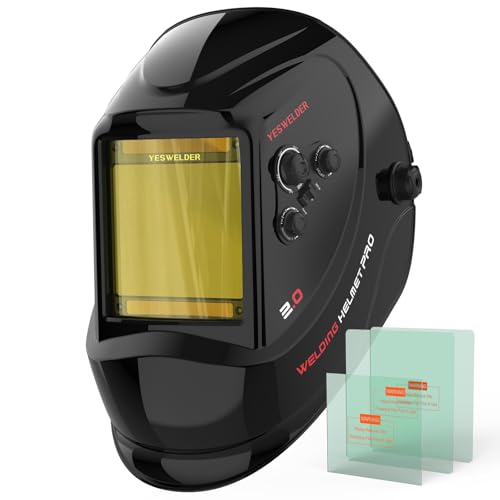 YESWELDER LYG-M800HBest overall
 ARCCAPTAIN Best with built-in light
 YESWELDER LYG-L600A-ABest certified budget
The basic job of a welding helmet
A welding arc gives off intense visible light plus ultraviolet (UV) and infrared (IR) radiation. Looking at it without proper protection can burn the surface of your eyes and damage your vision. The helmet also shields your face and neck from sparks, spatter and UV burns on skin.
Older helmets use a fixed dark lens. You see almost nothing through it, so you position the torch, then nod your head to snap the hood down just before striking the arc. It works, but it is awkward, and it makes precise starts harder.
An auto-darkening helmet solves that by changing the lens on its own. You see through a light shade while setting up, and the lens darkens the moment the arc lights.
How auto-darkening lenses work inside
The lens is called an auto-darkening filter, or ADF. It is built like a sandwich of layers that work together as an electronic shutter.
Two polarizing filters sit on either side of a layer of liquid crystals. In the light state, the crystals let polarized light pass through, so the lens looks clear. When the helmet's circuit applies a voltage, the crystals twist and block the light that passes the first filter from getting through the second. The lens appears dark.
Alongside those layers, the filter includes UV and IR blocking. Some listings, such as the ARCCAPTAIN with Light, describe protection up to DIN 16 against UV and IR. That protection is meant to stay in place whether the lens is light or dark.
What happens when you strike an arc
The sequence is quick, and you never have to think about it. Here is what the helmet does each time you weld:
- Light sensors on the front of the lens watch for the sudden brightness of an arc.
- The control circuit reads the signal and compares it to the sensitivity level you set.
- The circuit applies voltage to the liquid crystal layer, and the lens switches from its light shade to your chosen dark shade.
- When the arc stops, the lens waits for the delay time you set, then returns to the light shade.
Sensors, switching speed and power
Three specs shape how well the process above works in real life. The first is the number of arc sensors. More sensors help the lens keep darkening when your hand, the torch or the workpiece blocks one of them. This matters in awkward positions and for low-amp TIG, where the arc is dim. Our best welding helmet page lists helmets with anywhere from 2 to 6 sensors so you can compare.
The second is switching speed, which is how quickly the lens goes from light to dark. Faster is better because a slow switch lets a brief flash reach your eyes. The YESWELDER LYG-M800H switches in 1/30,000 second, while the ARCCAPTAIN with Light switches in 1/25,000 second.
The third is power. Many helmets use a small solar panel plus a replaceable battery. The YESWELDER LYG-M800H and both ARCCAPTAIN models we list use solar power with a replaceable battery, and the listings name a CR2450 lithium cell. If the lens ever acts sluggish or flickers, a weak battery is a common cause.
Shade, view size and weight compared
Shade numbers tell you how dark the lens gets. A lower number is lighter and a higher number is darker. Many helmets offer a range so one helmet can cover grinding, TIG, MIG and stick. Here is how a few helmets from our data compare:
| Helmet | Viewing area | Arc sensors | Switching speed | Dark shade range | Weight |
|---|---|---|---|---|---|
| YESWELDER LYG-M800H | 14.38 sq in | 4 | 1/30,000 s | 3 to 13 | 1.32 lb |
| ARCCAPTAIN with Light | 14.42 sq in | 4 | 1/25,000 s | 5 to 13 | 1 lb |
| YESWELDER LYG-L600A | 6.08 sq in | 2 | 1/30,000 s | 3 to 13 | 1.1 lb |
| ARCCAPTAIN GT995 | 14.42 sq in | 4 | 1/25,000 s | 5 to 13 | 2 lb |
Light state, grind mode and sensitivity
The light shade matters more than people expect. All the helmets above sit at shade 4 in the light state, which lets you see the work before you strike the arc. In a dim garage, a helmet with a built-in LED, like the ARCCAPTAIN with Light, can help you see the joint even more clearly.
Grind mode is a separate setting. It locks the lens in a light shade so that sparks from a grinder do not trigger it. Grind mode is not a substitute for a proper face shield or safety glasses when you grind.
Sensitivity and delay controls fine tune the lens. Raise sensitivity for low-amp TIG, and lower it if bright shop lights or sunlight trigger the lens by mistake. A longer delay keeps the lens dark while a hot weld puddle still glows.
What is a cheater lens?
A cheater lens is a small magnifying lens, like reading glasses, that fits inside the helmet next to the auto-darkening filter. It magnifies the weld puddle and joint for people who struggle to see fine detail up close. This is common for welders who need reading glasses for close work.
Not every helmet is built for one. Some listings, such as the YESWELDER LYG-M800H and LYG-L600A, state they work with magnifying lenses, so check that spec before you buy. Pick the magnification that suits your eyes, and do not use a cheater lens as a replacement for your prescription glasses unless it is designed for that.
Safety notes before you strike an arc
Auto-darkening helmets are reliable, but they are electronic, and electronics can fail. A few habits will keep you safer:
- Test the lens by looking at a bright light or briefly striking an arc with the helmet on, and replace it if it does not darken.
- Never use a helmet with a cracked lens or shell.
- Keep the front cover lens clean and replace it when it gets pitted by spatter.
- Wear safety glasses under the helmet, since they protect you when you lift the hood to chip slag or grind.
- Wear hearing protection when grinding or working near loud machines.
- Look for ANSI Z87.1 or an equivalent certification, as noted on our best welding helmet comparison.
Frequently asked questions
Can I see the arc if my helmet fails to darken?
Yes, and that is the danger. Stop welding at once and close your eyes if the lens stays light. Fix or replace the helmet before using it again.
Does a bigger viewing area mean better protection?
No. Protection comes from the shade level and UV/IR filtering. A bigger viewing area just lets you see more of the work.
Why does my helmet darken when I am not welding?
Sensitivity may be set too high, or bright light may be reaching the sensors. Lower the sensitivity setting and check that the helmet is not facing a bright window or lamp.
Can I weld with the lens in grind mode?
No. Grind mode keeps the lens light, so it will not protect your eyes from an arc. Switch back to a weld shade before you weld.