How Do Mechanics Move Their Tool Boxes? Rolling, Carrying and Hauling
Most mechanics move their tool boxes in one of three ways: they roll a wheeled chest around the shop, they carry a small box or a detachable top section by hand, or they load a big chest onto a truck or trailer with a lift. Yes, a tool box can be mobile. The right choice depends mostly on how much the loaded box weighs and how far it has to travel.
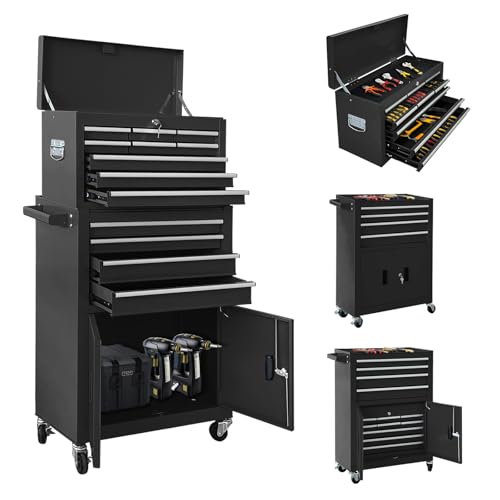 Sormols No.1Best overall
 HAUTMEC HT0428-TCHighest load capacity
 Jack Boss ASRJF-C3002Small carry-along box
The three main ways mechanics move tools
Day to day, most mechanics never lift their main chest at all. They roll it from bay to bay on casters, lock the wheels, and work from it. Casters are the small wheels under the cabinet, and good ones swivel so you can steer in tight spaces.
For jobs away from the main chest, mechanics pull out a small box or a few trays and carry only what the job needs. Some chests are built in two pieces, so the top box lifts off the rolling base and can be carried alone.
The third method is for big moves, such as changing shops or relocating a garage. Large chests are usually emptied in part, strapped down, and moved with a ramp, a lift gate or help from a tow or flatbed truck.
Rolling chests: what to look for
A rolling chest only works well if the wheels and the drawers behave. Swivel casters with brakes let you steer it and then hold it still while you pull out heavy drawers. A handle on the side or top makes pushing easier and keeps your hands out of the drawer fronts.
Drawer control matters just as much. Some boxes have a locking bar or latch system that keeps drawers and doors shut while rolling. Our best tool box for mechanics page lists lock details for each product, so you can check this before you buy.
Here are a few examples from the published specs. The Sormols 13-drawer chest lists 360 degree swivel casters with brakes and a handle. The Goplus 5-drawer chest lists four universal wheels, two of them with brakes, plus a locking bar that holds drawers and the door shut while rolling. The Maxority 7-drawer cart lists four lockable swivel wheels.
Carry boxes and detachable tops
If you work on the road, in a driveway or at a customer's site, a hand-carried box is simpler than a chest. The Jack Boss steel box weighs 5 lb and has a removable tray with compartments, a long handle and two latches. It lists no drawers, so it suits a focused set of hand tools rather than a full shop kit.
The VEVOR 24 in box has five drawers on ball-bearing slides and weighs 27.56 lb empty. It lists metal latches that lock the drawer when closed so it does not slide out during transport.
Two-piece designs split the difference. The Sormols lists a top box and a bottom cart that detach and lock independently. The Goplus lists a detachable box that can be used separately or together with the rolling chest. Keep in mind that a top section gets heavy fast once it is full of sockets and wrenches.
Comparing mobility by weight
Weight is the number that tells you the most about how a box will move. A heavier chest usually carries more, but it is harder to push up a ramp or shift across a rough floor. All weights below are empty weights from the published specs.
The table shows how far apart these options are.
| Product | Style | Empty weight | Mobility feature listed |
|---|---|---|---|
| Jack Boss 16 in | Carry box | 5 lb | Long handle, removable tray |
| VEVOR 24 in | Portable drawer box | 27.56 lb | Latches that lock drawers during transport |
| Goplus 5-drawer | Rolling chest | 38 lb | Wheels with brakes, locking bar |
| Maxority 7-drawer | Rolling cart | 60 lb | Four lockable swivel wheels |
| Sormols 13-drawer | Rolling chest | 73 lb | Swivel casters with brakes, detachable top |
| WORKPRO workbench-style | Heavy chest | 187.39 lb | See listing |
| HAUTMEC 72 in | Workstation | 405.6 lb | Four 6 in casters, 2 swivel and 2 locking |
How to move a loaded chest safely
Moving a full chest is where people get hurt. Steel tools are heavy, and a tall cabinet can tip. Take your time and follow a set routine.
Safety note: never try to lift a heavy chest alone, and never tip it back onto its wheels while it is loaded. If a ramp is steep, get help and use straps.
- Empty the top drawers first, since top-heavy loads tip more easily. Lay tools flat in boxes or bins.
- Engage any drawer locks or latch bars so nothing slides out mid-move.
- Unlock the wheel brakes, then push rather than pull so you can see your path.
- Go slowly over thresholds, cords and cracks, which can stop a caster and tip the cabinet.
- On a truck or trailer, strap the chest through its frame, set the wheel brakes and block the wheels so it cannot roll.
- Wear sturdy boots, and gloves if you handle sharp edges.
Choosing a box that fits how you move
Start by deciding how often and how far your tools travel. If the box stays in one shop, a big chest is fine, and a workstation like the HAUTMEC, which lists 15 drawers and 1600 lb of load capacity, can make sense. If you change locations often, a lighter chest or two smaller boxes are easier to handle.
Next, match wheels and slides to your load. Ball-bearing slides help loaded drawers open smoothly, and our page notes that the Sormols, HAUTMEC, Maxority and WORKPRO list them. Also check whether the maker publishes a load capacity, since many models do not.
If you are still building your kit, a good set can reduce what you have to move. Our best tool set for mechanics page compares sets side by side, which helps you carry only the tools you actually use.
Frequently asked questions
Can you get a mobile tool box for mechanics?
Yes. Rolling chests with casters, portable drawer boxes with carry handles and small hand-carried boxes are all common. Pick by weight and by how far you need to move it.
Do mechanics take their tool boxes when they change jobs?
Usually yes, since the box is their own. Large chests are often moved by truck or flatbed, so plan help and straps in advance.
Should I empty a chest before moving it?
For big moves, yes, at least partly. Removing the heaviest tools lowers the tipping risk and makes ramps and lifts safer.
Do locking wheels matter if I rarely move the chest?
Yes. Brakes keep the chest still while you pull out loaded drawers, which is a safety feature as well as a convenience.