How Do Kitchen Faucets Work? Parts Explained
A kitchen faucet is a valve in a decorative housing. Hot and cold supply lines feed a cartridge inside the body, and moving the handle slides or turns parts in that cartridge to set flow and temperature. The water then passes through the spout and an aerator, and on pull-down models a diverter and hose send it to the sprayer.
 Moen 7594SRSBest overall
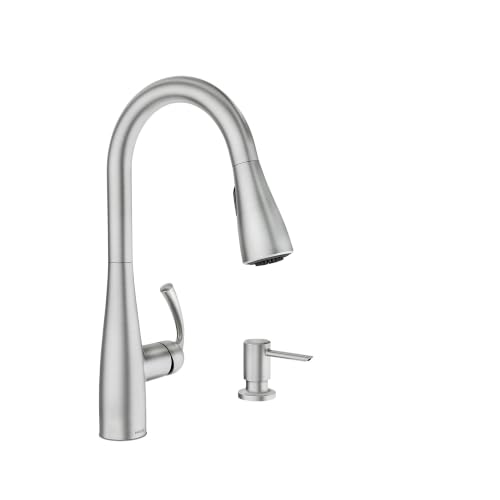 Moen 87014SRSBest for big sinks
 GIMILI GM1019NBest for RVs and small sinks
The water path from wall to spout
Every kitchen faucet starts at the shutoff valves under the sink. Two supply lines, one hot and one cold, run up from those valves into the base of the faucet. Inside the body, the two streams meet at a valve, which is where you decide how much water comes out and how warm it is.
From the valve, water travels through the spout and out the tip. On a pull-down faucet, the spout also holds a flexible hose that links to the spray head. The head can stay docked for normal use or be pulled out to reach the corners of the sink.
Most of what you see, such as the handle, spout and finish, is a housing around that simple path. The parts that actually control the water are small and mostly hidden.
What a kitchen faucet cartridge does
The cartridge is a self-contained valve that sits inside the faucet body under the handle. Your handle connects to it through a stem. When you lift, lower or swing the handle, you move the cartridge's internal parts, which opens or closes the hot and cold passages by different amounts.
In a single-handle faucet, lifting the handle raises flow, and swinging it left or right shifts the mix toward hot or cold. Many modern cartridges use ceramic discs with polished faces that slide against each other. When the discs line up, water flows. When they close, the seal stops it.
Because all the moving parts sit in one unit, a worn cartridge can usually be swapped out without replacing the whole faucet. A drip from the spout or a handle that feels stiff or loose often points to the cartridge.
Cartridge durability is sometimes listed as a cycle rating, meaning how many times the handle can be operated in a lab setting. In the data we compare, the OWOFAN 9009SN-A and the FORIOUS FF0023C each list 500,000 cycles. A higher rating is a useful signal, but it is not a promise about how long any one faucet will last in your home.
What a kitchen faucet aerator is, and why faucets have one
The aerator is the small screw-on piece at the very tip of the spout. Inside is a mesh screen, and often a plastic insert with tiny holes. It breaks one solid stream into many fine streams and mixes air into the flow.
That is why kitchen taps have aerators. The mixed-in air makes the stream feel full and soft, and it cuts down splashing in the sink. Aerators also help limit the flow rate, so a faucet can feel strong while using less water. Our comparison data lists flow rates such as 1.5 gpm for the Moen Arbor and Moen Essie, and 1.8 gpm for the FORIOUS.
On pull-down faucets, the aerator is often part of the spray head, which is why you will see modes described as an aerated stream or a spray. The VFAUOSIT 06MBV, for example, lists an aerated stream mode for non-splash filling and a separate rinse spray.
Minerals can clog the screen over time, which causes uneven spray or lower flow. Unscrewing the aerator and rinsing the screen is usually a quick fix.
The deck plate and how a faucet mounts
A deck plate, sometimes called an escutcheon, is a flat cover that sits on the sink or counter beneath the faucet base. It hides extra holes and gives the faucet a clean footprint. Sinks come with one, three or more holes, and the plate lets one faucet fit different layouts.
If your sink has three holes but your faucet only needs one, the plate covers the other two. If your sink has a single hole, you can usually skip it. Not every faucet includes one. Among the models we list, the Moen Arbor and Moen Essie include a deck plate, while the GIMILI GM1019N and VFAUOSIT 06MBV do not, so a plate would need to be bought separately if you need to cover extra holes.
Mounting hardware under the sink pulls the faucet snug against the sink or counter. Check your hole count and the thickness of your surface before you buy. Our best kitchen faucets page lists mounting hole support for each model so you can match it to your sink.
What a kitchen faucet diverter does
A diverter is a small valve that redirects water from one outlet to another. On a pull-down or pull-out faucet, it sends water to the spray head when you change modes or pull the head out. On older faucets with a separate side sprayer, it sends water to the side hose when you squeeze the sprayer handle.
Think of it as a railroad switch for water. If the diverter gets blocked with mineral buildup, you may notice weak flow from the sprayer or water coming out of the spout when it should not.
The pull-down hose and its docking system work with the diverter. Moen's Reflex system, listed on the Arbor and Essie, is described as providing smooth movement and secure docking of the spray head. A weight or counterbalance on the hose pulls it back so the head sits firmly in the spout. Hose length matters for reach, and the models we compare list lengths from 18 in on the FORIOUS to 68 in on the Moen Arbor.
The parts at a glance
Here is a quick reference for the main parts and what each one controls.
| Part | What it does | Common sign of trouble |
|---|---|---|
| Cartridge | Controls flow and temperature | Drip from spout, stiff or loose handle |
| Aerator | Shapes the stream and limits splashing | Uneven spray, low flow |
| Diverter | Switches water between spout and sprayer | Weak spray, water from wrong outlet |
| Deck plate | Covers extra sink holes | Gaps or uncovered holes |
| Spray hose | Lets the head reach around the sink | Hose snags or head will not dock |
| Supply lines | Bring hot and cold water to the valve | Wet cabinet floor, drips at connections |
Safety notes before you touch a faucet
Most faucet work is simple, but a few precautions are worth following.
Always close the shutoff valves under the sink first, then open the faucet to release pressure. Hot water can scald, so let it cool before removing parts. Wear safety glasses when working under the sink, since drips and debris fall toward your face.
- Turn off both supply valves before removing a handle, cartridge or aerator.
- Put a towel or plug over the drain so small parts do not fall in.
- Wrap tools in cloth to avoid scratching the finish.
- Check the connections for leaks after you turn the water back on.
- Look for lead-free construction and NSF certification, since this water may be used for drinking and cooking. Several faucets on our comparison page list these.
Frequently asked questions
Can I replace a faucet cartridge myself?
Often, yes. Shut off the water, remove the handle and any retaining parts, and pull out the old cartridge. Take it with you so you can match the replacement to your faucet's brand and model.
Why is my faucet spray weak?
The most common cause is a clogged aerator screen. If cleaning it does not help, the diverter or the hose may be blocked by mineral buildup.
Do all kitchen faucets have a diverter?
No. Faucets with only a spout and no sprayer do not need one. Pull-down, pull-out and side-sprayer faucets use one to route water to the spray outlet.
Is a single-hole faucet always easier to install?
Usually it is simpler, because there is only one opening to line up. Faucets that also support three holes give you more flexibility if you change sinks later.