How Do I Know If My Digital Bathroom Scale Is Accurate?
Digital bathroom scales are generally accurate enough for tracking your weight, but you should still check yours. Weigh yourself several times in a row, then weigh something of known weight and compare. If the readings agree with each other and match the known weight closely, your scale is doing its job.
 Etekcity ESF-551Best overall
 GE SC-500500 lb capacity with sync
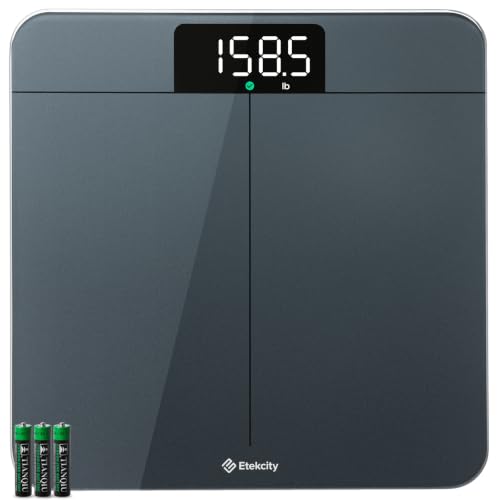 Etekcity EBS-C121-KUSFine 0.05 lb steps
Accuracy and display resolution are not the same thing
Many scale listings talk about fine increments, and that can be confusing. Display resolution is the smallest step the screen can show. Accuracy is how close that number is to your true weight. A scale can show 0.05 lb steps and still be off by a pound if it has drifted or is sitting on a bad surface.
On our best digital bathroom scale page, display resolution runs from 0.05 lb to 1 lb among the products that list it. For example, the Etekcity ESF-551 lists 0.05 lb steps, the GE SC-500 lists 0.1 lb, and the EatSmart Precision Plus lists 0.2 lb. A finer step helps you see small changes, but it does not prove the number is right.
Published specs also come from the maker. We compare those specifications, so the checks below are the way to learn how your own scale behaves.
Start with a repeatability check
The easiest test needs nothing but the scale. A good scale gives the same answer when nothing has changed. Do this on a hard, flat floor, with the scale in its usual spot.
Some scales have a calibration routine that runs when you step off. The Vitafit VT726 listing, for example, says a "CAL" message after you step off means the first reading was wrong and you should step on again. Check your manual to see whether yours does something similar.
- Step on, wait for the number to settle, and write it down.
- Step off, wait for the display to go blank, then step on again and record the reading.
- Repeat three to five times without changing clothes or what you hold.
- Compare the numbers. They should match or differ by no more than one display step or so.
Check it with a known weight
Repeatability only tells you the scale is consistent. To find out whether it is correct, you need something with a known weight. A scale can be consistently wrong.
Free weights such as dumbbells or a kettlebell are handy, but check the printed weight on them, since cast weights can vary a little from the label. Sealed items with the weight printed on the package also work. A digital kitchen scale can confirm the weight of smaller test items before you use them.
Weigh the object by itself if it is light enough, since many bathroom scales read poorly at very low loads. Otherwise, weigh yourself, then weigh yourself holding the object, and subtract. Repeat the process a few times and compare the difference with the known weight.
Test at different loads and positions
Accuracy can change across the platform. Weigh yourself standing in the center, then shift your feet slightly toward each edge. A well-built scale should stay close to the same number. A big swing suggests a sensor or placement problem.
Scales with more sensors may handle off-center standing better, but that is a general design point, not a promise. The GE SC-500 and EatSmart Precision Plus both list four sensors. Still, test your own scale and do not rely on the count alone.
If you can, check at two or three different loads. Stack a couple of known weights, or compare your own weight with and without a heavy object. A scale that is right at one load but off at another may be drifting.
What your results mean
Use this table to read what you found. These are practical rules of thumb, not published standards.
If your scale is not consistent, work through the setup fixes in the next section before assuming it is broken.
| What you see | Likely meaning | What to do |
|---|---|---|
| Readings differ each time you step on | Unstable placement or low battery | Move to a hard floor and replace batteries |
| Readings match but known weight is off | Consistent error or calibration drift | Recalibrate if your model allows it, or replace |
| Reading changes near the edges | Sensor or platform issue | Stand centered and consider replacing |
| Readings match known weights | Scale is working well | Keep using it in the same spot |
| Dim or flickering display | Weak batteries or failing electronics | Swap batteries, then retest |
Fix the common causes first
Most bad readings come from setup, not from a faulty scale. Carpet is the biggest one. A soft surface lets the feet sink unevenly, so use a hard, level floor such as tile or wood.
Moving the scale can also throw it off. Some models recalibrate each time they are lifted, so set it down, let it reset, and weigh after it settles. Keep your weight spread evenly on both feet and stand still until the number locks.
Weak batteries can cause odd or fading readings. The Etekcity EBS-C121-KUS listing mentions a low battery indicator, which is a useful cue. Replace batteries when you see low power warnings, then repeat your checks.
- Use the same spot every time.
- Weigh at the same time of day, ideally before eating.
- Wear the same clothing, or none.
- Do not let the scale get wet or sit on a damp floor.
Safety, tracking and when to replace
Tempered glass platforms can be slippery, especially with wet feet. Dry your feet before stepping on, and do not stand on a platform edge. If you test with dumbbells or a kettlebell, lift with your legs and keep the weight low. Do not drop weights onto the platform, and stay under the listed capacity, which on our page ranges from 330 lb to 550 lb.
For trends, one reading matters less than the pattern. Weigh at the same time each day and watch the direction over a week or two. Small day-to-day shifts are normal because of water, food and other factors.
Consider replacing your scale if it fails repeatability, gives wildly different edge readings, or keeps showing dim or wrong numbers after a fresh battery change. When you shop, compare capacity, display steps and platform size on our best digital bathroom scale page, then run these same checks when the new one arrives. If you need much finer measurement for small items, a different category such as the best digital scale 0 01 gram accuracy page is a better fit than a bathroom scale.
Frequently asked questions
Are digital bathroom scales more accurate than mechanical ones?
They are usually easier to read and give finer steps, which helps with tracking. That is not the same as being more accurate, so check yours with the repeat and known-weight tests.
Should I match my scale to the one at the doctor's office?
It can be a useful rough comparison. Weigh yourself at home right before or after, wearing similar clothes. Expect small differences, since scales and clothing vary.
Can I calibrate my digital bathroom scale?
Some models have a calibration step or recalibrate on their own when you step off, while many have no user calibration at all. Check your manual and the maker's instructions.
How often should I check my scale?
Do a quick check when you first set it up, after replacing the batteries, and any time the readings seem odd. Otherwise, a few times a year is plenty.
Does a higher capacity scale lose accuracy for lighter people?
We do not have published data showing that. Choose a capacity comfortably above your weight, then confirm the scale behaves well with your own checks.