How F Clamps Work and Why They Hold So Well
An F clamp has a fixed jaw at one end of a stiff bar and a sliding jaw that you move to meet the work. A screw or a trigger mechanism locks the sliding jaw in place, and the bar keeps the jaws lined up while pressure builds. They hold well because the mechanism cannot slip backward under load and the bar resists bending.
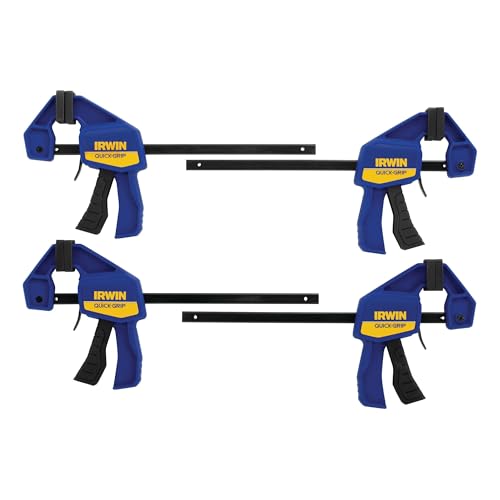 IRWIN 1964758Lightest listed clamp
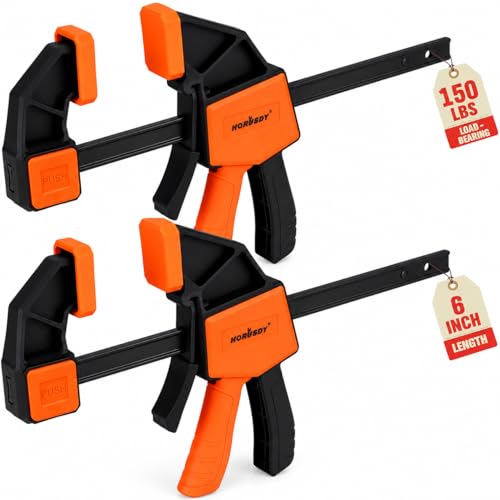 HORUSDY 88026Spreader in a two-pack
 Jorgensen 93424ALong reach, 24 in opening
The basic parts of an F clamp
The name comes from the shape. A long bar forms the spine of the "F," a fixed jaw sits at one end, and a movable jaw slides along the bar to form the arm. Your workpiece goes between the two jaws.
Every F clamp does the same job in three steps. You slide the movable jaw until it touches the work. You tighten the mechanism so the jaws press inward. The mechanism then locks, so you can let go and the clamp keeps squeezing.
- Bar: the rail the movable jaw rides on. It sets the maximum opening.
- Fixed jaw: the stationary end that takes the opposing push.
- Sliding jaw or head: the part that moves and carries the locking mechanism.
- Handle or trigger: where your hand adds force.
- Jaw pads: soft faces that spread pressure and protect the surface.
How the locking mechanism creates grip
There are two common ways to tighten an F clamp, and they work differently.
A screw-type clamp uses a threaded rod. Turning the handle pushes the jaw forward by a tiny amount per rotation. Threads act like a very long, thin ramp wrapped around a rod, so a small turning effort from your hand becomes a large pushing force at the jaw. The ramp is so shallow that the load cannot spin the screw backward, which is why the clamp stays tight.
A trigger or quick-grip clamp uses a different trick. The sliding head contains a small plate or set of plates with a hole slightly larger than the bar. When you squeeze the trigger, the plate tilts and bites into the bar, then pushes the head forward a little. When you let go, a spring keeps the plate tilted, and the tilted plate wedges against the bar and refuses to slide backward. Pressing the release lever straightens the plate, and the head slides freely again.
That wedging action is why a trigger clamp can be set with one hand and still stay put while glue dries.
Why the bar and jaws matter so much
Squeezing a joint creates an equal push back through the clamp. The fixed jaw, the bar and the sliding jaw form a loop that carries that load. If any part flexes, the jaws tilt and pressure drops or becomes uneven.
This is why bar design matters. One light clamp on our best f clamps page is built with hardened steel bars to resist flexing and bending. Another listing describes an I-beam bar design for the same reason. Thicker or shaped steel resists bowing, so the jaws stay closer to square.
Jaw faces matter too. Standard jaws can pivot slightly and press harder at one edge. Parallel jaw faces stay flat against the work, so pressure spreads across a full panel edge. The CRAFTZONE 36 in clamp is listed with parallel jaws and 1500 lb of clamping force, which suits wide glue-ups where even contact counts.
Force, reach and opening: what the numbers mean
Three specs describe how an F clamp behaves in real work. Clamping force is how hard the jaws press. Max opening is the widest piece the clamp holds. Throat depth is the distance from the bar to the center of the screw, which controls how far from an edge you can clamp.
Force varies a lot by style. Light trigger clamps on our comparison page list 140 lb to 350 lb. Heavy screw-type and parallel clamps list far more, with the Wilton GSM30 listed at 2660 lb and a 5.5 in throat, both the highest on the page. More force is not always better. Trim and small repairs need only modest pressure, while hardwood glue-ups need more.
| Clamp style | How it tightens | Listed example from our page |
|---|---|---|
| Light trigger clamp | Squeeze trigger, tilted plate wedges on the bar | IRWIN 1964758: 140 lb listed, 0.25 lb per clamp |
| Trigger clamp with spreader | Same wedge action, jaw can be reversed | IRWIN 1964720: 300 lb, 24 in opening |
| Parallel jaw clamp | Handle drives the head, flat jaw faces | CRAFTZONE 36 in: 1500 lb, 36 in opening |
| Heavy F-clamp | Threaded screw | Wilton GSM30: 2660 lb, 5.5 in throat |
Clamp mode versus spreader mode
Many trigger clamps can also push outward. On models with a quick-change button, you remove the movable jaw and reverse it, so the clamp pushes parts apart instead of pulling them together. The HORUSDY 2-pack and the IRWIN 24 in clamp both list this spreader function.
That is handy for holding a frame square, seating a panel in a rabbet, or nudging parts apart for a repair. The same physics applies. The wedge lock still holds against the load, only in the other direction.
Using F clamps safely and getting a better hold
A few habits improve the result and lower the chance of injury. Start with the safety points, then the technique.
Wear safety glasses, especially in spreader mode or when working near a joint under spring tension. A clamp that slips can snap back or fling a piece. Keep fingers out of the gap between the jaws and the work, and release trigger clamps with a hand ready to support the piece. Never use a clamp as a hoist, a hold for lifting, or a stand-in for a proper support. Do not extend the handle with a pipe or hammer the clamp tighter, because that can bend the bar or crack a nylon body.
For better holding power:
- Dry-fit first, so you know where each clamp goes before glue is wet.
- Put the work as close to the bar as the design allows. A long reach adds leverage on the bar and can make it bow.
- Use soft pads or scrap wood to protect the surface and spread the load.
- Alternate clamps above and below a wide panel to keep it flat.
- Tighten until the joint closes with a thin line of squeeze-out, then stop. Extra force can starve a joint of glue.
Choosing a clamp that fits the job
Start with the widest piece you will hold and add a little margin. Short 6 in and 12 in clamps suit trim and small frames, while panels need 24 in or more. If one bar is too short, some sets include a connector that joins two 12 in clamps to reach over 24 inches, and another set lists connectors that fit 6x18mm I-bars from other makers.
Then look at force and throat depth for the work you do most. Our best f clamps comparison puts these specs on one sheet and notes when a maker leaves one out, so you can match the numbers to your project.
Frequently asked questions
Why does a trigger clamp not slip back after I let go?
A small plate inside the head tilts against the bar when you squeeze. A spring holds it tilted, and that angle wedges the plate against the bar so it resists sliding backward until you press the release.
Do F clamps need pads?
Pads are not required for the clamp to work, but they protect finished wood and spread pressure. If your clamp has bare jaws, place scrap wood between the jaw and the work.
Can I overtighten an F clamp?
Yes. Too much force can bend the bar, dent the wood or squeeze too much glue out of a joint. Tighten until the joint closes firmly, then stop.
What is the difference between an F clamp and a C-clamp?
Both squeeze with a screw or lock, but an F clamp slides along a long bar so you can change the opening quickly. A C-clamp has a fixed frame, so its opening range is much smaller.