How Concrete Vibrators Work and What They Are Used For
A concrete vibrator is a tool with a rapidly shaking head that you push into freshly poured concrete. The shaking lets trapped air escape and helps the mix settle tightly around rebar and into corners. The result is denser, stronger concrete with fewer voids and a better surface.
 XtremepowerUS 61064Best overall
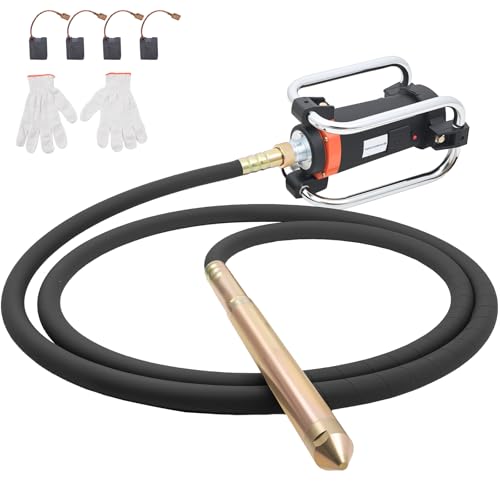 MECHINHUB MGCCFastest vibration, longest reach
 Seeutek SY-BZ-496Wide head, 6.6 ft shaft
What a concrete vibrator actually is
A concrete vibrator is a construction tool that shakes wet concrete right after it is placed. The most common type for DIY and small jobs is the handheld immersion vibrator, also called a poker, pencil or vibrating rod. It has a motor, a flexible shaft and a metal head, often called the needle.
You hold the motor end or handle and lower the head into the pour. The head does the work while it is surrounded by concrete. Other types exist, such as surface screed vibrators and form vibrators that clamp onto formwork, but this guide focuses on the immersion type because it is the one most buyers ask about.
How a concrete vibrator works
Inside the head is an off-center weight, called an eccentric weight, that spins. Because the weight is not centered, each rotation makes the head shake. That shaking is measured in vibrations per minute, or VPM. The motor can sit in the handle and turn the weight through the flexible shaft, which is how corded models like the ones on our spec sheet are built. Battery pencil models work on the same principle.
Fresh concrete is a thick mix of cement paste, sand, stone and water. When you pour it, air gets trapped between the pieces. The vibration briefly makes the mix behave more like a thick liquid. Air bubbles rise to the surface, and the stones and sand slide closer together to fill the gaps. When you pull the head out and the shaking stops, the mix firms up again in its denser state.
This is why vibration works. Air pockets are weak spots, and concrete that is packed tighter has fewer of them. The paste can also flow fully around reinforcing bars and into the corners of a form, so the finished piece grips its steel better.
What concrete vibrators are used for
The purpose is consolidation, which means getting the poured mix to settle into a solid, even mass. In practice that covers a few jobs:
- Removing air pockets from deep or thick pours such as footings, foundations and pedestals.
- Helping concrete flow around dense rebar in columns, walls and ring beams.
- Reducing honeycombing, which shows up as rough, stony gaps on the face of a wall after the forms come off.
- Improving the surface finish against formwork so the face is smoother.
- Helping layers bond when you pour in lifts, by pushing the head slightly into the layer below.
Choosing a vibrator by head size and power
Head diameter decides how much concrete the vibrator treats at once and whether it fits between rebar. Larger heads suit thick slabs and footings. Smaller heads fit tight steel and narrow forms. Shaft length sets how far you can reach without moving. Our best concrete vibrator page puts these specifications side by side.
Power and frequency should be read together. On our spec sheet, the 2200 W XtremepowerUS 61064 runs at 5000 VPM, while the 1500 W MECHINHUB reaches 18000 VPM. A higher wattage does not automatically mean faster vibration.
| Head diameter | Models on our spec sheet | Typical fit |
|---|---|---|
| 1.375 in | XtremepowerUS 61064, Seeutek SY-BZ-496 | Thicker slabs and footings |
| 1.125 in | DEWALT DCE531M1 (cordless) | Mid-size pours, tighter rebar |
| 1 in | Makita XRV02T and XRV01Z (cordless) | Narrow forms, dense rebar, small jobs |
Corded or cordless
Corded models on our list run 1500 W to 2200 W on 110 V and suit bigger pours where you need steady power. Cordless models list 18 V or 20 V and weigh 7.7 lb to 11.4 lb. They suit small jobs and sites without an outlet.
Runtime matters on battery tools. The Makita XRV02T lists up to 41 minutes of runtime, and the XRV01Z lists 25 minutes. If your pour takes longer than that, plan for spare batteries. You can compare more details on the concrete vibrator comparison page.
How to use one correctly
Technique matters as much as the tool. Too little vibration leaves air behind. Too much can push the stones down and let the paste and water rise to the top, which weakens the mix.
A simple routine works for most pours:
- Pour the concrete in layers rather than all at once.
- Insert the head straight down, quickly, and let it sink under its own weight.
- Hold it in place for a short time, until large bubbles stop breaking at the surface and the top looks glossy.
- Pull it out slowly while it is still running so the hole closes behind it.
- Move to the next spot, spacing insertions so each area overlaps the last.
- Do not drag the head sideways through the mix, and avoid resting it against the forms or rebar for long.
Safety notes
Never run the head in open air. One product listing in our data warns that a needle running outside the concrete will overheat, because the surrounding mix helps cool it. Stop and let the tool cool if overload or overheat protection trips.
Corded tools on a wet site call for care. Use a GFCI-protected outlet, keep cords out of puddles and away from the head, and check the cord and plug for damage before each use. Even tools with water resistance ratings, such as the IPX4 or IP68 ratings listed on some models, still need dry, undamaged cords and connections.
Wear hearing protection, safety glasses, waterproof gloves and boots. Wet concrete is caustic and can burn skin, so rinse any splashes promptly. When working at the edge of a deck or on scaffolding, make sure you have secure footing before you start a long shaft or heavy tool.
Frequently asked questions
Can I use a concrete vibrator on any concrete?
Vibrators are meant for wet, workable mixes. Very stiff mixes and very runny, self-consolidating mixes are handled differently, so check the mix specification before you vibrate.
What happens if I skip vibrating a pour?
Air pockets and honeycombing are more likely, especially in deep pours and around rebar. Thin, shallow pours with no steel may need less, but deep or reinforced work usually benefits.
Do I need a vibrator for a small slab?
A thin garden slab is often compacted by hand with a rake or screed. A vibrator becomes more useful as the pour gets deeper, thicker or more heavily reinforced.
Can I rent instead of buy?
Yes, renting is a common choice for a one-off pour. Compare the head size and shaft length of a rental against the specs in this guide before you pick it up.