How Deep and Long Should Garage Shelves Be?
For most garages, shelves 16 to 24 inches deep work best, and 24 inches suits bulky bins, tires and boxed goods. Length is more flexible: freestanding units run roughly 70 to 79 inches wide, while shelves you build yourself stay sturdier when each span is kept to about 4 feet. Measure your bins and your parking clearance first, then choose the smallest size that holds what you own.
 CCIOBTE storage shelvesBest overall
 SISESOL YSZXEHHJTallest at 79 in
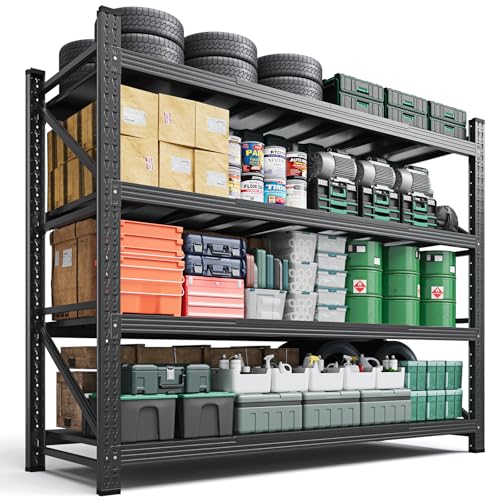 Letaya 1Steel panel shelf surface
Start with what you store, not the wall
The right shelf size comes from your stuff. Shelves that are too shallow let bins hang over the edge. Shelves that are too deep waste space and bury small items at the back where you forget about them.
Before you shop or cut lumber, gather your largest bins, boxes and gear in one spot. Measure the length and width of each, then write down the biggest few. Those numbers decide shelf depth. Your wall length and parking space decide how long the run can be.
How deep should garage shelves be?
Depth is the choice that affects your garage most, because every inch sticks out into floor space. A deeper shelf holds more per level, but it also narrows the walkway or the gap beside your car.
Use the table below as a starting point, then adjust to your own measurements. The 24 inch row matches the depth listed on four of the freestanding units on our comparison page, so it is a common size for ready-made frames.
| Shelf depth | Best for | Watch out for |
|---|---|---|
| 12 to 16 in | Paint cans, small tools, jars, boxes of fasteners, lawn chemicals | Large totes will overhang |
| 18 to 20 in | Mid-size storage bins and most boxed supplies | Can be awkward if you mix big and small items |
| 24 in | Bulky bins, tires, camping gear, bulk goods | Takes more floor space and hides items at the back |
How long should garage shelving be?
Length depends on two things: the wall you have and how much weight each shelf has to carry over its span. A long shelf with no middle support can sag over time, especially under heavy bins.
Freestanding steel units give you a good sense of typical lengths. On our spec sheet, the CCIOBTE 4-tier unit and the SISESOL unit are both listed at 79 inches wide, while the Letaya and BYNSOE units are listed at about 71 inches. One narrow rack on the page lists a 14 inch width, which fits a tight gap but holds less per level.
If you are building shelves from lumber or plywood, shorter spans are stronger. Many builders keep each span to about 4 feet, with a vertical support under every joint. Longer shelves are possible, but they need thicker boards or extra support in the middle.
If your wall is longer than one shelf, do not stretch a single board across it. Place two or more units side by side. Some units list a link-together design, which lets you build a longer storage wall one frame at a time.
Leave room for cars, doors and walkways
A shelf that fits your bins but blocks your car door is the wrong shelf. Park your vehicle in its usual spot, open the doors fully, and measure the gap to the wall. Then subtract the depth you plan to add, and leave a comfortable walking path.
If space is tight, use shallower shelves along the parking side and put deeper units on the end wall or the side that does not touch the car. You can also mix depths: 12 to 16 inch shelves for small items near the door, and a 24 inch unit where you have the room.
Do not forget the bumper area. Garage walls take hits from carts, bikes and open doors, and low shelf corners can snag clothing or scratch paint.
Check the specs before you buy a ready-made unit
Size is only half the story. A deep, wide shelf is useless if it cannot carry your heaviest bins. Our best garage shelving page lists capacity per shelf where the maker publishes it, and that number matters more than the total.
For example, the CCIOBTE unit lists 1500 lb per shelf and 6000 lb in total at 79 by 24 by 73 inches. The Letaya unit lists 5000 lb in total at about 71 by 24 by 70 inches, with solid steel panels. Not every maker lists a per-shelf rating, so check the listing before you count on a single shelf for tools or tires. You can compare these side by side on our best garage shelving page.
Also check height. The tallest unit on that page is 79 inches, and a shorter 69 to 73 inch frame can fit better under a low ceiling or an opener track.
A quick way to pick your size
Follow these steps to land on a size without guesswork:
- Measure your largest bins and boxes, then add an inch or two of space on each side so you can slide them in and out.
- Choose the depth that holds the biggest bin without a large overhang. Round up to the nearest common depth.
- Measure the clear wall length, and subtract room for doors, outlets, the water heater and any panels you need to reach.
- Divide the length into units or spans that stay short enough to support your heaviest loads.
- Mark the footprint on the floor with painter's tape and walk around it with your car parked. Adjust before you buy or cut anything.
Safety notes
Garage shelves hold heavy loads, so a few habits matter. Keep the heaviest items on the lowest shelves and lighter items higher. This lowers the center of gravity and makes tipping less likely.
Anchor tall units to wall studs or masonry using the anti-tip hardware that comes with the unit, or hardware rated for your wall. Never climb on shelves to reach the top level. Use a stable step stool or ladder instead.
When you drill, cut or tighten steel parts, wear safety glasses, and add hearing protection around power tools. Steel edges can be sharp, so wear gloves during assembly. Before drilling into a wall, check for wiring and pipes, and keep shelving clear of electrical panels, gas appliances and their vents.
Frequently asked questions
Are 12 inch deep shelves too shallow for a garage?
Not if you store small items. Twelve inches suits paint cans, jars and hand tools well. It is too shallow for most large totes, so use it only for small goods.
Is it better to have deeper or wider shelves?
Wider shelves with moderate depth are usually easier to use, because you can see everything at a glance. Go deeper only when you must hold large items, and keep the extra depth away from your car.
Can I put shelves above my parked car?
Overhead racks are possible, but they hold weight above you and your vehicle. Use hardware rated for the load, anchor into framing, and keep them to light, well-secured items.
How much space should I leave between shelves?
Leave enough height for your tallest bin plus a few inches to slide it in. Units with adjustable shelves, like several on our comparison page, let you change this later.