Fluid Extractor vs Drain Plug: Which Is Better?
Neither method wins every time. A fluid extractor is better when you want a cleaner, no-lift oil change, or when the vehicle or engine is awkward to get under. A drain plug is better when you want the most complete drain of the pan, and when you need to reach the oil filter from below anyway. Many DIYers use an extractor for routine changes and keep the drain plug for jobs where they are already under the car.
 VEVOR YS-087BBest overall
 Lustriix QDSDCYBBest compact dual-mode
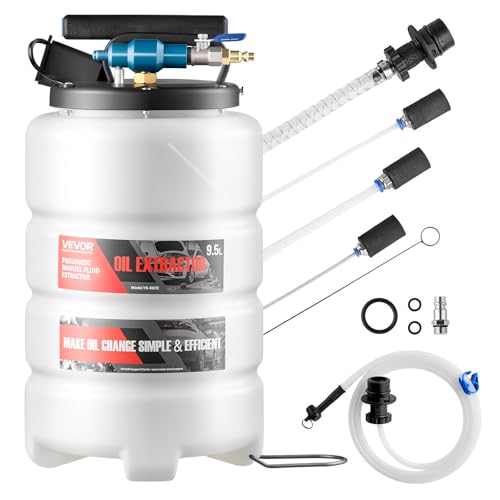 VEVOR YS-087CLongest tube
The short comparison
A drain plug change lets gravity pull the oil out of the pan. You lift the car, support it safely, remove the plug and let the oil run into a pan. A fluid extractor works the other way around. It creates suction and pulls the oil up through the dipstick tube, so the car stays on the ground.
Here is how the two methods line up on the points most people care about.
| Factor | Fluid extractor | Drain plug |
|---|---|---|
| Lifting the car | Not needed | Usually needed (ramps or jack stands) |
| Mess | Low, oil stays in a sealed tank | Higher, oil can spill or splash |
| Thread wear | Plug is never touched | Plug and pan threads see wear each change |
| How complete the drain is | Depends on tube reach and pan shape | Gravity drains from the lowest point |
| Setup | Tank, tubes and a pump or compressor | Wrench, drain pan, usually ramps or stands |
| Access to filter | Does not help | Often easier while you are underneath |
When a fluid extractor is the better choice
The biggest advantage is that you skip the lifting. There is no crawling under the car, no hot oil running down your arm and no plug to drop into a dirty pan. That makes it a good fit for low cars, tight driveways and anyone who does not want to deal with jack stands.
Because the drain plug stays in place, you also avoid the risk of stripping the threads by overtightening it. That risk is small if you use a torque wrench, but it is zero with an extractor.
Extractors also reach places a drain plug cannot. They pull fluid from boats, lawn tractors, motorcycles and small engines where the plug is hard to reach or missing. Our data shows the Harpy Eagle electric pump is marketed for transfer cases and rear axles on vehicles that lack drain plugs, and it handles lawn mowers, ATVs and generators too.
- Best for quick, clean routine oil changes at home.
- Best for boats, small engines and equipment that are hard to tip or lift.
- Best when you want to keep oil off the driveway.
- Useful for other fluids such as transmission fluid, coolant and brake fluid, depending on the model.
When the drain plug still makes sense
Gravity empties the pan from its lowest point. A suction tube sits above that point, and its reach depends on the tube length and the shape of the pan. Some engines have dipstick tubes with bends that make it harder to get a tube all the way down. In those cases a small amount of old oil can stay behind.
The drain plug also gives you a look at what comes out. Metal flakes or sludge on the plug or in the pan are easier to spot when you drain from below.
Finally, the oil filter usually needs to be reached from underneath. If you are going under the car anyway to change the filter, pulling the plug adds very little extra work.
Check your owner's manual too. Some manufacturers specify a drain plug change, and a few engines are not suited to extraction. For example, the EWK 6.5L listing warns that it is not compatible with the Mercedes W212 E350 or C218 CLS 350.
How an extractor oil change works
The steps are similar for most models. Follow your own extractor's manual for the exact order.
- Run the engine for a few minutes so the oil is warm and flows easily, then switch it off.
- Remove the dipstick and choose a tube that fits the dipstick tube, pushing it in until it reaches the bottom of the pan.
- Connect the tube to the extractor, then start pumping by hand, with an air compressor or with a 12V motor, depending on the model.
- Let the tank fill until the flow stops, then remove the tube slowly to avoid drips.
- Pour the used oil into a sealed container for recycling.
- Change the filter if due, refill with the correct oil and check the level on the dipstick.
Choosing an extractor if you go that route
Three specs matter most. First is tank capacity. It should be larger than your engine's oil capacity, and diesels need more. The 15L VEVOR YS-087B is the largest tank in our data and is dual-mode, meaning pneumatic or manual. The 9.5L VEVOR YS-087C has a 59 in main tube, which helps with reach. The Lustriix 6.5L has three extension tubes and a brake bleeder hose.
Second is how the pump is powered. Manual pumps work anywhere. Pneumatic mode is faster if you have an air compressor. Electric 12V pumps like the Harpy Eagle 100W run hands-free. For speed, the EWK 6.5L lists up to 1.8 L/min, while the Harpy Eagle listing says up to about 1 quart per minute.
Third is tube selection. Several tube sizes help you fit different dipstick tubes. You can see all of these specs side by side on our best fluid extractor page, which is the quickest way to match a model to your engine.
If you are mainly choosing between a hand pump and a powered one, our fluid extractor comparison also lists manual options in 6.5L, 7L and 9L tank sizes, plus a small 200cc syringe-style extractor for small jobs.
Safety notes
Oil from a warm engine can burn skin, so let it cool a little and wear gloves. Wear safety glasses, since oil can splash when you pull a tube out or open a plug.
If you use the drain plug method, never work under a car held only by a jack. Use ramps or jack stands on level ground, and keep wheels chocked.
For pneumatic extractors, stay within the maximum air pressure in the manual and use a regulator. For electric pumps, check the clamps and cable before use and keep the cable away from hot or moving engine parts.
Do not use these extractors with gasoline or other volatile fluids. The Lustriix and EWK listings both say so, and fumes and sparks are a fire risk. Dispose of used oil at a recycling point, never in a drain or on the ground.
Our take
If you change oil at home and value speed and cleanliness, an extractor is an easy method to live with. If you want the most complete drain, or you are already under the car for a filter, the drain plug is hard to beat. Choose based on your engine, your workspace and how comfortable you are working under a raised vehicle.
Frequently asked questions
Do I still need to replace the oil filter with an extractor?
Yes. An extractor removes the oil from the pan but does not change the filter. Follow your service schedule and replace the filter as usual.
Should the engine be warm?
Yes, slightly. Warm oil is thinner and flows through the tube faster. Let it cool enough that it is not scalding.
Can one extractor handle other fluids?
Often. Listings for the models we compare mention transmission fluid, coolant, power steering fluid or brake fluid. Check the fluid types for the exact model, and rinse or dedicate tanks to avoid mixing.
Is it okay to use an extractor on a turbocharged engine?
Often yes, but follow the manufacturer's guidance. Some engines have dipstick tubes that make extraction difficult, so check your manual first.