Exhaust Band Clamp vs U-Bolt Clamp: What Is the Difference?
A U-bolt clamp, often called a muffler clamp, pinches a lap joint with a U-shaped bolt and a saddle, which tends to crush the pipe and leak. An exhaust band clamp wraps a wide strap around the joint and squeezes it evenly, so it usually seals better and comes off more cleanly. For most repairs where the pipe sizes match, a band clamp is the better choice.
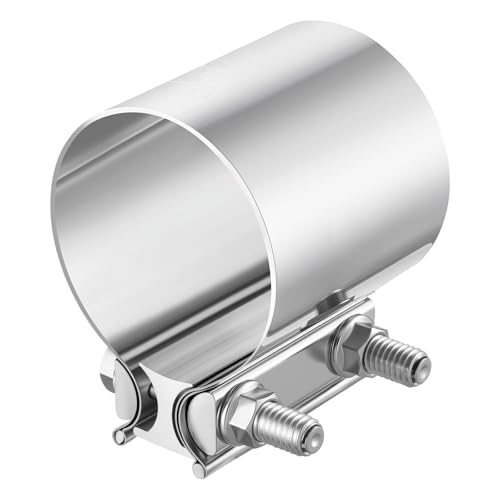 EVIL ENERGY 473SU5TBest overall
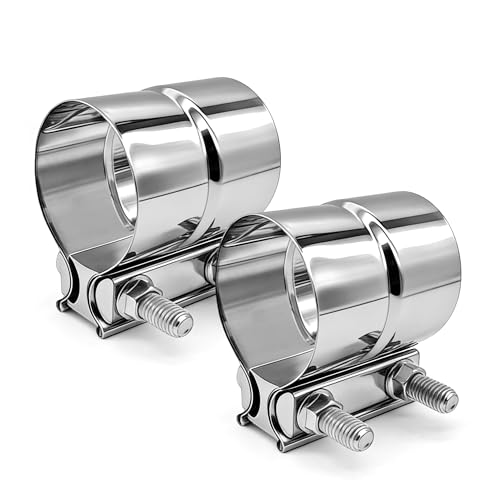 SKYMIRO CPBJ-3IN-2Best double-layer band
 SKYMIRO CPSC-25IN-1Best butt joint clamp
How a U-bolt clamp works
A U-bolt clamp has a U-shaped bolt, a flat or curved saddle and two nuts. You slide one pipe into another (a lap joint), set the saddle on one side and pull the U-bolt tight around the other side. This is the style most people mean when they say "muffler clamp."
The catch is that all the force lands on a narrow strip of the pipe. The clamp bends the outer pipe inward, leaving a crimp or ridge. The rest of the joint can stay slightly open, which is where leaks start. The crimp also makes the pipes harder to pull apart later.
U-bolt clamps are still common because they are simple and work with almost any slip joint. They can hold a joint that is already tight and well shaped. They just are not great at sealing one that is not.
How an exhaust band clamp works
An exhaust band clamp uses a wide metal strap that wraps all the way around the joint. A bolt tightens the strap, and a small block (often called an I-block) sits under the bolt. The strap closes in a full circle, so the force spreads around the pipe instead of pressing on one spot. Several listings on our page describe this as even 360 degree clamping.
Because the pressure is spread out, the pipe keeps its round shape. That helps the joint seal, and it makes the clamp easier to remove and reuse. Most band clamps also need no welding.
Band clamps come in two main types, and it matters which one you buy. A lap joint clamp seals where one pipe slides inside another, such as a pipe into a muffler inlet. A butt joint clamp joins two pipes of the same size end to end. The 2.5 in SKYMIRO butt joint clamp on our best exhaust clamp page, for example, uses a 3.5 in wide band to cover both pipe ends.
Side-by-side comparison
Here is how the two styles compare on the points that matter most for a repair.
| Feature | U-bolt clamp | Band clamp |
|---|---|---|
| Clamping action | Pinches one narrow area | Squeezes all the way around |
| Seal quality | Often leaks, especially on worn pipe | Usually seals better when sized correctly |
| Effect on pipe | Can crush or crimp the pipe | Keeps the pipe round |
| Removal and reuse | Crimp can make pipes stick | Easier to take apart and reuse |
| Joint type | Lap joint | Lap joint or butt joint, depending on model |
| Size fit | Forgiving on pipe size | Must match the pipe outside diameter closely |
| Typical material | Often plain steel | Often stainless steel, such as 304 |
Which one should you use?
Pick a band clamp when you want a leak-free joint, plan to take the joint apart again or want to avoid crushing the pipe. Pick a U-bolt clamp only when you need a quick, basic hold on a joint that is already snug, or when the pipe size is uncertain.
Use this quick checklist to decide:
- You have a pipe sliding inside another pipe: either style works, but a lap joint band clamp seals better.
- You have two same-size pipes meeting end to end: use a butt joint band clamp. A U-bolt clamp cannot do this job well.
- The pipe is thin or already rusty: a band clamp spreads the force and is less likely to crush it.
- You are not sure of the pipe size: measure first. A band clamp that is the wrong size will not seal.
- You want the clamp to resist rust: look for a stainless band. Our guide lists 304 stainless as the best choice for rust and heat.
Band clamp vs V-band clamp
The term "exhaust V-band clamp" causes some confusion. A V-band clamp is a different part. It joins two matching flanges, one on each pipe end, and a V-shaped channel in the clamp pulls the flanges together. You will see these on turbo outlets and some performance systems, and they require flanges to be welded onto the pipes first.
The clamps on our page are sleeve and band style clamps that slip over plain pipe. They need no welded flanges. If your pipes already have flanges, you need a V-band. If they are plain tubes, you need a standard band clamp.
Installing a band clamp safely
Exhaust parts are hot, heavy and awkward to reach, and the gas inside is dangerous. Let the system cool fully before you touch it. Support the vehicle on jack stands, never on a jack alone, and wear safety glasses because rust and debris fall when you work under a car. Leaks can let carbon monoxide into the cabin, so check the joint when you are done and do not run the engine in a closed garage.
Follow these steps:
- Measure the outside diameter of the pipe and match it to the clamp. The clamps on our page fit 2.5, 2.75 or 3 in pipe.
- Clean the pipe ends with a wire brush so the joint is free of rust and loose scale.
- Fit the pipes together and slide the clamp over the joint. Center it so the band covers the overlap, and keep it clear of the rolled edge of the pipe.
- Tighten the nuts a little at a time, alternating sides if the clamp has two bolts, until the band is snug all the way around.
- Tighten to the maker's torque spec if one is given. One listing on our page, the EVIL ENERGY 3 in clamp, gives 63 N·m.
- Start the engine outdoors and check for leaks by sound. Retighten after the first heat cycle if the maker advises it.
Frequently asked questions
What is a muffler clamp?
A muffler clamp is usually a U-bolt clamp with a saddle. It holds a pipe that slides into a muffler or another pipe. Some people also use the term for band clamps that do the same job.
Can I put a band clamp over a U-bolt crimp?
It is best not to. A crushed or ridged pipe leaves gaps the band cannot close. Cut back to a round, clean section of pipe if you can, or replace the damaged piece.
Are band clamps reusable?
Many can be removed and refitted without welding, and one listing on our page says its clamp can be reused. Inspect the band, bolt and nut each time. Replace any part that is stretched, cracked or badly rusted.
Do I need a gasket with a band clamp?
It depends on the model. Some packs include a gasket and some do not. The EVIL ENERGY 2-pack on our page lists a gasket as included, so check the contents before you buy.