Engine Hoist vs Crane: What Is the Difference?
An engine hoist, an engine crane, a shop crane and a cherry picker are the same tool: a wheeled, folding frame with a hydraulic boom. The real difference is between that tool and a gantry crane, which lifts from an overhead beam on legs. For most home garages with limited space, a folding engine hoist is the practical pick.
 Garvee bGc-OaKS-Gnv75Tn3-XOiBest overall
 Maxsa Innovations bxt-zZ9Zfp9tz6J8R1c-P-sVYbkDuLightest hoist
 Maxsa Innovations YellowHeaviest-built frame option
Are an engine hoist and an engine crane the same thing?
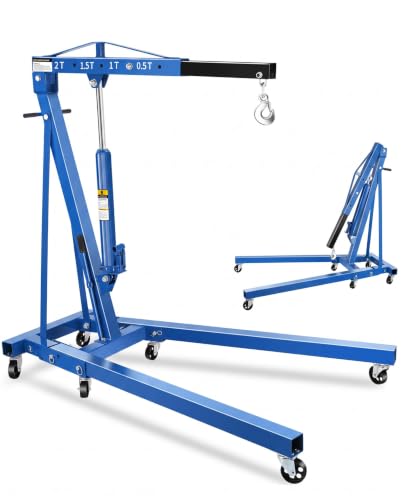
Yes. People use engine hoist, engine crane, shop crane and cherry picker for the same machine. It has a hydraulic ram that raises a boom, a chain or hook at the end of the boom, and a set of casters on a legged base. The names vary by region and by seller, not by function.
The word crane can confuse things, because in industrial work it covers many machines. A hoist, strictly speaking, only lifts and lowers a load. A crane lifts and also moves it sideways. A wheeled engine hoist does a little of both: the ram lifts, and you roll the whole frame to move the load. So it is a small crane that happens to be called a hoist.
How an engine hoist works
The legs straddle or reach beside the vehicle. The boom extends forward over the engine bay, and you pump a hydraulic jack to raise the hook. Once the engine clears the vehicle, you roll the hoist backward and lower the engine onto a stand or a cart.
Because the load hangs out in front of the frame, the boom position matters. The usual rule is that capacity is highest with the boom retracted and drops as you extend it. The listings in our data show four boom positions marked 0.5, 1, 1.5 and 2 ton, and the 2 ton mark applies at the shortest setting. Our best engine hoist page lists the rating and reach for each model so you can check the position you will actually use.
- Lifts with a hydraulic ram, so no hand-cranked winch is needed
- Rolls on casters, so one tool can move the load as well as raise it
- Folds for storage, which is why it suits home garages
- Works from one side of the vehicle, with the boom reaching over the bay
How a gantry crane is different
A gantry crane is a horizontal beam held up by two legs, with a trolley and a chain hoist hanging from the beam. The legs sit on either side of the vehicle, and the beam passes over it. You lift the engine straight up, then slide the trolley along the beam to move it clear.
This layout keeps the load centered between the legs instead of hanging out in front of a boom. That is why many people see gantries as steadier for heavy lifts. The trade-offs are floor space, since the legs and base need room around the vehicle, and ceiling height, since the beam has to be tall enough to clear the hood and the engine. Portable gantries are usually built from aluminum or steel and come apart for storage, but they take longer to set up than a hoist that simply unfolds.
Engine hoist vs gantry crane at a glance
The table compares the two designs in general terms. Specific ratings depend on the model, so check the published capacity before you buy either one.
| Feature | Engine hoist (cherry picker) | Gantry crane |
|---|---|---|
| Lifting method | Hydraulic ram raises a boom | Chain hoist on an overhead beam |
| Moving the load | Roll the whole frame | Slide a trolley along the beam, or roll the gantry |
| Load position | Hangs forward of the frame | Centered between the legs |
| Capacity changes | Drops as the boom extends | Set by the beam and hoist rating |
| Floor space | Smaller footprint, folds away | Wider footprint around the vehicle |
| Setup | Unfold and position | Assemble legs and beam, then adjust height |
| Best for | Home garages and occasional engine swaps | Shops with space, frequent heavy lifts |
What our hoist data shows
The hoists on our comparison page are all 2 ton folding models with six casters. Listed capacities are 4000 lb for two of them and 4400 lb for the other four. Weights run from 100 lb to 147.71 lb, and folded lengths run from 51.18 in. to 64.17 in.
Two features are worth checking. The first is an engine leveler, which tilts the engine as it comes out of the bay. Two of the six listings include one, and one of those lists a 1500 lb leveler rating. The second is boom reach. One model lists a telescopic boom from 38 to 57 in., which helps if the lift points sit far back in the bay. You can see all of these side by side on the engine hoist comparison.
Which one should you choose?
Choose an engine hoist if you work in a typical home garage, lift an engine a few times a year, and need to put the tool away afterward. It is also the better fit if the engine has to be rolled out of the garage or across the floor to a stand.
Choose a gantry crane if you have open floor space, a high ceiling, and plan to lift often. A gantry also helps if you want the load to stay between the legs rather than hang from a boom. If you are unsure, measure your garage first: floor width around the vehicle, ceiling height, and the space where the tool will be stored.
Safety notes before you lift
Engines are heavy and can drop quickly if something fails. Treat every lift as a risk, whichever tool you use.
Work through this checklist each time:
- Check the rating at the boom position you are using, not just the headline capacity.
- Work on a flat, level, hard floor, and lock the casters before lifting.
- Use only the engine's approved lift points, with chains or straps in good condition.
- Never place any part of your body under a suspended load. Move the engine to a stand as soon as it clears.
- Disconnect the battery, drain or secure fluids, and release fuel pressure before disconnecting lines.
- Wear safety glasses and gloves, and keep others away from the work area.
- Lift slowly, and stop if the frame tips or the load swings.
Frequently asked questions
Is a cherry picker the same as an engine hoist?
Yes. Cherry picker is a common nickname for a wheeled hydraulic engine hoist. Some sellers use it in product names, and it describes the same type of tool.
Can I use an engine hoist to lift something other than an engine?
Often yes. Listings mention transmissions, axles and other heavy parts. Stay within the rated capacity at your boom position and use proper lift points.
Do I need an engine leveler?
It helps when the engine must tilt to clear the bay or line up on the mounts. Some hoists include one and others do not, so check the spec list.
What happens to capacity when the boom is extended?
It goes down. Hoists are rated highest with the boom retracted, so match the setting to the reach you need and read the rating for that position.