Do You Really Need a Wood Planer? Alternatives Compared
You do not need a planer if you buy boards already milled to thickness and mostly build small projects. You do need one if you want to turn rough or uneven lumber into boards of a uniform thickness, or if you want to mill your own stock. A sander smooths a surface but cannot make a board an even thickness in any practical way.
 WEN PL1337Best overall
 CRAFTSMAN CMEW320Longest warranty listed
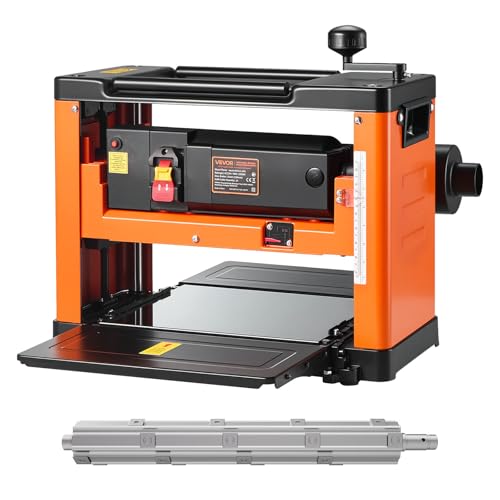 VEVOR M1B-LS-3301Fastest cutterhead speed
What a planer does that other tools do not
A thickness planer shaves wood from the top face of a board while a pair of rollers feeds it through. Do this a few times, flipping the board as needed, and you get two faces that run parallel and a board that is the same thickness from end to end.
That parallel, uniform thickness is the real reason people buy one. Joints close tightly, drawers slide, and panels glue up without steps between boards. Smoothness is a bonus, not the main job.
One honest caveat: a planer follows the shape of the board's bottom face. A cupped or twisted board needs a flat reference face first, made with a jointer, a hand plane or a planer sled. The planer then makes the other face parallel to it.
Planer vs sander: why they are not interchangeable
People often ask about a wood planer vs sander, or wood planer vs sanding, as if one replaces the other. They solve different problems.
A planer removes material in controlled, even passes and sets the thickness. A sander removes material slowly through abrasion and is meant for smoothing, blending and prepping a surface for finish. A handheld sander follows the surface under it, so it tends to round over high spots rather than flatten them.
You can remove a small amount of material with a coarse belt sander or a wide-belt sanding setup, but it is slow, dusty and hard to keep even across a whole board. For a few light fixes, sanding is fine. For bringing rough lumber down to a final thickness, it is the wrong tool.
The two also work well together. A planer leaves a clean surface, and a light pass with fine sandpaper before finishing is usually all that is left to do.
Alternatives to a planer, compared
If you are weighing your options, this table shows what each approach is good at and where it falls short.
| Option | Good for | Main limits |
|---|---|---|
| Buy surfaced lumber (S2S or S4S) | Most projects where stock thickness can match the plan | Limited thickness choices; boards can still move after you bring them home |
| Lumber yard milling | One-off jobs with rough stock | Depends on a local shop and on your schedule |
| Hand plane | Small jobs, quiet work, fixing a few high spots | Slow and takes skill on wide or long boards |
| Planer sled and router | Flattening wide slabs and live-edge pieces | Needs a setup, a flat base and extra time |
| Belt or random orbit sander | Smoothing and light leveling | Cannot reliably set thickness or make faces parallel |
| Benchtop planer | Repeatable thickness across many boards | Takes bench space and needs dust control |
Signs you can skip the planer
Plenty of woodworkers never own one. You can likely do without if most of these describe you:
- You build small items from lumber that is already surfaced.
- You work with sheet goods like plywood for most projects.
- You only need to trim a board once in a while and a hand plane can do it.
- Your shop space is tight and you cannot store or lift a heavy machine.
- You have a local yard that will mill rough boards when you need it.
Signs a planer is worth it
A planer starts to make sense when you buy rough lumber, reuse reclaimed boards, or need several boards at exactly the same thickness. It also helps when a design calls for a thickness you cannot find on a shelf, such as thin drawer sides or thick table legs.
If that sounds like you, the next step is choosing the right size. Our best wood planer page puts several models on one spec sheet so you can compare them side by side.
What to check if you decide to buy
Start with capacity, meaning the widest and thickest board you plan to run. On our comparison, the 13 in models such as the WEN PL1337 and the DEWALT DW735 list a 6 in maximum thickness. The CRAFTSMAN CMEW320 takes boards up to 12.25 in wide.
Next, look at the cutterhead. The WEN lists a spiral head with 26 blades, while the DEWALT DW735 uses three knives. Spiral heads are usually quieter and tear out less on figured grain. Straight knives are often simple to replace when they dull.
Weight matters if you lift the machine onto a bench. Benchtop models on our page run from 60 lb to 91.25 lb, and the DW735 sits at the heavy end of that range. A 20 in shop planer like the JET JWP-208HH weighs 753 lb and is not a benchtop tool at all.
Also check for snipe control, a dust port and warranty details. Several models list anti-snipe features, and the WEN lists a two-year warranty while the CRAFTSMAN lists three years. You can see all of these in one place on our wood planer comparison.
Safety notes
Planers are loud and throw a lot of chips, so wear hearing protection and safety glasses every time. A dust mask is a good idea too, since fine dust builds up quickly.
Unplug the machine before changing knives, clearing a jam or reaching near the cutterhead. Check boards for nails, staples and grit before feeding them, because metal can damage the cutters and throw debris.
Stand to the side of the board path, keep your hands off the board once the rollers have it, and never feed a piece that is too short. Get help lifting heavier machines, since a planer near 90 lb is easy to drop or strain your back on.
Frequently asked questions
Can a hand plane replace a power planer?
For small jobs, yes. A sharp hand plane can flatten and thickness a few boards, but it takes more time and practice on long or wide stock.
Is a planer the same as a jointer?
No. A jointer flattens one face and squares one edge. A planer then makes the opposite face parallel. Many woodworkers use both for rough lumber.
Does a spiral cutterhead matter for a beginner?
It can help. Spiral heads use many small cutters and tend to be quieter and to tear out less on figured grain, which is forgiving when you are learning.
What is snipe and can I avoid it?
Snipe is a shallow dip near the ends of a board. Models with anti-snipe designs help, and you can also feed extra scrap boards at each end and support long boards on both sides.