Do You Really Need a Welding Jacket?
Yes, you need a welding jacket for almost any welding, cutting or grinding job. Sparks, spatter and ultraviolet light from the arc can burn skin and ignite everyday clothing in seconds. A purpose-made jacket gives you a flame-resistant layer, and it costs you very little in comfort or time compared with a burn.
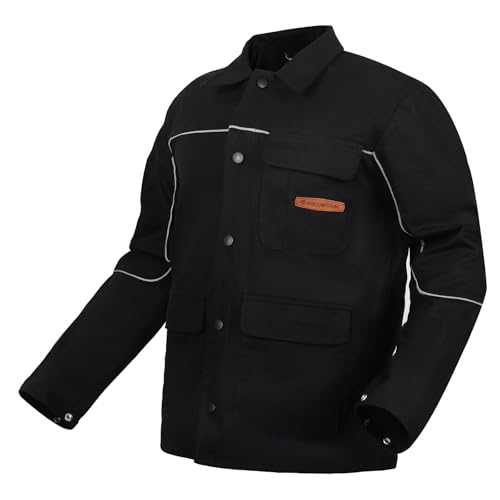 ARCCAPTAIN Best overall
 QeeLink QLCJBMKevlar-stitched FR cotton
 ARCCAPTAIN Heavy cowhide with Kevlar
Why a jacket matters
Welding throws molten metal. Spatter lands on your forearms, chest and lap, and slag can roll into any gap in your clothing. A welding jacket is built to shrug that off instead of catching fire or melting onto your skin.
The arc itself is the other problem. It gives off ultraviolet and infrared radiation that can burn skin, much like a sunburn, even through a thin shirt. Heavier flame-resistant fabric blocks much of that exposure, especially on the arms.
So the jacket is not just about big sparks. It handles the steady, small hits that add up over a long day at the bench.
Can you weld without a jacket?
Physically, yes. Nothing stops you from striking an arc in a T-shirt. But it is a poor trade, because the risks land on the parts of you that face the work most: forearms, chest and neck.
Everyday clothing is the weak point. Synthetic fabrics such as polyester can melt and stick to skin. Plain cotton can catch fire and keep smoldering. Shorts, open shoes and rolled sleeves leave bare skin where spatter loves to land.
If you only tack a small part once in a while, you might feel a jacket is overkill. A burn from one stray bead says otherwise. At minimum, wear long sleeves made of heavy natural fiber, and treat that as a stopgap rather than a plan.
What about OSHA and workplace rules?
If you weld on the job, your employer is generally required under OSHA's rules to assess hazards and provide suitable personal protective equipment. Welding is a clear case where protective clothing is expected, and many shops write a jacket or sleeve requirement into their own policy.
OSHA rules apply to employers and workers, not to a hobbyist in a home garage. That does not make the hazards any smaller. If you are unsure what your site requires, ask your supervisor or safety lead, and follow the stricter rule if two apply.
Jacket types compared
Not every jacket fits every job. The main choice is between leather, flame-resistant (FR) cotton and a mix of the two. Our best welding jacket page lines these up on one spec sheet so you can see the differences.
Here is how the options compare in general terms:
| Option | Strengths | Watch for |
|---|---|---|
| FR cotton jacket | Lighter, more breathable, easier for all-day wear | Check for a stated flame-resistance standard |
| Leather jacket | Tear resistance and heavy-duty protection | Heavier and warmer; many listings state no FR standard |
| Leather sleeves, cotton body | Tougher where sparks hit hardest, lighter elsewhere | Standard may not be stated |
| Regular work shirt | Better than bare skin if it is heavy natural fiber | Not designed for sparks; can ignite |
| Synthetic clothing | None for welding | Can melt onto skin |
What to look for in a jacket
Start with the flame-resistance standard. On our comparison page, NFPA 2112 appears on three jackets, and five of the nine products state no standard at all, including both leather models in the top five. A listed standard gives you something to verify, while a general claim of fire resistance does not.
Then check the build and fit details:
- Fabric weight: the three heaviest cotton jackets we list reach 11 oz, and the other cotton models list 9 oz. Heavier cloth is thicker, though lighter cloth breathes better.
- Closures: snaps open and close quickly with gloves on, while buttons take more care.
- Cuffs: adjustable cuffs let you tighten the wrist against slag when sparks fly.
- Collar: a stand-up collar covers the neck, which is exposed during overhead work.
- Length: several models list 30 in, so compare it with your own torso so the waist stays covered.
- Pockets: counts range from one to four on the jackets we list, so decide how much you want to carry near sparks.
Fit, limits and safety notes
A jacket only works if it covers you. Size ranges vary a lot. Some listings show S to 4XL, while others offer only one size, so measure your chest and length before you order. A jacket that rides up leaves your waist exposed.
Know what a jacket is not. One 11 oz FR cotton listing says plainly that it is designed for brief, intermittent exposure to sparks, spatter and radiant heat. It states it is not designed for electric arc flash or firefighting, and it will not protect against direct, sustained flames. Read the maker's warnings on any jacket you buy.
Wear the jacket as part of a full kit:
- Keep the collar closed and cuffs snug so slag cannot slip inside.
- Wear a welding helmet with the correct shade, plus safety glasses under it.
- Wear welding gloves and closed leather boots, with pant legs over the boot tops.
- Use hearing protection when grinding or cutting.
- Keep flammable materials, fuel and solvents away from the work area, and keep a fire extinguisher close.
- Replace a jacket that has burn-through holes, thin spots or damaged closures.
So, which way should you go?
If you weld regularly, get a proper jacket and match it to your work. FR cotton suits long shop days and lighter-duty tasks like TIG. Leather suits heavy spatter and overhead work, though you should check whether a flame-resistance standard is stated.
If you only weld now and then, the same logic applies. A burn does not care how often you work. Browse the welding jacket comparison to narrow the choices by standard, fabric weight and fit, and pick the one that covers you properly and that you will actually wear.
Frequently asked questions
Is a welding jacket the same as a leather apron?
No. An apron covers the front of the torso but leaves your arms and back open. A jacket covers the arms and shoulders too, which take a lot of spatter.
Can I wear a hoodie under my welding jacket?
A cotton layer is better than a synthetic one, since synthetics can melt. Keep the layer thin enough that the jacket closes properly and your cuffs and collar still seal.
Do women and men need different jackets?
The protection is the same. What changes is fit, so use the size chart and your own chest and length measurements. One listing on our page notes it is designed to be worn by both men and women.
How do I know when to replace a welding jacket?
Replace it when you find burn-through holes, thinning fabric, torn stitching or closures that no longer hold. Also check the maker's care instructions, since washing limits differ by product.