Do You Need a Whole House Water Filter?
Not every home needs one. A whole house filter makes sense when your water has a problem you notice or can confirm, such as sediment, chlorine taste and odor, iron, or scale. If your water tests clean and tastes fine, a smaller point-of-use filter at the kitchen tap may be enough.
 iSpring WGB32B-KDS+WSP50ARBBest overall
 EXPRESS WATER WH300SCKPHeavy metals with gauges
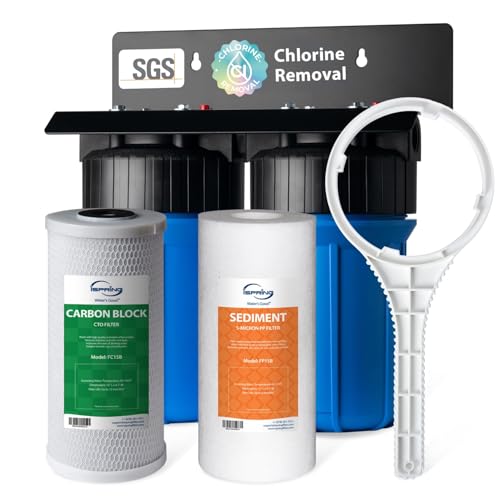 iSpring 1Simple two-stage setup
What a whole house filter does
Yes, you can filter the water for your whole house. A whole house filter, also called a point-of-entry system, installs on the main water line where it enters your home. Every tap, shower, washing machine and water heater then gets filtered water.
That is different from a pitcher, a faucet-mounted filter or an under-sink unit, which treat water at one spot. It is also different from reverse osmosis. Some whole house models, including the iSpring units in our data, say they keep healthy minerals in the water and do not reduce total dissolved solids.
Signs you may need one
The best reason to install a whole house filter is a specific problem. Look for these signs:
- Water smells or tastes like chlorine, or you notice a rotten-egg odor.
- Sand, rust flakes or cloudy water show up at the tap.
- Orange or brown stains appear in sinks, tubs or laundry, which often points to iron.
- White scale builds up on fixtures, kettles and appliances.
- You use a private well, where nobody else treats the water before it reaches you.
- Your water report lists a contaminant you want to reduce at every tap, not only at the kitchen sink.
When you probably do not need one
If your city water report shows no concerns and you are happy with how the water tastes and looks, a whole house system adds upkeep without much gain. Many people only want better drinking water, and a filter at one tap handles that with less hardware.
Shower and laundry water matter too, though. Chlorine can bother some people's skin and hair, and sediment can wear on appliances. If those are your concerns, whole house filtering starts to make more sense.
What to test first
Before buying anything, find out what is in your water. City customers can usually get a water quality report from their utility. Well owners should use a state-certified lab, since nobody else is testing the supply.
Then match the filter to the result. Sediment stages catch sand and rust. Carbon stages reduce chlorine, taste and odor. Heavy metal reduction and scale inhibition are extra steps, and not every model lists them. Iron and manganese need a stage built for them, which is why well owners should look closely at that spec.
Our best water filter for whole house page puts several models on one spec sheet, so you can see which ones list the stages your water report calls for.
Matching your problem to a filter type
This table sums up which stage addresses which common issue. Models differ, so check each spec sheet.
| Problem | Stage that helps | Example from our data |
|---|---|---|
| Sand, rust, dirt | Sediment filter | The iSpring WGB21B uses a 5 micron sediment filter |
| Chlorine, taste, odor | Carbon filter | Listed as chlorine reduction on all five models we compare |
| Iron and manganese | Iron-specific media | The VEVOR YMT004 targets both |
| Scale on pipes and appliances | Anti-scale stage | Listed on the iSpring WGB32B, the Express Water WH300SCKP and the XINSHUO |
| Lead and other heavy metals | Heavy metal reduction | Listed on the iSpring WGB32B and the Express Water WH300SCKP |
The downsides to weigh
Whole house filters are useful, but they come with trade-offs. Knowing them up front helps you decide.
Pressure and flow can drop. Max flow rate is listed in GPM, and port size is the pipe connection. A 1 in port with a 15 GPM max flow rate suits a main line feeding a full home, while a 3/4 in port is smaller and may suit a small household better. If the filter is undersized, showers and several open taps can suffer.
Upkeep never stops. Cartridges wear out. Capacity in gallons shows how long they should last, and the range in our comparison runs from 50000 gal to 250000 gal among the models that list it. Pressure gauges, pressure release buttons and an auto-flush sediment stage make changes easier.
The units are heavy and bulky. The weights we list run from 12 lb to 66.7 lb. A heavy unit needs a solid wall or frame and enough room around it to change cartridges.
They do not fix everything. Carbon and sediment stages do not make microbiologically unsafe water safe, and most do not reduce dissolved solids. Only one model in our comparison lists NSF/ANSI certification, so look closely at what each one is certified for. Warranties are short too, at 1 year on the models that list one.
Installation and safety
Many people hire a plumber, and some do it themselves. Either way, plan the job around these steps:
- Shut off the main water supply and open a tap to drain pressure before cutting into any pipe.
- Pick a spot on the main line after the shutoff and before the water heater, with room below for cartridge changes.
- Mount the unit on a solid wall or its frame. A 66.7 lb system is a real lifting job, so get a second person to help.
- Never solder copper pipe near wood or other flammable material without proper precautions, and keep a fire extinguisher handy.
- Wear safety glasses when cutting pipe or changing cartridges, since pressurized water can spray.
- Use the pressure release button, if your model has one, before opening a housing.
- Check every fitting for leaks after you turn the water back on, then again a day later.
So, is it a good idea?
It is a good idea when it solves a problem you have confirmed. Well owners with iron, homes with heavy sediment, and households that dislike chlorine in showers and laundry have the clearest case. For everyone else, a point-of-use filter may do the job with less upkeep.
If you decide to go ahead, start with your water report, then compare flow rate, port size, stages and capacity. You can see those numbers side by side on our whole house water filter comparison. Where a maker does not publish a spec, we say so instead of guessing.
Frequently asked questions
Will a whole house filter make my tap water safe to drink?
Not on its own. Sediment and carbon stages reduce specific things like chlorine, taste and odor. If your water has bacteria or other concerns, you need treatment designed for that and a lab test to confirm.
Does a whole house filter remove minerals?
The iSpring models in our data say they keep healthy minerals in the water and do not reduce total dissolved solids. Their anti-scale stage prevents scale from forming rather than removing calcium and magnesium.
How often do the cartridges need changing?
It depends on your water and usage. Capacity ratings in gallons give a guide. For example, the VEVOR YMT004 lists 100000 gal capacity, and its listing says cartridges last 6 to 12 months.
Can I install one myself?
Many models are designed for DIY installation on the main line, with a manual and mounting bracket. If you are not comfortable cutting pipe or soldering, hire a licensed plumber.