Do You Need a Transmission Jack for Your Repair?
If the job involves lowering a transmission out of the vehicle or raising it back in, yes, a transmission jack is the right tool and the safest choice. If you are only changing fluid, swapping a filter or replacing external parts, you can usually skip it. A regular floor jack can work for brief support, but it is a poor stand-in for a full removal.
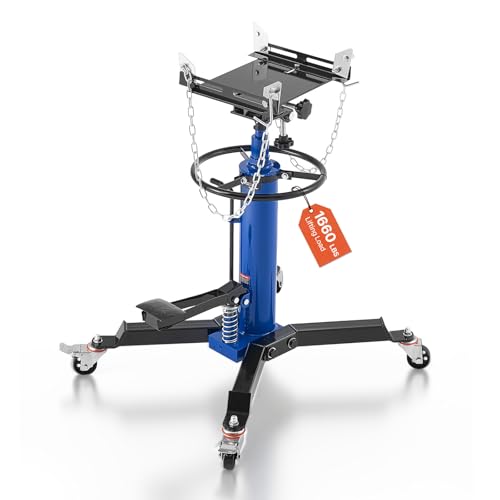 VEVOR GW-0.8Best overall
 VEVOR HTJ-1322Best for steady saddles
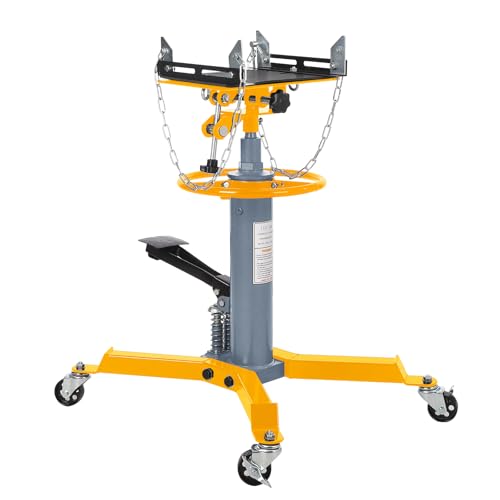 JustSmart LL-jackshuang-YELLOWIos3Le2Best dual plunger
The short version: it depends on the repair
A transmission is heavy, awkward and hard to balance. It also has to line up with the engine within a small margin when it goes back in. A transmission jack is built for exactly that: it holds the load, lets you raise and lower it in small steps, and lets you tilt the unit to match the engine angle.
So the question is really whether your repair means the transmission has to move. If it does, plan on a proper jack. If it stays where it is, you probably do not need one.
Repairs where you can usually skip it
Many jobs happen with the transmission left in place. In these cases the main need is safe access under the vehicle, not a way to hold the gearbox.
Check your service manual first, since some vehicles need the transmission supported even for small jobs.
- Changing transmission fluid
- Replacing a pan gasket or filter, where the design allows it
- Replacing a speed sensor or other external sensors
- Swapping a shift cable or linkage part
- Replacing a rear axle seal or driveshaft slip yoke seal on some vehicles, with the weight supported by the mount
Repairs where you really do need one
Anything that separates the transmission from the engine, or drops it out of the vehicle, calls for a transmission jack. The common examples are clutch replacement on a manual, a rear main seal job on many vehicles, a torque converter or flexplate repair, and a full transmission swap or rebuild.
The reason is control. A transmission has to come back in level and square to the engine so the input shaft slides into place without force. A jack with a tilting saddle lets you fine-tune that angle in small steps. Without one, people tend to force parts together or let the unit hang on a half-engaged shaft, which can damage the shaft, the clutch or the bell housing.
Transfer cases and some drivetrain parts follow the same logic. If it is heavy and has to be lined up, a transmission jack makes the job controlled.
What people use instead, and the trade-offs
You will see several substitutes suggested online. Some work for short, light-duty support. None gives you the tilt control and strap restraint of a real transmission jack.
Here is how the common ones compare.
| Substitute | Works for | Main drawback |
|---|---|---|
| Floor jack with a wood block | Briefly supporting a transmission while changing a mount or crossmember | The load can slip off the pad, and you have little tilt control |
| Floor jack with a helper | Short lowering jobs on some light vehicles | Hard to balance, and a second person adds risk if the load shifts |
| Engine support bar | Holding the engine while you work | It supports the engine, not the transmission, so it is not a replacement |
| Borrowed or rented transmission jack | Any one-off removal | Check the capacity and the condition of the chain and casters before you use it |
| Lowering by hand on a creeper | Nothing safe | Never do this, because a dropped transmission can cause serious injury |
Can you put a jack on the transmission?
Yes, for support. A floor jack under the transmission pan with a block of wood between the pad and the pan is a common way to hold the rear of the engine and transmission while you swap a mount. The wood spreads the load so the jack pad does not dent or crack the pan.
Be gentle with it. A transmission pan is not designed to carry the full weight, and a thin or aluminum pan can bend or crack under a concentrated load. Use the jack to take weight off the mount, not to lift the whole assembly. If the transmission needs to come out, move to a transmission jack.
If you decide to get a jack, what to compare
Start with how you will work. Telescoping jacks suit a vehicle raised on a lift, and low-profile floor models suit a vehicle on jack stands. On our best transmission jack page, the lift ranges run from 7 to 76 in and the capacities from 450 to 2000 lb, so the choice matters.
Then compare capacity against your transmission's weight. Pick a jack with a comfortable margin above it. For example, the VEVOR 1660 lb two-stage model lists a 34.6 to 69.3 in lift range and a tray that rotates 360° and tilts up to 30°. The Sunex 7796 lists 1000 lb with a 35 to 73.5 in range and an air/hydraulic design.
Finally, look at stability. Locking casters, a wide base and a tie-down chain or strap keep the load in place. The VEVOR 1660 lb model lists four swivel casters with two brakes, and the Sunex 7796 lists a tie-down strap. If you work on a car on stands rather than a lift, our page also covers low-profile floor jacks such as the 450 lb MAXSA, so you can compare transmission jacks side by side before you choose.
Safety checklist before you lower anything
A falling transmission is a serious crush hazard. Treat every step as if the load could shift.
Follow these steps each time:
- Support the vehicle on a lift or on rated jack stands on level ground. Never rely on a jack alone to hold a vehicle.
- Confirm the jack's capacity is well above the transmission's weight, then check the chain or strap, casters and hydraulic fittings for damage.
- Lock the casters and secure the transmission to the saddle with the chain or strap before you raise or lower it.
- Keep your head and body out of the drop path, and lower slowly with the release valve.
- Wear safety glasses, since fluid and debris fall when you loosen bolts, and gloves for hot or sharp parts.
- Disconnect the battery before you unplug sensors or wiring, and let exhaust parts cool first.
Frequently asked questions
Can one person remove a transmission with a transmission jack?
Often yes, because the jack takes the weight. Still, a helper makes steering the unit around the exhaust and crossmember much safer.
Do I need a transmission jack for a clutch replacement?
On most manual vehicles, yes. The transmission has to separate from the engine and come back in square, which a tilting saddle makes much easier.
Is an engine support bar a substitute for a transmission jack?
No. It holds the engine in place while you work. It does not hold or position the transmission.
Can a transmission jack handle a transfer case?
Some can. For example, the JustSmart listing mentions transmissions and transfer cases. Check the listing and your part's weight first.
Can I use a transmission jack on a car on jack stands?
Only a low-profile floor jack, since telescoping models are designed for vehicles raised on a lift. Check that the jack fits under the car with room to work.