Do You Need a Special Tool to Remove an O2 Sensor?
You do not strictly need a special tool, but an O2 sensor socket makes the job much easier and protects the sensor wire. A regular deep socket will not fit because the wire is in the way, so the usual no-special-tool route is a 22mm (7/8 in) open-end or box wrench. That works only if you have room to swing it and the sensor is not seized.
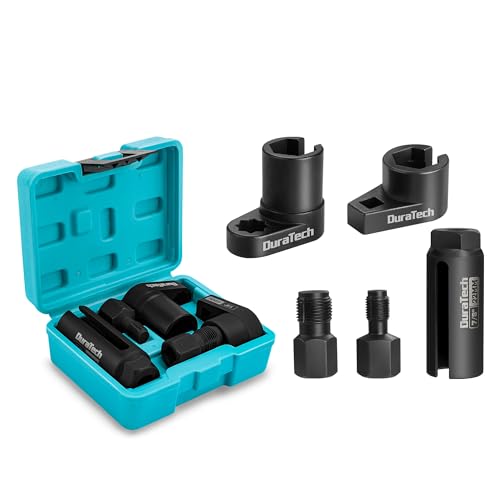 DURATECH b612d438-a26d-4bfb-828d-ce6346c97df9Best overall
 Rlokciy 5pcsBest CR-V set
 A ABIGAIL A7841FBest low-profile access
The short version: what you can use instead
Most oxygen sensors have a 22mm hex, which is the same as 7/8 in. The sensor also has a wire and connector coming out of the top, and that wire is why an ordinary socket will not slide on.
If the sensor is easy to reach and not stuck, a 22mm open-end wrench or a combination wrench can turn it. The wrench goes on from the side, so the wire stays out of the way. Many people finish a simple job this way.
The trouble starts when the sensor has been heated and cooled for years. Exhaust parts can seize in their threads, and a thin wrench can slip, round off the hex, or bend. At that point a purpose-built tool pays off.
Why an O2 sensor socket exists
An O2 sensor socket has a slot cut along its side, so the wire can pass through while the socket grips all six sides of the hex. A six-point grip spreads force evenly and is less likely to round the corners than an open-end wrench.
Many designs are also offset or low-profile. These reach sensors tucked behind the manifold or above a crossmember, where a straight socket and ratchet will not fit. Our best oxygen sensor removal tool page lists several of these designs side by side so you can compare them.
Comparing your options
Here is how the common approaches stack up for a typical removal job.
| Option | Works best when | Main drawback |
|---|---|---|
| O2 sensor socket (slotted) | Sensor is seized or the wire is in the way | You need to buy or borrow it |
| Offset or crowfoot O2 socket | Space is tight above or behind the sensor | Needs a compatible drive size |
| 22mm open-end or box wrench | Open access and a loose sensor | Can round off the hex if stuck |
| Line wrench (flare nut) | You have no other option and moderate access | Thinner jaws can spread under heavy torque |
| Deep socket with the wire cut | Not recommended | Cuts the wire and complicates installing a new sensor |
How to remove an O2 sensor without a special tool
If you only have a wrench, a careful approach improves your odds. Take your time, because a rounded sensor is much harder to remove than a stubborn one.
Work on a cool or only warm exhaust. A slightly warm exhaust can loosen the threads, but a hot one can burn you quickly.
- Park on level ground, set the parking brake, and let the engine cool until it is only warm. If you need to lift the vehicle, use jack stands, never a jack alone.
- Unplug the sensor's electrical connector first and free the wire from any clips.
- Spray penetrating oil on the threads where the sensor meets the exhaust, and give it time to soak in.
- Fit a 22mm wrench squarely onto the hex, pushing it all the way on so it grips fully.
- Pull with steady force instead of jerking. If the sensor will not budge, soak it again rather than adding a pipe for leverage.
- Once loose, unscrew it by hand and keep the old sensor in case you need to match the new one.
What to look for in a set
If you decide to buy, the details that matter are socket style, drive size, steel, and whether thread chasers are included.
Drive size changes how you apply force. A 1/2 in drive takes a breaker bar for seized sensors, while a 3/8 in drive fits tighter spaces. Sets that include both are flexible. For example, the DURATECH 5-piece set lists three 22mm sensor sockets in 1/2 in and 3/8 in drive sizes, plus two thread chasers, and its listing gives a weight of 1.85 lb.
Steel type affects strength under high torque. Our listings show chrome vanadium in sets like the Rlokciy 5-piece and chrome molybdenum in sets like the A ABIGAIL 5-piece, which offers low-profile and offset crowfoot designs on a 3/8 in drive. Both are meant to resist twisting. The O2 sensor socket comparison covers more of these differences.
Thread chasers are worth having. They clean carbon and rust out of the exhaust threads so the new sensor seats straight and does not cross-thread. The M12 x 1.25mm and M18 x 1.5mm chasers in several of the listed sets are two examples of sizes you may see.
Safety notes
Exhaust parts get very hot and stay hot for a long time. Let the system cool before you touch it, and wear gloves that can handle heat.
Wear safety glasses. Rust, grit, and old carbon fall off when you work under a vehicle, and a slipping tool can send debris toward your face.
Use jack stands on a firm, level surface if you raise the vehicle. Do not work under a car supported only by a jack.
Be careful with a torch. Heating a stuck sensor can ignite fuel lines, oil residue, or wiring nearby, so penetrating oil and patience are the safer first steps.
So, should you buy one?
If you plan to replace a sensor once and it is easy to reach, a 22mm wrench may be enough. If you work on your own vehicles regularly, or the sensor sits in a cramped spot, a slotted socket set is a reasonable addition to your toolbox.
A set with thread chasers also helps with the install, which is where many repairs go wrong. Cleaning the threads takes only a minute and can save you from a leaky or crooked fit.
Frequently asked questions
Can I use a regular socket on an O2 sensor?
Usually not, because the sensor's wire gets in the way. Cutting the wire to fit a regular socket is not recommended, since you would need to splice it back together.
What size is an O2 sensor?
Most take a 22mm hex, which is 7/8 in. Check the sensor itself before buying a tool, since a few vehicles use a different size.
Should I put anti-seize on the new sensor?
Many new sensors come with anti-seize already applied to the threads. If yours does not, check the instructions that came with it, and keep any compound off the sensor tip.
Is it better to remove the sensor when the engine is warm?
A slightly warm exhaust can help loosen the threads, but it should never be hot. Let it cool until you can work near it safely.