Do Refrigerant Scales Need to Be Calibrated?
Yes. A refrigerant scale is a measuring instrument, and its readings can drift over time, so it should be checked against a known weight on a regular schedule. Follow your manufacturer's interval and check it sooner after a drop, a hard knock or a temperature swing. If a check shows the scale is outside its stated accuracy, adjust it using the maker's procedure or have it serviced.
 YELLOW JACKET ASRCS-220LBest overall
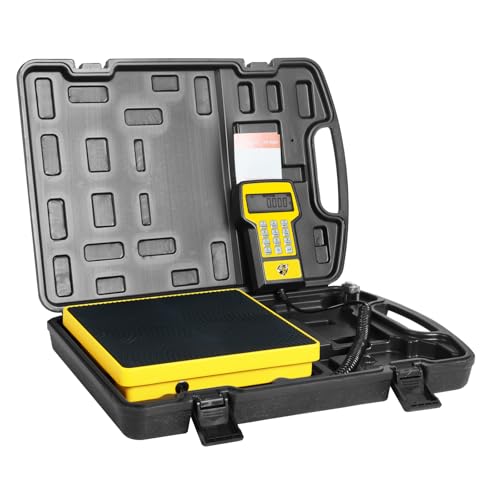 YELLOW JACKET ASRCS-220CProgrammable target weight
 Elitech LMC-100ALight 220 lb option
Why calibration matters for refrigerant work
Charging by weight only works if the scale tells the truth. If the display reads a little high or low, you will put in a little too much or too little refrigerant, and you may never notice. Over or under charging can hurt cooling performance and put extra stress on a compressor.
Recovery has its own risk. A cylinder should never be filled past its safe limit, and a scale that reads low can hide how full it really is. A quick accuracy check is cheap insurance for both jobs.
Some regions and certification schemes also set tolerances for scales used on regulated work. Rules vary by location and employer, so ask your licensing body or program administrator what applies to you.
Calibration versus a calibration check
The two terms get mixed up, so it helps to separate them. A calibration check compares the scale's reading with a known reference weight and tells you whether it is within tolerance. Calibration or adjustment actually changes the scale so its readings line up with that reference.
Some scales have a built-in calibration mode that uses a specific test weight. Others have no user adjustment and must go back to the manufacturer or a service lab. The product listings we compare do not describe calibration procedures, so read your own manual to see which type you own.
For most people, the routine task is the check. You only need adjustment or service if the check fails.
How accuracy is stated on spec sheets
Accuracy is usually a percent of the reading, and some listings add a fixed amount on top. For example, the Yellow Jacket ASRCS-220L, the Elitech LMC-100A+ and the VIVOHOME VH104 all list accuracy of 0.05% of reading plus 10 g. The Fieldpiece SR47 lists 0.03% of reading plus 0.25 oz. Our best refrigerant scale page puts these figures side by side.
Here is what 0.05% of reading plus 10 g works out to at a few readings. This is simple arithmetic from the published formula, not a measured result.
Use these numbers as your pass or fail line when you check a scale with that spec.
| Reading | 0.05% of reading | Plus fixed 10 g | Allowed error |
|---|---|---|---|
| 2 kg | 1 g | 10 g | 11 g |
| 5 kg | 2.5 g | 10 g | 12.5 g |
| 20 kg | 10 g | 10 g | 20 g |
| 50 kg | 25 g | 10 g | 35 g |
How to check your refrigerant scale
You need a known reference weight. Certified test weights are the best choice. Avoid guessing with household items, because their labeled weights are not reliable enough for this job.
Work on a hard, level surface away from drafts, and keep the platform clear of anything else.
- Insert fresh batteries or confirm the battery is healthy, since low power can cause odd readings.
- Turn the scale on and let it settle for the time your manual suggests.
- Zero (tare) the scale with the platform empty.
- Place the reference weight in the center of the platform and note the reading.
- Compare the reading with the weight, using the allowed error from your scale's spec.
- Repeat at two or three different weights, including one near the amounts you normally handle.
- Remove the weight, confirm the scale returns to zero, and write down the date and results.
How often to check, and what to do if it fails
There is no single schedule that fits everyone. Start with the interval in your manual, and check more often if the scale gets heavy use or rides in a work truck every day. A written log of dates and readings helps you spot drift early.
Check it right away after any of the events in the table below. A fall onto a hard floor or a cylinder dropped on the platform can shift the sensor even when nothing looks damaged.
- Keep the scale in its case between jobs. Several scales on our comparison list include a hard case.
- Stay within the rated capacity. The scales we compare list 110 lb, 155 lb, 220 lb or 252 lb.
- Do not use a failed scale for charging until it has been fixed and rechecked.
| Situation | Suggested action |
|---|---|
| Start of a new season or job cycle | Run a routine check |
| Scale was dropped or hit | Check before the next job |
| Overload warning such as FULL appeared | Check, because the sensor was pushed past its rating |
| Readings jump or will not return to zero | Replace batteries, then check again |
| Check fails twice | Follow the maker's calibration steps or send it for service |
Safety notes
Refrigerant cylinders are pressurized. Wear safety glasses and gloves whenever you connect hoses or open valves, and never fill a recovery cylinder beyond its safe fill limit.
Test weights and full cylinders are heavy. Lift with your legs, and get help rather than straining your back. Set the scale on stable ground so a tipping cylinder cannot fall on your feet.
If you are shopping for a replacement, a scale with an overload warning helps protect the sensor. Our refrigerant scale comparison lists which models include one.
Frequently asked questions
Can I use a bathroom scale as a reference?
No. Bathroom scales are not accurate enough, and they usually cannot read the small steps a refrigerant scale shows. Use certified test weights.
Does a new scale need a check before first use?
A quick check is a good habit. It confirms the scale was not damaged in shipping and gives you a first entry in your log.
Does auto-zero fix an inaccurate scale?
No. Auto-zero or tare only resets the display to zero, for example after you place a cylinder on the platform. It does not correct errors in the sensor.
Can temperature affect readings?
It can. Let the scale reach the working environment before you check or use it, and avoid leaving it in a very hot or cold vehicle.