Do Magnetic Tool Holders Work and How Do They Hold Tools?
Yes, magnetic tool holders work well for tools made of iron or steel, such as wrenches, pliers, screwdrivers and hammers. A strong magnet inside a steel bar pulls the tool against its surface, and friction keeps it from sliding. They work best when the tool touches the bar flatly and the holder is rated for more weight than your heaviest tool.
 TOOLEAGUE Strip Rack-1Best overall
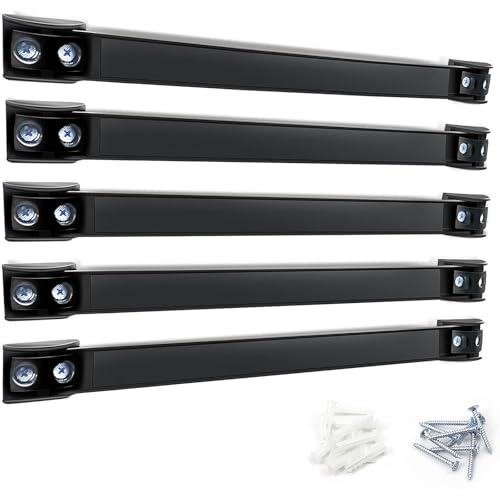 DGSL Magnetic Strip 001Five 16 in wall strips
 BEILITEMAG BEILITE-DJ17inchDouble-sided with knuckle gap
How a magnetic tool holder actually holds a tool
A magnetic tool holder is a bar or rack with permanent magnets built into it. Steel and iron are drawn toward a magnet, so when you set a wrench against the bar, the magnetic field pulls it in. No power, batteries or moving parts are involved.
Two things keep the tool in place. The first is the pull straight into the bar. The second is friction between the tool and the bar surface. A tool that lies flat against the bar has more contact area, so it grips better than one that touches at a single point.
That is why a screwdriver or a flat wrench sticks firmly while a round, curved or oddly shaped tool may be less secure. The magnet works the same way in every case. What changes is how much of the tool sits against it.
Which tools are magnetic?
The short answer is that a tool sticks if it is made of a ferrous metal, meaning one that contains iron. Most hand tools are steel, so most of them stick. A quick test is to hold any fridge magnet to the tool. If it clings, a magnetic holder will work.
Metals without iron do not respond, and some stainless steels are only weakly magnetic or not at all.
| Item | Usually sticks? | Why |
|---|---|---|
| Steel wrenches and sockets | Yes | Iron-based steel |
| Pliers and screwdrivers (metal shafts) | Yes | Steel body or shaft |
| Hammers with steel heads | Yes | Steel head |
| Drill bits and screws | Yes | Steel |
| Aluminum or brass tools | No | No iron content |
| Copper items | No | Not magnetic |
| Some stainless steel | Sometimes not | Depends on the alloy |
| Plastic or wood handles | No | Not metal, so only the steel part sticks |
How a magnetic drill bit holder works
A magnetic drill bit holder uses the same idea on a smaller scale. Most drill bits have steel shanks, so a strip or block with magnets lets you lay bits against it or press them into slots, where the magnet holds them upright or flat. This keeps small bits from rolling around in a drawer.
Magnets also help with loose screws and small steel parts. You can park them on the bar while you work and pick them up when you need them.
For bigger power tools, a drill rack is a different style of holder. The ULIBERMAGNET rack on our comparison page lists space for 4 drills and 9 screwdrivers and holds up to 100 lb. It attaches to a metal surface with two 3.46 inch rubber coated magnets, so it needs no drilling or screws. Check the maker's listing for your exact drill sizes before you buy.
What is a magnetic keeper?
A magnetic keeper is a piece of soft iron or steel that bridges the two poles of a magnet. It gives the magnetic field an easy path to travel, so the magnet stays strong when it is not holding anything. You will see keepers on some magnet products and in storage setups.
In a tool holder, the tools themselves act as a keeper. When a steel wrench lies across the bar, it completes the path for the field. Leaving a few tools on the bar is fine for the magnets, and it keeps the bar busy doing its job.
If you store loose magnets, such as spare bars, you can lay a steel piece across them to act as a keeper. Keep them away from other magnets so they do not snap together.
What to check before you buy
A holder is only useful if it matches your tools and your wall. These are the points that matter most:
- Holding force: this tells you how much weight a holder can carry. Our best magnetic tool holder page lists forces from 10 lb to 110 lb among the seven products that publish a figure. Treat the number as a ceiling and leave yourself some margin.
- Length: bars on that page run from 2.4 in to 17.32 in. Measure your wall or bench first.
- Mounting method: some bars stick to steel without drilling, while others screw into a wall. Check whether hardware is included.
- Surface thickness: if you attach a bar straight to a metal surface, the metal has to be thick enough. The BEILITEMAG 17 in holder lists a minimum of 0.047 inches (1.2 mm), or the holder will slide off.
- Knuckle room: a gap between the bar and the wall makes tools easier to grab. That same BEILITEMAG holder lists a 0.94 inch wall gap.
Matching a holder to your space
Where you plan to hang tools decides which type suits you. For a toolbox, cart or steel cabinet, a double-sided bar is handy. The TOOLEAGUE set lists two 12 in bars rated up to 110 lb, drill-free mounting for magnetic surfaces and screws for non-magnetic ones. You can compare these side by side on our best magnetic tool holder page.
For a wood or drywall wall, look for hardware in the box. The DGSL set has five 16 in strips with mounting hardware, and each strip lists 22 lb. Several shorter bars also let you spread tools out by weight and shape, which can be easier than one long row.
If you want slatwall or van storage, the SEDY 7-piece set lists seven 12 in strips with 24.25 lb of force and mentions slatwall use. For work on the go, a clip-on holder is the lightest option, and our page lists one at 0.26 lb that fits belts up to 1.75 in.
Good light helps when you organize a bench. If your wall is dim, see our best magnetic work light page for lights that also stick to steel surfaces.
Mounting and safety notes
Magnets are simple, but heavy tools and strong pull force call for a few precautions.
Before you drill into a wall, check for electrical wires and pipes behind the spot. Wear eye protection when you drill or drive screws, and hearing protection if you use a power drill for long. Use a stud or the right anchors for the load, since a falling hammer or wrench can injure your feet.
Strong magnets can snap together and pinch fingers, so slide them apart rather than pulling straight. People with pacemakers or other implanted medical devices should follow their doctor's and the device maker's advice about distance from magnets. Keep bare blades pointed away from where your hand reaches, and mount bars at a height that keeps sharp tools out of the reach of children.
After you hang the bar, test it by loading tools gradually. If a tool shifts, move it closer to the center of the bar or add another bar.
Frequently asked questions
Will a magnetic tool holder damage my tools?
Not in normal use. Magnets can make small steel parts such as screws and bits cling to each other or to the tool, which is usually helpful. Keep the holder away from items that can be affected by magnets, such as magnetic cards.
Can I use a magnetic holder on a wooden wall?
Yes, if it comes with mounting screws and you fasten it into the wall. The magnet does not stick to wood by itself. Check that the listing includes hardware.
Do magnets get weaker over time?
Permanent magnets lose strength slowly, but heat, hard knocks and dropping can weaken them faster. Keeping the bar in a normal room, and mounting it securely, helps it last.
Can I put kitchen knives on a tool holder?
Some listings on our comparison page, including TOOLEAGUE, DGSL and SEDY, note that the product is kitchen safe. Mount it out of the reach of children and keep blades pointed away from where you reach.
How many bars do I need?
It depends on how many tools you own and how heavy they are. Add up the weight of the tools for each bar and stay under the listed rating, then add another bar if you run out of space.