Do I Need a Knee Kicker for Carpet Installation?
For most carpet jobs, yes: you need some way to pull carpet tight onto the tack strips, and a knee kicker is the basic tool for that. It works well for small rooms, closets, corners and edges. For a whole room, a power stretcher does the main stretching, and the kicker finishes the edges.
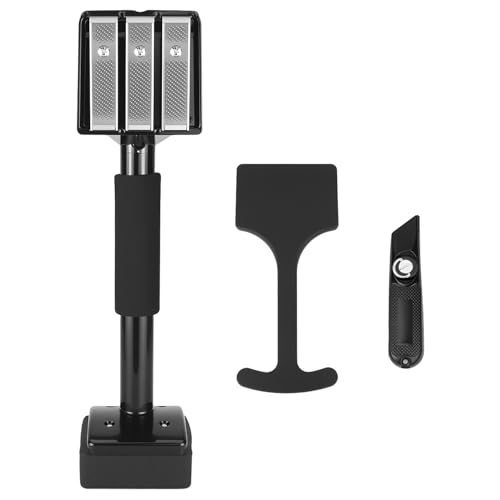 QWORK DG16521Best overall
 NATGAI NTJ-0915-01Simplest fixed-length kicker
 ROBERTS 10-410Adjustable basic option
What a knee kicker actually does
A knee kicker has a toothed head on one end and a padded bumper on the other. You grip the carpet with the teeth, then bump the pad with your knee. The carpet moves a short distance and hooks onto the tack strip along the wall.
That short push is the key point. A kicker positions carpet and removes small wrinkles. It does not pull a large room evenly tight. Some listings on our comparison page say this outright. The QWORK DG16521, for example, is described as a positioning tool, not a stretcher, and is aimed at small DIY jobs, corners and wrinkle removal.
If you want to see how specific models differ, our best knee kicker page lines up length, head size, pile rating and padding on one sheet.
Can you lay carpet without a knee kicker?
Physically, yes. People have laid carpet with hand pressure and a few improvised tools. In practice it is a poor idea for anything but a tiny space. Carpet that is not pulled tight tends to ripple and buckle over time, and the loose spots wear faster because they flex underfoot.
The tack strip is designed to hold carpet that is under tension. Without tension, the carpet can slip off the pins, and the seams and edges may lift. If you are laying a closet, a landing or a small patch, you may get away with less. For a bedroom or living room, plan on proper stretching.
How to stretch carpet without a knee kicker
If you decide not to buy a kicker, the realistic substitute is a power stretcher, which braces against the opposite wall and pulls the carpet across the room. Many tool rental counters carry them. A power stretcher does the heavy work that a kicker cannot, so you can skip the kicker in some rooms, though you will still need a way to tuck edges.
A basic sequence looks like this:
- Install tack strips around the room, leaving a small gap from the wall, with the pins angled toward the wall.
- Lay the pad, trim it to the strips, and tape the seams.
- Roll out the carpet with a few extra inches at every wall, and hook one edge onto the tack strip.
- Set the power stretcher head against the carpet and brace the tail against the opposite wall or a stiff board.
- Work the lever to pull the carpet taut, then hook it onto the strips.
- Repeat in the other direction, working across the room in a pattern rather than in one line.
- Trim the excess and tuck the edges into the gap with a stair tool or a wide putty-style tucking tool.
Can you stretch carpet with just a knee kicker?
You can, within limits. In a small room, a hallway or a closet, a kicker can seat the carpet well enough if you work in steady steps and check for ripples as you go. The reach of the tool is the constraint. Each strike moves the carpet a short distance, so across a large room the tension builds unevenly and your knee takes a lot of strikes.
The pile matters too. Most of the light-duty kickers on our list are rated for low to medium pile, and the FLKQC listing says low pile only. The QWORK listing also says it is not suitable for thick or high-pile carpet. If your carpet is thick, a kicker may not grip well, and a heavier setup is the safer plan.
That is why we treat the kicker as a finishing tool. If you want to browse models for that role, the knee kicker comparison shows which ones publish a pile rating and which leave it out.
Which approach fits your job?
Use this table as a quick guide.
| Situation | Knee kicker only | Power stretcher | Both |
|---|---|---|---|
| Closet or small landing | Often enough | Usually not needed | Optional |
| Hallway | Possible with care | Helpful | Good |
| Bedroom or living room | Risk of uneven tension | Good | Best fit |
| Low to medium pile | Works as a helper | Good | Good |
| Thick or high-pile carpet | Check the listing first | Good | Check tool ratings |
| Edges, corners, small wrinkles | Good | Awkward | Good |
If you buy a knee kicker, what to check
Start with the pile rating, then think about how long you will be kneeling. Your knee hits the pad on every strike, so a named bumper pad is worth looking for. The Roberts 10-422BK lists a 50% thicker bumper pad, and the Roberts 10-412-2 lists a foam-filled seamless bumper pad.
Length is the other choice. Adjustable models, such as the Roberts 10-412-2 at 17 to 21 inches, let you change the reach. Fixed models, like the QWORK and NATGAI units at 16.625 inches, are simpler and have nothing to set wrong. Weight is listed on only four of the eight models we compare, and the lowest listed is 4.3 lb on the Roberts 10-412-2.
Remember that none of these listings claim to replace a power stretcher for full rooms.
Safety notes
Tack strips are lined with sharp pins, and the kicker has sharp teeth. Wear thick gloves when handling strips and keep the teeth covered when the tool is stored. Some models, such as the NATGAI 20260819LN-2, list a protective shell for this reason.
Wear knee pads or a thick pair of work pants, even with a padded bumper. Wear safety glasses when cutting or trimming, since small fragments and blade tips can fly. If you use a utility knife, retract the blade between cuts, and cut away from your body.
Check the floor for loose nails or staples before you kneel on it. Take breaks. Repeated strikes on the same knee add up, and stopping early is better than a sore joint.
Frequently asked questions
Does the kicker bite into the pad?
It can if the teeth are set too long. Adjust the tooth depth so the pins grab the carpet backing without digging into the pad underneath.
How do I know the carpet is tight enough?
Press down in the middle of the room. If you can push a visible ripple across the surface, it needs more tension. A well-stretched carpet feels firm and flat.
Is a knee kicker useful on stairs?
Usually it is awkward on stairs because there is little room to swing your knee. Stairs generally call for a smaller hand tool for tucking and seating the carpet.
Should I rent a power stretcher or borrow one?
Either works if you only have one room. Make sure the stretcher has a tail pole long enough to reach across your room, and ask how to adjust the head for your carpet's thickness.