Crowfoot Wrench Set vs Standard Wrenches: Differences
A crowfoot wrench is an open-end head with no handle. It clips onto a ratchet, extension or torque wrench, so it reaches fasteners that a standard wrench or socket cannot. Standard wrenches are faster and stronger for everyday work, so most people keep a crowfoot set as a specialist add-on, not a replacement.
 NEIKO 03324ABest overall
 VEVOR XMNJBS0030ATMost pieces included
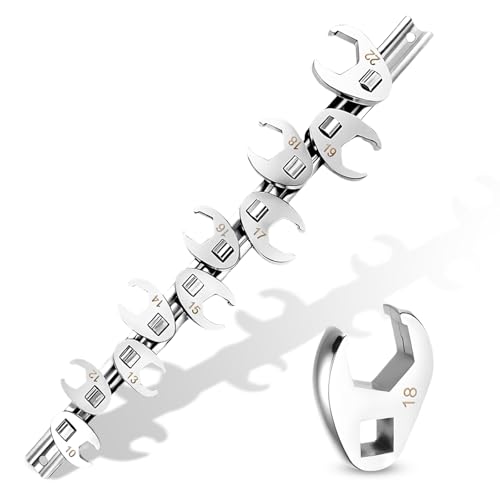 DikTalk RP-CT04301Simple clip-on organizer
The core difference
A standard wrench, such as a combination wrench, has its own handle and a fixed head at each end. You swing it around the fastener. A crowfoot wrench is only the head. It has a square hole that snaps onto the drive of a ratchet, an extension bar or a torque wrench.
That one change affects everything else. The handle can sit above, below or behind the fastener, so the head can slip into places where a full-length wrench has no room to swing. The trade-off is that you need a ratchet and a drive size that matches, and most crowfoot heads are open-ended, so they grip fewer sides of the fastener than a box end does.
Crowfoot vs combination and open-end wrenches
Combination and open-end wrenches are the default for loose bolts and nuts with clear access. They are quick, they need no other tools, and a good combination wrench set covers most jobs around a garage or a home.
Crowfoot wrenches earn their place when the fastener sits under a line, behind a bracket or at the end of a tube. A common example is a flare nut on a brake or fuel line, where a socket cannot slide over the pipe. A crowfoot with a flare-nut style opening can slide on from the side and grip the nut without crushing the line.
The reverse is also true. If you can fit a combination wrench on a fastener, it is usually the better choice, because the box end holds all around the hex and the long handle gives you leverage and feel.
Quick comparison table
Here is how the main wrench types compare on the points that usually decide the purchase.
| Feature | Crowfoot set | Combination wrench | Adjustable wrench |
|---|---|---|---|
| Needs a ratchet | Yes | No | No |
| Tight or blocked access | Strong | Limited | Limited |
| Grip on the fastener | Open-end, side entry | Box end grips all sides | Adjusts, but can loosen under load |
| Sizes to carry | One head per size | Two sizes per wrench | One tool covers a range |
| Best for | Line fittings, odd angles | General bolts and nuts | Occasional or odd-sized jobs |
| Risk of rounding the fastener | Moderate | Lower with the box end | Higher if the jaw is loose |
What about square, Snap-on and adjustable comparisons?
People often search for a few related comparisons, so here are short answers.
Square: if you mean a square drive, that is the hole that connects the ratchet to the crowfoot. Drive sizes must match. Most sets on our comparison page use 3/8 in, while larger sets such as the BILITOOLS jumbo SAE set and the LainKeen jumbo metric set use 1/2 in. If you mean a square-head fastener, a crowfoot with the right opening size can fit it, but check that the size is covered.
Snap-on: a premium brand mainly changes finish, tolerances and warranty terms. The tool still works the same way. We compare published specifications, so check the steel type, hardness rating, size range and drive size listed for any brand you are considering.
Adjustable: an adjustable wrench covers a range of sizes with one tool, but the moving jaw can shift and round off a fastener. A crowfoot set is fixed, so it fits better, but you need the exact size.
When a crowfoot set is the right choice
Think about what you actually work on. If your tasks include these, a set will pay off:
- Brake, fuel or transmission line fittings that a socket cannot slip over
- Fasteners behind engine parts, under dashboards or beneath sinks
- Plumbing and HVAC fittings with limited swing room
- Jobs where you need to tighten to a torque value in a tight spot
- Mixed work where a ratchet and extension are already in your tool box
How to choose a set
Start with the drive size. A set must match your ratchet, so check it before anything else. The Neiko set listed on our best crowfoot wrench set page covers both 3/8 in and 1/2 in drives, with metric sizes from 8 to 24 mm.
Next, pick the measurement system. Metric and SAE fasteners are not interchangeable. The VEVOR set lists 30 pieces in both systems on a 3/8 in drive, while metric-only sets suit owners who work only on metric fasteners. You can see these options side by side on our best crowfoot wrench set page.
Then look at steel and storage. Chrome molybdenum and chrome vanadium are common alloy steels for hand tools. Some listings publish a hardness rating in HRC, where a higher number means harder steel. A tray or case with size markings saves time, because crowfoot heads look alike. Weight matters too: the Neiko set is listed at 0.7 lb, while the LainKeen jumbo metric set is listed at 10.6 lb.
Using crowfoot wrenches safely
Keep the head fully seated on the fastener before you pull. A partly seated head can slip and round the nut, and a slip can drop your hand into nearby parts.
Pull the ratchet toward you instead of pushing away from you when you can. Wear eye protection when working under a vehicle, because rust and dirt can fall. If the vehicle is lifted, support it on proper jack stands and never rely on a jack alone.
Be careful with torque wrenches. A crowfoot adds length to the tool when it points in line with the handle, so the torque at the fastener can be higher than the dial reading. When the head sits at a right angle to the handle, the effect is small. For any critical fastener, look up the correction method for your torque wrench and the crowfoot you are using.
Fuel and brake lines are safety-critical. Work with the engine cool, keep ignition sources away from fuel fittings, and have a qualified mechanic check any brake work you are not sure about.
Frequently asked questions
Can I use a crowfoot wrench without a ratchet?
Not really. The head has no handle, so it needs a ratchet, extension bar or torque wrench to turn.
Do crowfoot wrenches work on impact tools?
Some product listings say their sets work with impact torque wrenches, but check the listing for your set. Use impact-rated tools only with sets that state they are compatible, and wear eye protection.
Why do some sets include extension bars?
Extensions move the ratchet away from the fastener, which gives you room to swing. The YIYEIE set lists two 3/8 in extension bars, and the LainKeen jumbo set also lists extensions.
Is one crowfoot set enough for metric and SAE work?
Only if it lists both systems, as the VEVOR and YIYEIE sets do. Otherwise you need a separate set for each system.