Crimping Tool vs Pliers: What Is the Difference?
A crimping tool uses shaped dies to squeeze a connector evenly around a wire, while pliers grip, bend, twist or cut. Pliers can crush a terminal into a loose, uneven joint, so use a crimper for any electrical connector you want to stay put. Wire cutters only cut, and a punching (punch-down) tool seats wires into network and phone jacks, so neither replaces a crimper.
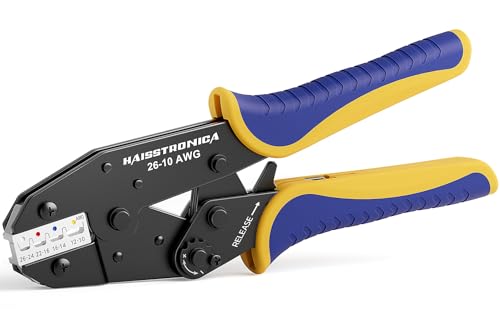 haisstronica HS-1073Best overall
 Plustool K-BM-104-USFull-featured heat shrink runner-up
 KLEIN TOOLS 3005CRColor-coded insulated terminal slots
The short version
These tools look alike because most have two handles and two jaws. Their jobs are different. A crimper deforms a metal barrel around a wire so the two become one tight joint. Pliers hold things, bend things and sometimes cut them.
The key difference is the jaw shape. Crimper jaws are dies with cavities sized for a specific terminal. Pliers have flat, serrated or pointed jaws that press on a few small spots. Those spots can pinch one side of a terminal and leave the other loose.
What a crimping tool does
A good crimp squeezes the barrel from several directions at once, so the metal wraps the wire strands and leaves little air space. That is why a crimp can hold firmly and carry current reliably.
Crimpers are built for one terminal family. Heat shrink connectors, insulated terminals, hex ferrules and battery lugs each need different dies. For example, the haisstronica HS-1073 is made for heat shrink connectors and lists a 10 to 26 AWG range. The Klein Tools 3005CR is made for insulated terminals and has three color-coded cavities: 22 to 16, 16 to 14 and 12 to 10 AWG.
Many crimpers also have a ratchet. A ratchet holds the squeeze until the cycle is complete, so the crimp gets the same force each time. Both tools above list full-cycle release, and the haisstronica also lists adjustable force and a quick-release lever. If you want to compare connector types and wire ranges on one sheet, see our best crimping tool page.
What pliers do well
Pliers are general-purpose hand tools. Needle-nose pliers reach into tight spots and bend small loops. Slip-joint and linesman styles grip, twist and pull. Some have a cutting edge near the pivot.
Pliers are the right choice for holding a nut, straightening a bent pin or twisting wires together before a splice. They are not designed to compress a terminal barrel. If you need a versatile everyday grip tool, our best pliers page lines up the options.
A pliers-crimped terminal may look fine and still pull out when tugged. It may also overheat under load, because a poor contact adds resistance. For anything carrying real current or exposed to vibration, such as vehicle or boat wiring, use a proper crimper.
Crimping tool vs wire cutter vs punching tool
People often group these three because they all show up in the same electrical kit. Here is how they compare.
A wire cutter shears through a conductor. It does not join anything. Some crimpers include a cutting edge for convenience. One pick on our crimping page cuts and crimps 10 to 22 AWG terminals, but a cutter blade built into a crimper is a side feature, not the main job.
A punching tool, also called a punch-down tool, pushes a wire into a slotted contact in a keystone jack or patch panel. The contact cuts through the insulation and grips the conductor. That is a different connection method from crimping, and it is used for network and phone wiring.
Side-by-side comparison
Use this table to match the job to the tool.
| Tool | Main job | How it works | Use it for |
|---|---|---|---|
| Crimping tool | Joins a connector to a wire | Dies squeeze the barrel evenly | Heat shrink connectors, insulated terminals, ferrules, lugs |
| Pliers | Gripping, bending, twisting | Jaws hold and pinch | Holding parts, shaping wire, pulling pins |
| Wire cutter | Cutting wire | Blades shear the conductor | Trimming wire to length |
| Punching tool | Seating wire in a jack | Pushes the wire into a slotted contact | Keystone jacks, patch panels, phone blocks |
How to choose the right one
Start with the connector, not the tool. Ask what you are attaching and what wire it must fit.
Then work through these steps:
- Identify the connector type: heat shrink, insulated terminal, ferrule, lug, modular plug or jack.
- Check your wire gauge. AWG numbers run backward, so a lower number means thicker wire.
- Pick a crimper whose dies and AWG range cover both ends of your wire sizes.
- Prefer a full-cycle ratchet if you want consistent crimps.
- Keep pliers and cutters on hand for the jobs around the crimp: holding, shaping and trimming.
Size, weight and heavy-duty jobs
Most hand crimpers on our crimping page weigh from 0.8 lb to 1.72 lb, so they fit a small toolbox. Heavy battery cable is another category. The Brileine hydraulic tool reaches 2/0 AWG and weighs 5.95 lb, which suits lug work but not a light kit.
If you only crimp a few small terminals a year, a single well-matched hand crimper usually covers it. If you switch between terminal families, look at kits with swappable dies, such as the Vesmikit set with six die options.
Safety notes
Turn off and disconnect power before you cut, strip or crimp any wire. For vehicle work, disconnect the battery first.
Wear safety glasses. Cut wire ends can fly off, and spring-loaded handles can snap open. Keep fingers out of the jaw area, especially on hydraulic tools, which can pinch hard.
After crimping, give each connection a gentle tug to check that it holds. If it slips, cut it off and redo it with the correct die.
Frequently asked questions
Can I crimp a ferrule with pliers if I am careful?
It is possible to squash one, but the result is usually uneven. Ferrules are designed for hex or square dies that press from all sides. Use the right crimper if the connection matters.
Do crimpers strip wire too?
Most do not. Strip the insulation first with a dedicated stripper, then crimp. Some multi-function tools add a stripping notch, but it is not the main job.
Is a crimp as good as solder?
A properly made crimp with the correct tool and terminal is a standard, reliable method, especially where vibration is a concern. A bad crimp from the wrong tool is worse than either.
Can a punching tool crimp RJ45 plugs?
No. RJ45 plugs need a modular crimper. A punch-down tool is for jacks and patch panels.