Core Drill vs Hammer Drill: What Is the Difference?
No, a core drill is not the same as a hammer drill. A hammer drill spins a solid bit while adding rapid impacts to break up masonry, which suits small to medium holes and anchors. A core drill spins a hollow bit that cuts a ring and leaves a solid plug, which suits large, clean holes in concrete.
 VEVOR Z1Z-9230Best overall
 VEVOR (8260H)Z1Z-9260Largest hole capacity
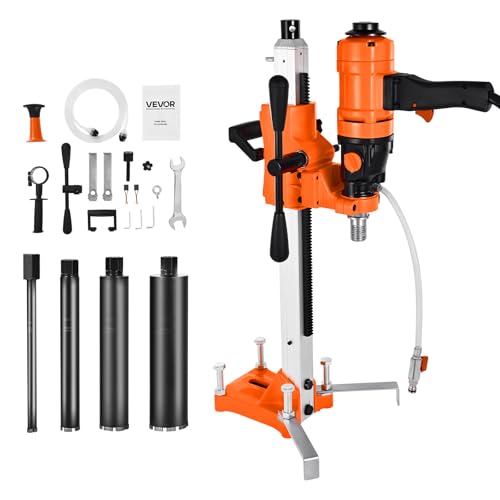 VEVOR Z1Z-CF03-80SHandheld or stand with four bits
The short version: two different ways to cut
A hammer drill and a core drill both make holes in hard material, but they do it in opposite ways. One crushes the material in front of the bit. The other cuts a circle and lifts the middle out in one piece.
A hammer drill pairs rotation with fast, short impacts. The bit chips and pulverizes masonry as it turns, and dust comes out through the flutes. A core drill uses a hollow cylinder, usually with diamond segments on the rim, that grinds a ring-shaped channel. The center stays intact and comes out as a solid core.
That difference explains almost everything else: the hole sizes each tool handles, the noise and vibration, the mess, and the kind of job each one fits.
How a hammer drill works
Inside a standard hammer drill, two ridged discs or cams ride against each other. As the chuck turns, the ridges knock the bit back and forth in tiny, fast strikes. You push forward, the bit hammers and rotates, and the concrete or brick breaks away.
Hammer drills usually have a clutch-style mode switch, so you can turn the hammering off and use the tool as a regular drill for wood and metal. That flexibility is why they are common in home workshops and on job sites. If you are shopping, our best hammer drill corded and best hammer drill cordless pages compare them side by side.
How a core drill works
A core drill has no hammering action. It relies on steady rotation, firm but even pressure, and a bit with a hollow center. Diamond core bits are common for concrete, brick and stone because the diamond segments grind through hard aggregate and rebar-free concrete cleanly.
Many core drills are designed for wet cutting. Water cools the bit, flushes out slurry and keeps dust down. Because the tool does not pound the material, the edges of the hole stay smooth and the surrounding concrete is less likely to crack or spall.
Core drills are usually heavier and often mount on a stand that holds the bit square to the surface. That stand matters for big holes, where hand-holding the tool is hard to control. If you want to see the options compared, check our best core drill page.
Core drill vs rotary hammer, SDS and SDS Max
These terms get mixed up, so here is how they fit together. A rotary hammer is a stronger cousin of the hammer drill. Instead of cams, it uses a piston mechanism to deliver heavier impacts, which makes it faster in concrete and easier on your wrist.
SDS and SDS Max are not tool types. They are bit-holding systems. SDS bits slot into the chuck and can slide back and forth, which lets the hammering action pass straight to the bit. SDS Max uses a larger shank for heavier rotary hammers and bigger bits. The two are not interchangeable, so match the bit to the tool.
Some SDS Max rotary hammers can run special core bits for large holes, usually in a dry, hammering-assisted style. A dedicated diamond core drill still usually gives a cleaner, quieter cut with less vibration, especially at larger diameters. If you are weighing general options, our best drill page covers the wider field.
Side-by-side comparison
Here is how the main tools stack up in general terms.
| Feature | Hammer drill | Rotary hammer (SDS) | Core drill |
|---|---|---|---|
| Cutting action | Rotation plus cam impacts | Rotation plus piston impacts | Rotation only with hollow bit |
| Bit type | Solid masonry bit | Solid SDS or SDS Max bit | Hollow core bit, often diamond |
| Best hole size | Small to medium | Small to large | Large |
| Hole quality | Good for anchors | Good, can chip edges | Clean, smooth edges |
| Dust and mess | Dry dust | Dry dust | Slurry if wet, less dust |
| Typical use | Anchors, light masonry | Frequent concrete work | Pipes, vents, cable passes |
Which one should you choose?
Start with the hole you need. Small holes for screws, plugs and anchors are a hammer drill job. If you drill concrete often, or need faster progress, a rotary hammer is worth a look.
Reach for a core drill when the hole is large and needs to look right: plumbing and drain lines, dryer or exhaust vents, and cable runs through a wall or slab. Cutting a large hole by drilling many small ones is slow and leaves ragged edges.
Use this quick checklist:
Think about how many holes you need and how often you will make them. One or two large holes may be better handled by a rental or a pro. Regular large-hole work justifies owning a core drill.
- Anchors and small holes in brick or concrete: hammer drill.
- Frequent heavy concrete drilling: rotary hammer with SDS or SDS Max.
- Large, clean holes for pipes or vents: core drill.
- Mixed wood, metal and light masonry: hammer drill with the hammer mode off when needed.
Safety notes before you drill
Concrete work carries real risks, so set up carefully.
Wear safety glasses, hearing protection and a dust mask rated for fine mineral dust. Silica dust from concrete is harmful to breathe, so use water suppression or a dust extractor where you can.
Check the wall before you cut. Look for hidden wires, pipes and rebar, and use a detector if you have one. Never drill into a spot where live electrical lines may run.
Wet core drilling mixes water and electricity. Use a tool designed for it, plug into a GFCI-protected outlet, and keep cords away from the water. Hold the tool with both hands, or use a stand, because a bit that binds can twist the tool hard. When working on a ladder or at height, make sure your footing is stable before you start.
Frequently asked questions
Can I use a hammer drill to make a core hole?
Only for small holes. A standard hammer drill is not built to turn a large hollow bit, and the impacts can crack the material or damage the bit. Use a core drill or a rotary hammer rated for core bits.
Do core drills have a hammer mode?
Dedicated diamond core drills do not. They rely on rotation and the diamond edge. Some rotary hammers offer a rotation-only setting so they can turn core bits.
Why do some core drills use water?
Water cools the diamond bit, carries away slurry and keeps harmful dust down. It also helps the bit last longer and cut more smoothly.
Is a rotary hammer better than a hammer drill?
For concrete, usually yes, because the piston mechanism hits harder and works faster. A hammer drill is lighter and more flexible for mixed jobs, so the better choice depends on your work.