Can You Use Copper Pipe for Air Compressor Lines?
Yes, you can use copper pipe for air compressor lines. Rigid copper with soldered or press-style fittings resists rust, keeps the air path smooth and holds up well in a shop. It takes more skill and time to install than modern kit pipe, and you should never use PVC for compressed air.
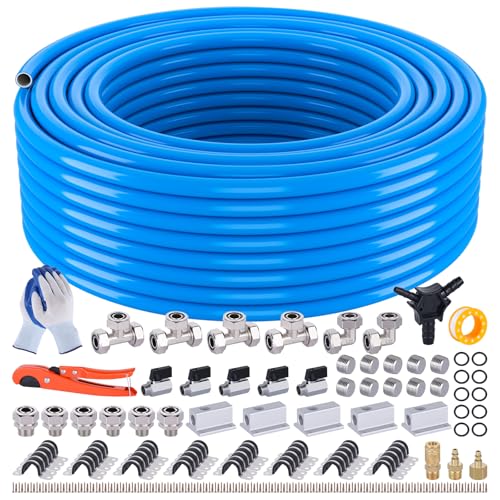 MOLAVIEE 200FT-3_4HDPE-Al-KITSBest overall
 Fideursus 9130GLongest run
 boeray HDPE Piping-200FTMost fittings
Short answer on copper, PVC and black pipe
Copper is a proven choice for compressed air. Condensation forms in any air system, and copper does not rust the way steel does, so the inside of the line stays cleaner. The trade-off is installation. You need to cut, clean and join every joint correctly, and a poor joint can leak or fail.
PVC is the one material to avoid. It is not made for compressed air and can shatter into sharp pieces if it fails, because air stores energy that water does not. Black iron pipe works but rusts inside over time and is heavy and slow to thread. For most home shops, a bendable HDPE-aluminum-HDPE kit is the easier route, and you can see how those kits compare on our best pipe for air compressor lines page.
How copper compares with other pipe types
Each material has a different mix of strengths. The table below sums up the general differences. It describes how these materials behave in practice and is not a set of pressure ratings.
| Pipe type | Install effort | Rust inside | Safe for air? |
|---|---|---|---|
| Rigid copper | High: cutting, cleaning, soldering or pressing | Does not rust | Yes, with proper joints |
| Black iron | High: threading, heavy lengths | Rusts over time | Yes, but scale can reach tools |
| PVC | Low | Does not rust | No, can shatter |
| HDPE-aluminum-HDPE | Low: cuts and bends by hand | Does not rust | Yes, within its rating |
What to know before choosing copper
Not all copper pipe is the same. Use rigid, hard-drawn copper pipe intended for plumbing or gas service, and do not use thin soft coil tubing for a main line. Rigid pipe holds its shape and handles the stress of a fixed run better.
Be careful with pressure ratings. A rating printed for water pipe describes static liquid pressure. Compressed air behaves differently because the gas can be compressed and releases its energy suddenly if the pipe or a joint fails. Choose pipe and fittings from the manufacturer's stated rating for compressed air, and keep your regulator and tank settings well within that rating.
Heat also matters. Soldering softens copper near the joint, which can lower its strength there. A clean, well-made joint is fine, but a rushed one is the weak point in the system.
Planning a copper air line
A good layout matters as much as the pipe. Short, simple runs with few turns keep pressure loss low. A 3/4 in line suits most home shops, and that size works well for copper too.
Follow these steps for a layout that handles moisture well:
- Mount the pipe on the wall or ceiling with a slight slope away from the compressor, so water flows to a low point.
- Add a drain valve at each low point and at the end of the line.
- Take each drop off the top of the main line, then bend down. This keeps water out of your tools.
- Place an outlet near every work area so you rarely need a long hose.
- Pressure test with soapy water after the first fill and check every joint for bubbles.
Safety notes for building the line
Always release all air pressure from the tank and the pipe before you cut, loosen or change any fitting. Wear safety glasses whenever you work on a pressurized system or cut pipe, because fragments and fittings can fly. Hearing protection is smart when the compressor is running nearby.
Soldering involves an open flame, so clear flammable materials from the area, keep a fire extinguisher close and protect nearby wood with a heat shield. If your compressor is electric, unplug it before you work on the line. Use a stable ladder for ceiling runs and have a second person help with long lengths.
When a kit may be the simpler choice
If you want less time on the ladder and no torch, an HDPE-aluminum-HDPE kit is worth a look. Our top pick on the pipe page, the MOLAVIEE 3/4 in kit, includes 200 ft of pipe, 5 aluminum outlet blocks and 5 drain valves, with a bevel tool and pipe cutter among its 170 pieces. The listing states it holds 200 PSI at 73°F and 160 PSI at 140°F, and that it meets ASTM F1282 and F1974. Its bend radius is 6 to 8 inches, so the pipe can be shaped by hand.
If you have a bigger shop, the Fideursus 3/4 in kit runs 300 ft and includes a pressure gauge. The Boeray 3/4 in kit offers 200 ft and 186 pieces with install tools. These kits join with compression fittings, so there is no glue or soldering. For help with the connections at your tools and compressor, see our best air compressor fittings comparison.
The pipe is only half of the system, and the compressor should match the job. If you are still choosing one, our best air compressor for home garage page is a good place to start.
Frequently asked questions
Can I use soft copper tubing for an air line?
It is better suited to short connections than a main line. Rigid copper holds its shape and supports a fixed run more securely, so use it for the long stretches.
Does copper need a drain valve like other pipe?
Yes. Copper does not rust, but water still collects in the line. Drain valves at low points let you remove it.
Is PVC ever acceptable for compressed air?
No. It can shatter under pressure and send sharp fragments flying. Choose copper, black iron or an air-rated HDPE-aluminum pipe instead.
Can I mix copper with other pipe types?
You can, if the fittings are rated for compressed air and match the pipe on each side. Use the correct adapter at each change and check every joint for leaks.