Can You Use a Finish Nailer for Hardwood Floors?
Only for small jobs. A finish nailer can face-nail the last row or two against a wall, where a flooring nailer will not fit, but it is the wrong tool for installing a whole floor. Flooring nailers drive cleats or staples at the tongue of each board, and a finish nailer cannot match that hold.
 Metabo HPT NT65MA4Best overall
 meite T64A with 2500 Nails (US)Light with jam release
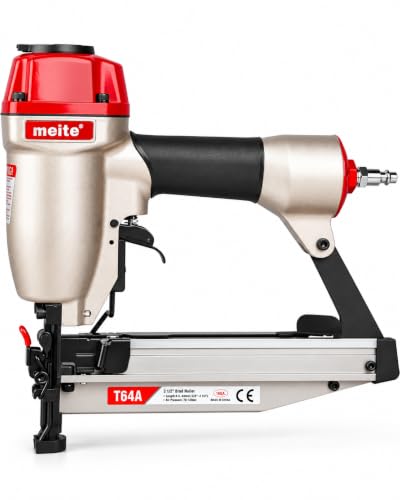 meite T64APlain T64A configuration
The short answer
A finish nailer is built to fasten trim, casings and cabinet parts. It drives a thin, headed nail straight down through the face of a board. Hardwood flooring is normally installed differently, with a nail or cleat driven at an angle through the tongue, so the fastener stays hidden and the board is pulled tight to its neighbor.
That difference is why most flooring guidance points you to a dedicated flooring nailer for the main field of the floor. A finish nailer still has a place in the job, mostly at the edges and in the finishing details. The sections below show where it fits and where it does not.
Why a flooring nailer does the job better
A flooring nailer is designed around the tongue-and-groove board. It sits on the board edge, and a mallet strike or air pressure drives a cleat or staple at roughly a 45 degree angle through the tongue. The fastener is hidden by the next board, and the angle helps draw each board snug against the last one.
A finish nailer does none of this. Its nails go in straight from the top, they leave a visible hole in the surface, and the nose is not shaped to sit on a tongue. A thin finish nail also does not have the shape of a flooring cleat, which is made to grip the subfloor and resist the board lifting or shifting over time.
Wood moves with humidity, and a floor is a large surface that moves as one piece. That is another reason flooring fasteners are designed for the job. If you are not sure what your flooring maker requires, check the installation instructions that came with the boards, because they often name the fastener type and spacing.
Where a finish nailer does help on a floor job
There are a few spots where a finish nailer earns its place. The first and last rows of a floor often sit too close to a wall for a flooring nailer to swing or sit properly. Many installers face-nail those rows with a finish nailer, then hide the gap under baseboard or shoe molding.
Face-nailing leaves holes, so plan to fill them with color-matched putty. Pick a nail length that reaches the subfloor through the board, and set the depth so the nail head sits just below the surface without crushing the wood.
A finish nailer is also useful for the parts around the floor:
- Baseboard and shoe molding along the walls
- Quarter round at the floor edge
- Stair nosing and stair parts, where a heavier nail holds better
- Door casings that need trimming after the floor goes in
- Transition strips and thresholds, if the maker allows face-nailing
Which finish nailer suits floor-related work
Gauge matters. A 15 gauge nail is thicker and holds heavier trim, casings and stair parts. A 16 gauge nail is thinner and leaves a smaller hole to fill. For face-nailing flooring near a wall, the thicker nail gives more holding power. For delicate trim and quarter round, the thinner nail is often enough.
In our spec comparison, the Metabo HPT NT65MA4 is the 15 gauge model. It accepts nails from 1.25 to 2.5 in., weighs 4.2 lb, and has an angled magazine for tight corners. The meite T64A is a 16 gauge model with the same 1.25 to 2.5 in. nail range at 3.86 lb, with tool-free jam release. You can see the full lineup on our best finish nailer page.
If you are deciding between several nailer types for a bigger project, our best nailer page compares them side by side.
| Tool | Fastener | Best floor-related use |
|---|---|---|
| Flooring nailer | Cleat or staple at an angle through the tongue | Main field of a tongue-and-groove floor |
| 15 gauge finish nailer | Thicker straight nail | Face-nailing last rows, stair parts, heavy trim |
| 16 gauge finish nailer | Thinner straight nail | Baseboard, shoe molding, quarter round |
| Brad nailer | Very thin pin-like nail | Light trim only, not flooring |
Quarter round, fencing and PVC trim
Quarter round is a good match for a finish nailer. Nail it into the baseboard, not down into the floor, so the floor can still expand and contract under it. Use a nail long enough to bite into the wall framing or baseboard, and set it slightly below the surface.
Fencing is a poor match. Fence boards need fasteners with strong holding power and corrosion resistance outdoors, and a thin finish nail is usually not meant for that. A framing or siding nailer is more typical for pickets and rails. A finish nailer can work for small decorative fence trim if the nails are rated for outdoor use.
PVC trim works well with a finish nailer. Use stainless steel or hot-dip galvanized nails so they do not stain or corrode, and keep the depth setting gentle because PVC can dent. Leave room for the material to expand and contract with temperature, and follow the trim maker's guidance on spacing.
Safety notes
Wear safety glasses every time you fire a nailer, since a nail can ricochet or a chip can fly off hard wood. Add hearing protection if you are working with an air compressor for long stretches.
Keep your free hand and your body away from the nose and the line of fire. Disconnect the air hose before you clear a jam, adjust the tool or walk away. If you use a compressor, stay within the maximum pressure printed on your tool. For example, the meite T64A lists 120 PSI as its maximum.
Check for pipes, wires and radiant heat lines before you nail into a subfloor or wall. If you are working on a ladder or stairs, set your footing first so a recoil does not throw you off balance.
A simple way to decide
Ask what you are fastening. If it is the main field of a tongue-and-groove floor, use a flooring nailer. If it is a last row, trim, stair part or quarter round, a finish nailer is a sensible choice.
Then pick the gauge for the job: 15 gauge for holding power, 16 gauge for smaller holes. Match the nail length to the thickness of what you are nailing through, and fill your holes before finishing.
Frequently asked questions
Can I use a brad nailer instead of a finish nailer on floors?
Not for flooring boards. Brad nails are too thin to hold hardwood. They suit only light trim and small moldings.
Should I use glue along with nails on the last row?
Many installers add a bead of flooring adhesive on the last rows, since face nails alone may not hold well. Check what your flooring maker allows.
Do I need to fill nail holes after using a finish nailer on flooring?
Yes. Face-nailing leaves visible holes, so fill them with putty matched to the wood color before you finish or clean the floor.
Is cordless or air-powered better for trim work near floors?
Both work. Air-powered models like those on our comparison page are lighter in the hand, but they need a compressor and a hose.