Can You Sharpen Knives and Blades on a Bench Grinder?
Yes for tough, heavy blades such as lawn mower blades, axes and shovels, but it is a poor choice for kitchen knives and fine chisels. A bench grinder removes metal fast and builds heat quickly, and heat can soften the steel and ruin the edge. If you use one, keep the blade cool, take light passes and wear eye protection.
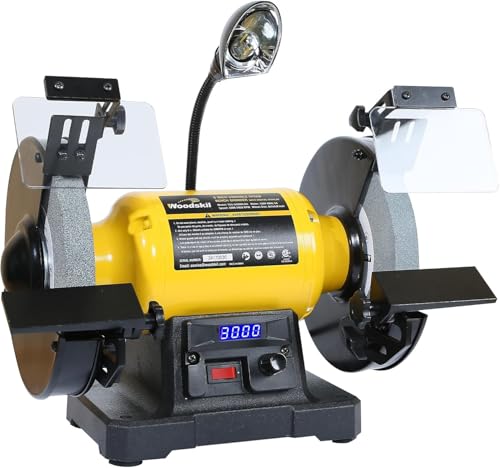 Woodskil TDS-G200VLGABest overall
 WEN BG625VVariable speed with warranty
 Greteefor NS-SLJ-01-3Cast iron variable speed
Why heat is the real problem
A bench grinder spins a hard abrasive wheel at high speed. That removes steel quickly, but it also creates friction heat at the very thin edge of a blade. Thin edges heat up fastest because there is little metal to carry the warmth away.
Most blades get their hardness from heat treatment, which is called temper. If the edge gets hot enough, that temper is lost and the steel turns soft. A softened edge may look fine and even feel sharp for a moment, then fold over or go dull almost right away. You can't restore it by sharpening again. You have to grind back past the damaged steel.
A common warning sign is bluish or straw-colored discoloration near the edge. If you see color, the metal has already been overheated.
Which blades suit a bench grinder
The rule of thumb is simple: the thicker and tougher the blade, the safer it is on a grinder. Thick steel absorbs heat better, and a slightly rough edge does the job well for chopping, cutting grass or splitting wood.
Fine, thin or expensive blades belong on stones, guided systems or strops instead. The table below sums it up.
| Tool | Bench grinder? | Why |
|---|---|---|
| Lawn mower blade | Yes, with care | Thick, tough steel and a rough edge is fine |
| Axe or hatchet | Yes, with care | Heavy edge, but keep it cool to protect temper |
| Shovel or garden hoe | Yes | Low-precision tool, forgiving |
| Wood chisel or plane iron | Only for repairs | Needs a flat, fine edge; use the grinder for reshaping only |
| Kitchen knife | Not recommended | Thin edge overheats fast and the wheel is too coarse |
| Pocket or fine knife | Not recommended | Easy to burn and hard to hold at a steady angle |
How to sharpen a mower blade or axe safely
Before you start, make sure the grinder is stable and that the tool rest is set close to the wheel. Remove the mower blade from the mower first, and disconnect the spark plug wire before you reach under the deck. If you are choosing a machine, our best bench grinder page compares published specifications such as wheel size and motor details.
- Wear safety glasses or a face shield, hearing protection and snug gloves, and tie back loose hair and clothing.
- Secure the blade or axe so it can't be pulled out of your hand. For a mower blade, a vise and a hand file can be a calmer alternative.
- Check the wheel for cracks or chips before turning the grinder on. Replace a damaged wheel.
- Stand to the side of the wheel, not in line with it, and let it reach full speed.
- Match the existing bevel angle and move the edge across the face of the wheel with light, even pressure.
- Dip the blade in water often so it stays cool enough to touch. Never quench a blade that is red hot or glowing.
- Keep an eye on balance for mower blades. Remove the same amount of metal from both ends, then check on a nail or a blade balancer.
What about kitchen knives and chisels?
For kitchen knives, skip the bench grinder. Kitchen blades are thin, often hardened to hold a fine edge, and the wheel makes it easy to remove too much steel in one pass. Whetstones, pull-through sharpeners and guided systems are far more forgiving and let you hold a steady angle.
Chisels and plane irons are a middle case. A grinder can fix a chipped edge or reshape a worn bevel, but it should not be the last step. Grind lightly with frequent cooling, then finish on a fine stone to get a flat, keen edge.
If you want a tool that is easier on the steel, a slow-speed wheel or a wet grinder runs cooler. That is a different kind of machine from a standard high-speed bench grinder.
Other options for mower blades
If you don't own a bench grinder, you can sharpen a mower blade with a hand file or an angle grinder. An angle grinder is handy because you can work on a blade held in a vise. Our guide to the best angle grinder disc for sharpening mower blades explains what to look for in a disc.
Whichever tool you pick, the goals are the same. Keep the original bevel, avoid overheating the steel and keep the blade balanced. After sharpening, wipe the blade clean and wear gloves when you refit it.
Quick checklist before you grind
Run through these points every time and you will avoid most problems.
- Is the blade thick and rugged enough for a grinder?
- Do you have eye, ear and hand protection on?
- Is the wheel in good shape and the tool rest set close?
- Do you have a bucket of water within reach?
- Are you taking light passes instead of pushing hard?
Frequently asked questions
What grit should I look for on a grinder wheel?
Coarser wheels cut fast and run hotter, while finer wheels cut slower and leave a smoother edge. For sharpening, a finer wheel is usually the gentler choice, and a friable wheel stays cooler than a hard one.
How do I know if I overheated the blade?
Look for blue or straw-colored tints near the edge. Another sign is an edge that feels sharp at first but dulls or rolls quickly. Overheated steel must be ground back past the damage.
Can I finish the edge after grinding?
Yes. A fine stone, file or strop can refine a ground edge and remove the burr. This extra step makes chisels and axes cut much better.
Should the grinder wheel spin toward me or away from me?
Hold the blade so the wheel rotates down toward the tool rest, with the edge trailing away from the wheel. That way the wheel is less likely to catch the edge and pull the tool out of your hands.