Can You Sharpen Jointer Blades and How Often?
Yes, straight jointer knives can be sharpened, either by honing them by hand or by sending them to a sharpening service. Spiral and helical heads use small inserts that you rotate to a fresh edge or replace, not sharpen. There is no fixed schedule. Sharpen, rotate or replace when the cut quality drops, which depends on how much and what kind of wood you joint.
 CUTECH 401120HI-IFBest overall
 Jet JJ-6HHDXLongest 6 in tables
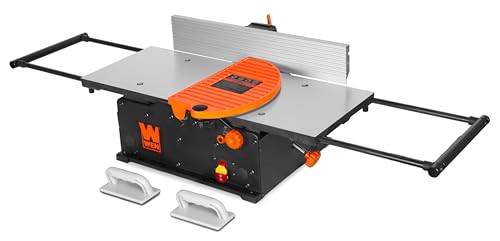 WEN JT1224HBest wide benchtop value
The short answer: it depends on your cutterhead
Whether you can sharpen the cutting edges comes down to what is on your cutterhead. Long straight knives are made to be sharpened over and over. Small inserts on spiral and helical heads are made to be turned or swapped.
Straight knives come in two or three per head and are bolted in with gibs. When they dull, you can hone them, grind them, or send them out. Inserts are small squares or diamonds held by one screw each. Most are carbide, and some spiral heads use HSS inserts. Carbide is very hard and hard to sharpen well at home.
Our best jointer page lists the cutterhead type for each model, so you can see which upkeep style you would be signing up for before you buy.
Straight knives: sharpen, hone or send out
Straight knives give you three realistic options. The right one depends on how dull or damaged the edge is.
A light touch-up works when the edge is just a little dull. You can hone the bevel on a flat stone or a sharpening plate, using a jig that holds the knife at the factory angle. This keeps the edge fresh between deeper sharpenings. Because honing removes very little steel, it works best on knives that have not yet been nicked.
Deeper damage needs a grinder. If a knife has nicks from a hidden nail or a hard knot, honing will take too long. A professional sharpening service can regrind the knives to a matching edge and weight. Matching matters, because knives that differ in weight can make the head vibrate.
Whichever method you choose, sharpen all the knives in the set evenly. If you grind one knife more than the others, the edges will no longer sit at the same height when reinstalled. That leaves ridges or a poor finish.
Spiral and helical heads: rotate, don't sharpen
Inserts are designed so that you never have to sharpen them. Each insert has more than one cutting edge. When one edge dulls or chips, you loosen the screw, turn the insert to a fresh edge, and tighten it again.
The JET JJ-6HHDX is a good example from our data. It has 27 four-sided carbide inserts, and the listing says you rotate a dull or nicked insert 90° to a fresh edge. It also includes five spare inserts. The CUTECH 12-inch model has 24 two-sided inserts, so each one gives you two edges. The Powermatic 60HH has 54 four-sided carbide inserts.
This is a big reason people choose spiral heads. A nick from one bad board usually affects a single insert, so you replace or rotate that one piece instead of resetting a full-length knife. If your head uses HSS inserts, such as the 24 on the WEN JT1224H, follow the maker's manual for turning or replacing them.
How often should you sharpen or rotate?
There is no honest one-size answer. How long an edge lasts depends on the wood species, how much stock you remove, how clean the lumber is, and whether the edge hit grit or metal. Hardwoods and dirty or reclaimed boards dull edges faster. Carbide generally holds an edge longer than HSS, as noted on our best jointer page.
Instead of watching the calendar, watch the machine and the wood. These signs tell you it is time:
- Tear-out or fuzzy grain that was not there before, especially on wood that used to cut cleanly.
- Visible lines or ridges running along the board, which often mean a nick in one knife or insert.
- Burn marks or a shiny, burnished surface, which can mean the edge is rubbing instead of cutting.
- Needing more passes or more force to feed the board.
- A louder, harsher sound or more vibration during the cut.
Quick comparison of upkeep by cutterhead type
Here is how the main options compare when it is time to refresh the cutting edge.
| Cutterhead type | Example from our data | What you do when it dulls | Notes |
|---|---|---|---|
| Straight knife | VEVOR 6-Inch Benchtop Jointer (2-blade straight cutterhead) | Hone, regrind or replace the knives | Set knives carefully so they sit level with the outfeed table |
| Spiral, carbide inserts | CUTECH 12-Inch Spiral Benchtop Jointer (24 inserts) | Rotate to a fresh edge or replace the insert | Only the dull or nicked inserts need attention |
| Helical, four-sided carbide | JET JJ-6HHDX (27 inserts, 5 spares included) | Rotate 90° to a new edge | Four edges per insert before replacement |
| Spiral, HSS inserts | WEN JT1224H (24 HSS blades) | Follow the manual to rotate or replace | Check the manual for how many edges each insert has |
Safety and setup tips
Jointer knives and inserts are very sharp, and the head spins fast. Treat every maintenance task as if the machine could start.
Always unplug the jointer before touching the cutterhead, and keep the cord where you can see it. Wear cut-resistant gloves when handling knives, and use eye protection when you hone, grind or brush away chips. Hearing protection is smart whenever the machine runs, since jointers are loud.
Use the correct wrench and tighten insert and gib screws to the maker's specification. A loose insert can come out at speed. Clean the seat under each insert first, because a speck of resin or dust can tilt the cutting edge.
Tips to make edges last longer
Good habits stretch the time between sharpenings and rotations.
Check boards for nails, staples and embedded grit before they reach the head, and brush off dirt. Take lighter passes. The listed maximum depth of cut is 1/8 in on most of the models in our data, but a lighter pass is easier on the edge and the motor. The Powermatic 60HH lists a 1/2 in maximum cut, but light passes still help.
Spread the wear by using the full width of the head instead of running every board along the same strip. This helps especially on narrow stock. Keep spare inserts or a spare knife set on hand so a nick does not stop your project, and wipe down the tables so a clean board slides smoothly.
Frequently asked questions
Can you sharpen carbide jointer inserts?
It is not practical for most home shops. Carbide needs special diamond abrasives and equipment. Most makers expect you to rotate the insert to a fresh edge and replace it once all edges are worn.
Do I need to sharpen new jointer knives first?
Usually not, but you should check the set. Make sure they are installed level with the outfeed table and tightened properly, since a bad setup causes problems that look like dull knives.
Can a nick in one knife be fixed without regrinding all of them?
On a straight-knife head, a small nick can sometimes be hidden by shifting a knife sideways. A lasting fix usually means regrinding the set evenly. On an insert head, you just rotate or replace the damaged insert.
Is it cheaper to sharpen or replace?
It varies by machine and by how you work. Sharpening services suit long straight knives, while inserts are meant to be replaced. Check the cost of replacements for your model before you decide.