Can You Sharpen a Chainsaw Chain? A Filing Guide
Yes, you can sharpen a chainsaw chain at home with a round file that matches your chain's pitch, a flat file for the depth gauges, and a filing guide. Most chains can be sharpened many times, until the cutters wear down to the maker's wear mark. If the chain is bent, cracked or filed down past that mark, replace it.
 KAKEI 18" 3/8"LP .050" 62DL- German Steel *3Best overall
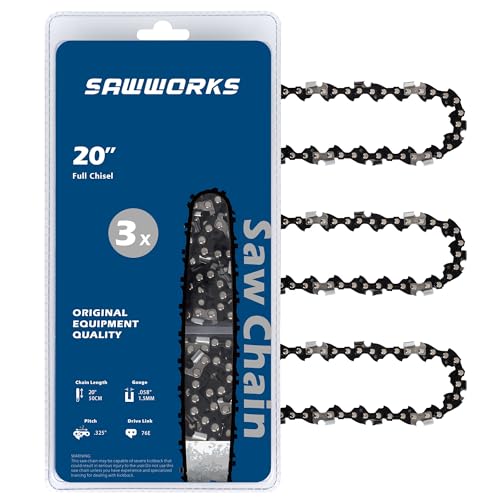 SawWorks 20" 76DL .325" .058"-GermanSteel *3PcsBest for big saws
 GSSHBR 18Inch 3/8 050 62 5PackBest 18 in value pack
Signs your chain needs sharpening
A sharp chain pulls itself into the wood and throws out long, thick chips. A dull chain makes fine dust, needs pushing, and can drift to one side. Smoke or a burning smell from the cut is another clue.
Do not wait until the saw is struggling. A chain that is only slightly dull takes a few quick strokes per cutter to fix. A badly dulled or damaged one takes much longer, and a chain that hit dirt or rock may need to be ground or replaced.
- Chips look like powder instead of curls
- You have to press down on the saw to make it cut
- The saw pulls left or right in the cut
- The cutters look rounded, shiny or chipped on the top plate
- The chain smokes even with enough bar oil
What size file for a chainsaw chain
The round file must match the chain's pitch. Too small and you cut a notch that does not reach the cutting edge. Too large and you remove too much metal and ruin the cutter's shape. The pitch is usually stamped on the guide bar, and the chain maker's chart is the final word if it differs from the sizes below.
If you shop with us, the pitch is listed with each chain on our best chainsaw chain comparison. For example, the 18 in KAKEI 3-pack is 3/8 LP pitch with a .050 in gauge. The 20 in SawWorks 3-pack is .325 pitch with a .058 in gauge. Gauge is the drive link thickness, so it does not change the file size. Pitch does.
| Chain pitch | Typical round file | Example from our comparison |
|---|---|---|
| 3/8 LP (low profile) | 5/32 in (4.0 mm) | KAKEI 18 in, 62 drive links |
| Standard .325 | 3/16 in (4.8 mm) | SawWorks 20 in, 76 drive links |
| Standard 3/8 | 7/32 in (5.5 mm) | Not in our current picks |
Tools and safety before you start
You need a round file in the right size, a file handle, a filing guide, a flat file and a depth gauge tool. A filing guide with angle markings helps keep each cutter the same. A bench vise or a stump vise holds the bar steady.
Safety comes first. Turn the saw off and let it cool. Remove the spark plug cap on a gas saw or the battery or plug on an electric one so it cannot start. Wear cut-resistant gloves, because even a dull chain can cut skin, and wear eye protection because filings and metal dust fly. Engage the chain brake only if your saw's manual says that is safe for filing, and never rest your hand on the sharp edge of a cutter.
How to file the chain, step by step
The goal is simple: every cutter on the chain ends up the same length with the same angle. Go slowly and count your strokes.
Use a marker on the first cutter so you know where you started.
- Clamp the bar in a vise or secure it on a stump, with the chain tight enough to hold still but still able to move by hand.
- Pick a starting cutter and mark it. Place the round file in the cutter's gullet, with the file guide resting on the top plate and the depth gauge.
- Match the filing angle stamped on the guide or the one the chain maker recommends. Many chains use around 30 degrees, but check yours.
- Push the file forward and slightly across, in one direction only, with firm pressure. Lift the file on the return. Do not saw back and forth.
- Take the same number of strokes on each cutter, usually 2 to 5 for a lightly dulled chain.
- Move to every other cutter on one side, then flip the saw around and do the cutters on the other side.
- Check that all cutters are the same length. If one is shorter, file the others to match it.
Do not forget the depth gauges
Each cutter sits behind a small hook called a depth gauge, or raker. It sets how deep the cutter bites. As you file the cutters, they get shorter and the gauges stay the same, so the chain begins to cut more slowly even when it is sharp.
Every few sharpenings, check the gauges with a depth gauge tool that matches your chain's pitch. If a gauge sticks up above the tool, file it flat with the flat file, then round off the front corner so the chain does not grab. Do not file the gauges lower than the chain maker's setting. Too low a gauge makes the saw grab and can raise the risk of kickback.
How many times can you sharpen a chain
There is no fixed number. It depends on how much metal you remove each time, how dirty the wood is, and how well you keep the cutters even. A light touch-up removes little material, so a chain you maintain often will last through many sharpenings.
The real limit is the wear mark. Many chains have a line or notch on the cutter top plate. Once the cutter is filed down to that mark, retire the chain. Also replace it if you see cracked or bent links, loose or worn rivets, or cutters that no longer hold an edge after proper filing.
Semi-chisel cutters, like those on the KAKEI and JINFFR chains on our comparison page, are generally easier to file and hold an edge in dirty wood. Full chisel cutters, like the SawWorks chain, cut quickly in clean wood but dull sooner, so they need more careful filing.
Sharpen, send out or replace
Hand filing costs you only your time once you own the tools. Having a shop grind the chain is useful if you hit dirt or the cutters are uneven. We do not list prices, so check local shops for their rates.
Replacing the chain makes sense when it is worn out or damaged. Buying a multi-chain pack also lets you swap in a fresh chain in the field and sharpen the dull one later at home. Our chainsaw chain comparison shows packs of 1 to 5 chains. Whichever you pick, match bar length, pitch, gauge and drive link count to your saw before you buy.
Frequently asked questions
What size file for .325 chainsaw chain?
A 3/16 in (4.8 mm) round file is the usual match for standard .325 pitch chain. Confirm with the chain maker's chart, since cutter shape can vary.
Do I need to sharpen a new chain?
Usually not. New chains come sharp and coated in protective oil. File the first time when the chips turn fine or the saw starts to pull to one side.
How often should I touch up the chain?
A few light strokes per cutter whenever the cut slows is better than one big sharpening later. Many people touch up after every tank of fuel or every battery charge, depending on the wood.
Can I sharpen a chain while it is on the saw?
Yes, and it is the usual way to do it. Keep the saw off and unable to start, hold the bar steady, and wear gloves and eye protection.