Can You Repair a Hose Reel? Common Problems and Fixes
Yes, you can repair many hose reel problems yourself. Leaks at fittings, loose mounting hardware, tangled hose and stiff swivels are usually simple fixes. A retractable reel with a broken internal spring is the main exception, because the coiled spring is under tension and is usually better replaced than opened.
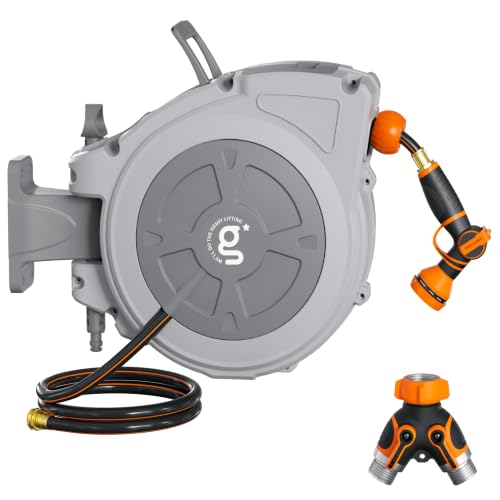 Giraffe Tools MWBest overall
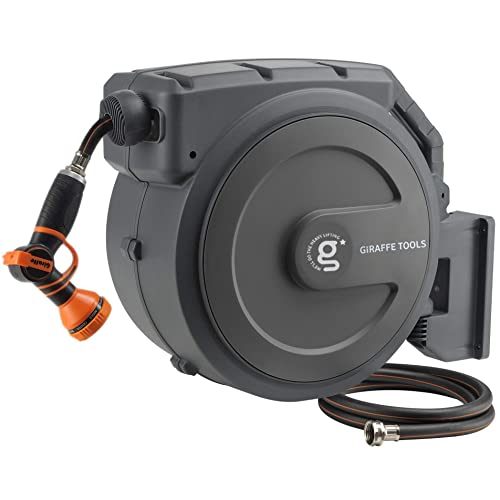 Giraffe Tools AW40-1/2Most retractable hose
 Liberty Garden 712Lightest, widest swivel
What you can fix and what you should not
Hose reels are fairly simple machines. A frame holds a drum, the drum holds the hose, and a swivel or tube carries water from the spigot to the hose. Retractable models add a coiled spring and a locking mechanism. Most trouble comes from worn seals, loose screws, dirt or a kinked hose, and those are all cheap to deal with.
The problems to be careful with are inside the spring housing. A wound spring can release suddenly and cause a cut or a crushed finger. If the reel will not rewind at all and the hose itself is fine, replacement is often the sensible choice.
Here is a quick way to sort your problem:
| Problem | Likely cause | DIY fix? |
|---|---|---|
| Leak at the spigot connection | Worn or missing washer | Yes, replace the washer |
| Leak at the reel swivel or inlet | Worn seal or cracked inlet tube | Often, if the part is available |
| Hose will not rewind smoothly | Twists, kinks or a dirty guide | Yes, untwist and clean |
| Hose will not lock | Dirty or worn latch | Sometimes, clean first |
| Reel wobbles on the wall | Loose screws or weak backing | Yes, re-anchor it |
| Reel will not rewind at all | Broken or detached spring | Usually replace the reel |
Fixing leaks
Start at the spigot and work toward the nozzle. Turn the water on and watch where the drips appear. Wipe the connections dry first so you can see the exact source.
A leak where the hose screws onto the spigot or the reel is nearly always a flat rubber washer that has hardened or gone missing. Turn off the water, unscrew the fitting, drop in a new washer and hand-tighten. Do not crank on it with pliers, since that can crack plastic fittings.
If water sprays from the reel body itself, the problem is often the swivel joint or the inlet tube inside. Some reels let you swap that part, while others do not. Check the maker's parts list before you buy anything. If the tube is cracked and no replacement is sold, replacing the reel is more practical than patching it.
- Turn off the water and relieve pressure at the nozzle before loosening any fitting.
- Replace washers at every connection, not just the one that drips.
- Wrap plumber's tape on threaded metal connectors if a washer alone does not seal.
- Check the hose near the fitting for cracks. A short split can sometimes be cut out and a new end fitted.
Retractable reels that rewind badly or will not lock
A retractable reel pulls the hose back with a spring, so many problems come down to friction or twisting. If the hose rewinds in jerks, pull it all the way out, let it hang straight, and check for kinks or twists. Then guide it back slowly by hand while the reel retracts.
Dirt and grit are another common cause. Wipe the hose as it goes back in, and clear leaves or sand from the guide opening. Some reels have a top cover you can open to look at the drum. The Giraffe Tools MW listing, for example, describes an openable top cover meant to make inspection and maintenance easier. If your reel has one, use it to look for a snagged hose or a debris jam.
For a lock that will not hold, clean the latch area and check for a bent or worn catch. Many models, including those in our best hose reel comparison, have an any-length lock. That feature depends on a small ratchet, so a bit of grit can stop it from engaging.
If the hose still will not retract, the spring may have slipped or broken. Without special tools and a clear parts diagram, do not try to rewind a spring yourself.
Wobbly or loose mounting
A reel that shakes, leans or pulls away from the wall is a safety issue, not just an annoyance. Hose weight, water weight and the tug of rewinding all load the bracket.
Remove the reel, find solid backing such as a stud, masonry or a thick post, and re-anchor it with fresh hardware. The Giraffe Tools listings suggest a post larger than 4x4 or 4 x 6 inches for stability, which shows how much support these reels expect. Some reels do not include screws at all. The Liberty Garden 712 listing says mounting hardware is not included, so you may need to buy suitable anchors for your wall type.
Weight matters too. Reels in our ranking run from 12.5 lb for the Liberty Garden 712 up to 31.75 lb for the VEVOR NW-S40, and that is before the hose is full of water. If you are replacing a reel, check that your wall or post can carry the new one.
Manual reels and hideaway boxes
Manual reels have fewer parts to fail. If the drum turns stiffly, spray the pivot with a light lubricant suited to outdoor use and work it back and forth. A rotating carriage that sticks, like the eight-position carriage described on the Liberty Garden 712 listing, usually just needs dirt cleared from the locking points.
Hideaway boxes such as the Suncast SMW200 are freestanding and resin-built. Cracks in the shell can be a cosmetic issue, but a split near a hose outlet may cause leaks or snag the hose. Check the guide path for debris, and make sure the hose is fully seated on the drum before winding.
A note on air hose reels
Air hose reels look similar but handle compressed air, which is a different kind of risk. A failed fitting or burst hose can whip and release air suddenly. Always depressurize the line and unplug or switch off the compressor before any repair, and wear eye protection. If you are shopping, our best air hose reel page compares those models separately, and the same rule applies: use parts rated for the pressure of your system.
Safety checklist
Keep these points in mind before you start any repair:
- Shut off the water and release pressure before opening any fitting.
- Wear safety glasses when working near springs, fittings or pressurized lines.
- Never open a retractable spring housing unless the maker gives instructions for it.
- Use a stable ladder when working on a high wall mount, and have someone hold it.
- Support the reel's weight while you remove screws so it cannot drop on you.
When replacing makes more sense
Repair is worth it when the fix is a washer, a screw or a cleaning. Replace the reel when the frame is cracked, the spring has failed, or no parts are sold for the leaking section.
If you replace it, use the specs on our hose reel comparison to match capacity and hose diameter to what you own. Capacity on our page runs from 78 ft to 225 ft, and it is tied to a stated hose size such as 5/8 in. Also look at fittings and warranty terms. Brass fittings are a common sign of durability, and among the ranked products only some list a warranty, with a listed term of 2 years.
Frequently asked questions
Why does my hose reel leak only when the water is on full?
Higher pressure pushes water past worn washers and seals that hold at a trickle. Replace the washers first, then check the swivel or inlet tube if it still leaks.
Can I replace the hose on a retractable reel?
Sometimes. It depends on the model, and many retractable reels are built around a specific hose and lead hose. Check the maker's instructions for replacement hoses and whether the reel can be opened safely.
How do I stop my hose from tangling on the reel?
Pull the hose straight, avoid yanking it at an angle, and guide it back by hand as it rewinds. Reels with a built-in guide system help, but they still work best when the hose comes out straight.
Should I leave water in the hose over winter?
No. Drain the hose, disconnect it from the spigot and store the reel somewhere sheltered if you can. Trapped water can freeze and expand, which can crack fittings.