Can You Compress a Coil Spring Without a Tool?
Sometimes, but only in one narrow case. If your suspension has a separate coil spring that sits between the lower control arm and the frame, a floor jack can relieve and release the spring. A strut assembly, where the spring wraps around the strut, needs a proper coil spring compressor, because there is no safe way to improvise one.
 Amerbm 2010ATHBest overall
 Orion Motor Tech 2328BXWidest spring range
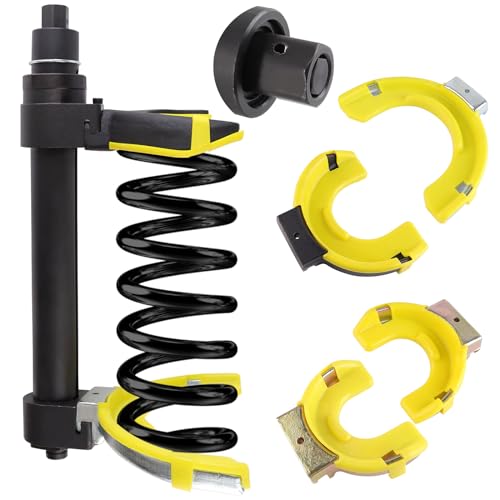 aremnry 2010ASCBest with carrying case
The short version, and why it matters
A coil spring on a car or truck holds a large amount of stored energy. If it slips out of a compressor, a jack or a homemade rig, it can fly loose with enough force to cause serious injury. That is the reason the question needs a careful answer instead of a quick trick.
Two situations come up most often. In the first, the spring is a standalone part that you can unload by lowering a control arm on a jack. In the second, the spring is wrapped around a strut and has to be squeezed so you can remove the top nut and mount. The first can be done with a floor jack and care. The second cannot be done safely without a compressor.
When a floor jack can do the job
Many trucks, SUVs and some cars use a design where the spring sits in a seat on the lower control arm and presses up into a pocket on the frame. The shock absorber is a separate part. On these, the jack holds the control arm while you slowly lower it, which lets the spring extend in a controlled way.
The steps below are general. Your vehicle's service manual has the exact jack points and the order for removing bolts, so check it first.
- Park on level, solid ground, set the parking brake and chock the wheels that stay on the ground.
- Lift the vehicle and support the frame on rated jack stands. Never rely on the jack alone to hold the car.
- Remove the wheel and disconnect parts that limit arm travel, such as the sway bar link and the shock lower bolt, following the manual.
- Place a floor jack under the lower control arm close to where the spring sits, and raise it just enough to take the load off the arm bolts.
- Remove the bolts that let the arm drop, then lower the jack slowly in small steps so the spring unloads gradually.
- Keep your head, hands and body out of the spring's line of travel the whole time.
- To reinstall, reverse the process, raising the arm slowly and checking that the spring seats fully in its pockets before you tighten anything.
When you cannot skip the compressor
On a MacPherson strut, the spring is wrapped around the strut and held under load between a lower seat and an upper mount. Swapping the spring, strut or top mount means pulling the assembly out and compressing the spring until the top nut is loose. A jack cannot do that, because the spring is loaded on the bench, not in the car.
This is the job a spring compressor exists for. Our coil spring compressor comparison lists tools that clamp the coil securely so the load goes through a threaded rod instead of through your hands. If you only have a strut job to do once, borrowing or renting a compressor is a sensible alternative to buying one.
Why homemade compressors are a bad idea
Searches for how to make a coil spring compressor turn up rigs built from threaded rod, chains, ratchet straps or hooks. We don't recommend building one. A homemade tool has no rated load capacity, no retaining tongues and no overload protection. If a hook straightens or a strap slips, the spring releases instantly.
Commercial tools are built around features you cannot easily copy. For example, one compressor on our comparison page lists a 9921 lb rated load, three interchangeable forks and an overload pin designed to break before the spring slips. Another lists a 2200 lb capacity with jaws that fit springs from 0.9 to 11 in. A garage-built rig has none of these published limits, so you would be guessing at what it can hold.
Your options at a glance
Here is how the main approaches compare for a home mechanic.
The takeaway is that the jack method is a narrow exception, the compressor is the standard answer, and a shop is a good fallback when the job feels beyond your setup.
| Approach | Works for | Level of control | Main concern |
|---|---|---|---|
| Floor jack on the control arm | Separate springs seated between the control arm and frame | Moderate, depends on setup | Arm or jack slipping while the spring is loaded |
| Coil spring compressor | Strut assemblies and removed springs | High, when sized correctly | Wrong size or too low a load rating |
| Homemade rig | Not recommended | Low and unpredictable | No rated capacity, no slip protection |
| Professional shop | Any spring job | Handled for you | Not a DIY option, but removes the risk |
If you decide to buy a compressor
Match the tool to the spring, not the other way around. Measure the spring's outside diameter and check that it falls inside the range of the forks or jaws. Then choose a load rating well above what your spring needs. Trucks and stiff springs call for higher ratings, and you should never use a tool rated below your spring's load.
Drive method matters too. Some compressors are impact rated, which saves time, but not all of them are. The OMT set, for example, says not to use it with air or pneumatic tools, and the BILITOOLS kit recommends a standard 22 mm wrench or socket for steady, controlled compression. Always read the maker's notes for your tool.
Our best coil spring compressor page puts load capacity, spring diameter range, impact compatibility and safety features side by side, so you can narrow the choice quickly.
Safety rules for any spring job
Whichever method you use, treat the spring as loaded until it is fully relaxed. Wear safety glasses or a face shield and sturdy gloves, because a slipping spring or tool can throw debris. Use jack stands, never a jack alone, whenever you are under or near a raised vehicle.
Lubricate compressor threads before use if the maker says to, and tighten in small steps, alternating sides so the spring stays square. Never stand in line with a compressed spring, and stop if anything looks bent, cracked or misaligned.
Frequently asked questions
Can I use ratchet straps or zip ties to hold a spring?
No. Straps and ties are not designed for this kind of stored energy and can snap or slip. Use a rated compressor or leave the job to a shop.
Do I need a compressor to replace just a shock absorber?
Not always. If the shock is a separate part from the spring, you can often replace it without touching the spring. If the spring is wrapped around the shock as a strut assembly, you will need to compress it.
Is it safe to compress a spring in a vise?
A sturdy vise or stand can help hold a strut while a rated compressor does the work. The vise is not a compressor, and it should never be the only thing controlling the spring.
What should I check before using a compressor on a new spring?
Confirm the spring's outside diameter fits the fork or jaw range, and confirm the tool's load rating is above the spring's load. Also check the winding direction if your kit comes in left and right versions.