Benchtop Jointer vs Planer: What's the Difference?
A jointer creates a flat face and a square edge on a rough or warped board. A planer then makes the opposite face parallel to the first and brings the board to a consistent thickness. They do different jobs, so a planer cannot replace a jointer for flattening, and a jointer cannot set thickness.
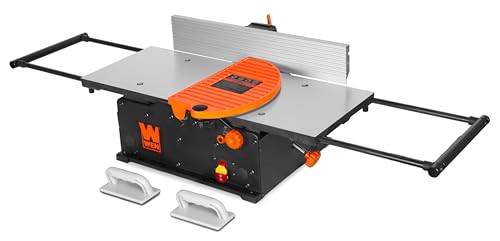 WEN JT1224HBest overall
 CUTECH 401120HI-IF#1 on our Best Score
 CUTECH 40180HBMid-size 8 in spiral
The core difference in one idea
A jointer makes a surface flat. A planer makes two surfaces parallel. That one distinction explains almost everything else about how the two machines are used.
A jointer has a long, flat infeed table and outfeed table with a cutterhead between them. You hold the board against the tables and push it across the knives. The cut follows the outfeed table, so the board's own shape does not matter. A warped board comes out with a flat face.
A planer works differently. The board rides on a bed under a cutterhead, and rollers pull it through. The planer measures from the bed, so it copies whatever is on the bottom face and trims the top to match. If the bottom is cupped or twisted, the top ends up thinner but still cupped or twisted.
What a benchtop jointer does
A benchtop jointer is a compact version of the floor-standing machine. It does two jobs: flatten one face, then square one edge to that face. Those two surfaces become the reference for every cut that follows.
The tradeoff with benchtop models is table length and cutting width. Shorter tables make it harder to flatten long boards, because the board can rock or drop at the ends. They also limit how wide a board you can face. Many woodworkers use a benchtop jointer mostly for edge jointing and for flattening smaller stock.
If you are weighing models, our best benchtop jointer comparison lines up the published specifications side by side. If you are not sure whether a benchtop size will be enough, best jointer covers larger machines too.
What a benchtop planer does
A benchtop planer takes a board with one good face and reduces it to a uniform thickness. You set the depth of cut, feed the board in, and it comes out the other side with a smooth, parallel surface. Repeating light passes gets you to your target thickness.
Planers are also the tool most people reach for first, because they are easier to set up and use. They are forgiving on boards that are already close to flat, such as lumber sold surfaced on both sides. They are not able to fix a bow, cup or twist by themselves.
Cutterhead type matters. Straight knives are common and easy to find replacements for. Helical (spiral) cutterheads use small individual inserts, which can leave a cleaner surface on tricky grain. Our best benchtop planer page covers the general field, and best benchtop planer with helical cutterhead narrows it to models with that style of cutterhead.
Jointer vs planer at a glance
This table summarizes what each machine is built to do.
| Feature | Benchtop jointer | Benchtop planer |
|---|---|---|
| Main job | Flatten a face and square an edge | Make the second face parallel and set thickness |
| Fixes warp, cup or twist | Yes, on the face it cuts | No, it copies the bottom face |
| Sets consistent thickness | No | Yes |
| How the board moves | You push it by hand over the tables | Rollers feed it through |
| Reference surface needed | No | Yes, one flat face |
| Typical limit on a benchtop model | Short tables and narrow cutting width | Maximum board width and thickness |
Which comes first, and why
The order is jointer first, planer second. The jointer gives you a trustworthy flat face. The planer uses that face as its reference and cuts the top parallel to it. Edge jointing can happen before or after planing, but the face always comes first.
A typical workflow for rough lumber looks like this:
- Joint one face until it is flat along its full length.
- Joint one edge square to that face.
- Plane the opposite face until the board reaches the thickness you want.
- Rip the board to width on a table saw, with the jointed edge against the fence.
- Clean up the sawn edge if needed.
Safety notes for both machines
Both tools have exposed, fast-spinning cutters, so treat them with respect.
Wear eye protection and hearing protection every time. Both machines are loud and throw chips. A dust mask or a dust collector connection also helps, since fine wood dust is a respiratory irritant.
On a jointer, use push blocks instead of bare hands, especially as the board gets short or thin. Keep your fingers away from the cutterhead and never reach over it. Do not joint boards that are too short to hold safely.
On a planer, never put your hands near the infeed or outfeed while the machine is running. Stand to the side of the feed path in case a board kicks back. Unplug the machine before changing knives, clearing a jam or adjusting anything near the cutterhead. Check lumber for nails, staples and loose knots first, since metal can damage the cutters and throw debris.
Which should you buy first?
If you mostly buy lumber that is already surfaced and want consistent thickness, start with a planer. It handles the most common small-shop task and is easier to learn.
If you buy rough or air-dried boards and need flat, square stock, a jointer matters more. Without one, you would have to flatten boards by other methods, such as a planer sled or hand planes.
Many shops eventually own both. If space is tight, a benchtop pair covers the full process, and you can compare each option using the pages linked above before you decide.
Frequently asked questions
Can a planer flatten a warped board?
Not by itself. The rollers press the board flat as it passes through, then it springs back. A planer sled, which supports the board on a flat carrier, can work around this.
Do I need both a jointer and a planer?
Only if you work from rough lumber and want flat, square, uniform boards. If you buy lumber already surfaced, a planer alone often covers your needs.
Is a jointer the same as a thickness planer?
No. A jointer flattens a face or edge. A thickness planer, often just called a planer, sets thickness and makes faces parallel.
Can a jointer be used for edges only?
Yes. Many people use a benchtop jointer mainly for squaring edges before gluing boards together, and flatten wide faces another way.